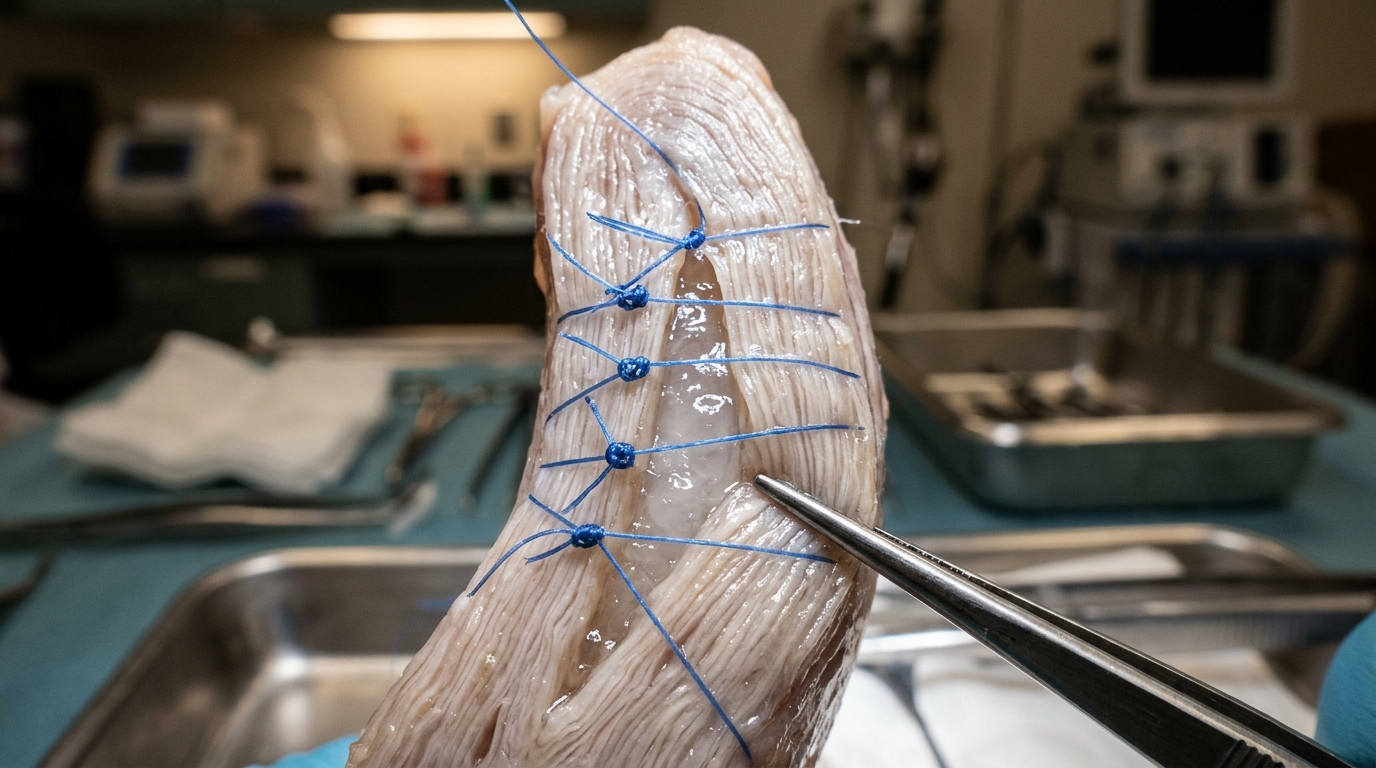
In a computational biomechanical investigation evaluating post-discectomy repair mechanics, researchers discovered that closing the residual annular gap and strategically positioning sutures substantially improve nucleus pulposus containment, whereas increasing suture quantity or axial spring stiffness offers negligible benefit. Published in the journal Frontiers in Bioengineering and Biotechnology by Guo Sen Li, Gong Cai Chen, Wen Tao Tu, Zheng Ping Zhang, En Song, and Jiang Jun Zhou, the finite element study analyzed how different surgical repair parameters influence containment following lumbar intervention. The authors determined that mechanically engaged suturing successfully mitigates displacement pathways, yet improved containment does not normalize stress concentrations along the annular rim, establishing that structural barrier closure and physiologic load transfer represent separate biomechanical objectives.
A persistent annular defect following lumbar discectomy creates an open pathway through which recurrent nucleus pulposus displacement can take place. While annular suturing techniques are intended to reinforce containment, the relative biomechanical significance of suture number, axial spring stiffness, specific placement, and direct tissue edge apposition has remained unclear in existing biomechanical research. To evaluate these mechanical determinants under controlled conditions, the research team implemented a publicly available human L4-L5 finite element disc model. Because the nucleus pulposus was fully retained in this simulation, the computational model was specifically designed to represent an idealized post-discectomy defect state rather than a clinical case involving substantial nucleus evacuation.
The investigators utilized this human L4-L5 model to compare several distinct disc conditions and repair configurations. The simulated states included an intact lumbar disc, an unrepaired posterolateral full-thickness annular defect, open-gap repairs secured with one to three sutures, and graded three-suture partial-apposition repairs. In the numerical simulation protocol, an initial 1-MPa expansive nucleus-boundary pressure preload was applied to represent baseline internal pressure. This preload phase was followed by axial compressive loading reaching up to 2,000 N, evaluated both in pure axial compression and under a combined mechanical loading regime that included an applied 7.5-N m flexion moment.
The primary outcomes evaluated in the study were peak contained nucleus pulposus protrusion and the positive-only area under the protrusion-load curve, designated as AUC. Annular rim stress and intradiscal pressure served as secondary mechanical outcomes across all tested conditions. Creating an unrepaired posterolateral full-thickness defect substantially increased nucleus pulposus displacement across both loading modes. Under pure axial compression, peak protrusion increased from 0.107 mm in the intact disc to 0.358 mm in the unrepaired defect model. Under combined flexion and compression, peak protrusion rose from 0.183 mm in the intact disc to 0.474 mm in the unrepaired model.
Every primary load-targeted suture repair evaluated by the team succeeded in reducing peak nucleus protrusion compared to the unrepaired defect condition. However, containment efficacy depended decisively on local suture placement and the state of edge apposition rather than suture quantity. Among untensioned single-suture configurations, only sutures crossing the deep, load-opening region of the defect produced large reductions in nucleus protrusion. In contrast, altering the total number of sutures or changing axial spring stiffness shifted peak protrusion by at most 1.0%, indicating that adding sutures or modifying spring stiffness without optimizing placement or apposition yields minimal mechanical benefit.
Direct edge apposition produced a substantial improvement in displacement resistance under compressive loading. As the mean residual annular gap decreased from 1.69 mm down to 0.80 mm across the graded partial-apposition repairs, the positive-only area under the protrusion-load curve dropped from 235 mm N to 102 mm N under pure axial compression. Open-gap repairs restored between 29% and 32% of the defect-to-intact AUC difference at the baseline 1-MPa preload condition, and restored approximately 90% of that difference when evaluated at a 0.1-MPa preload. Nevertheless, secondary outcome analysis revealed that rim stress remained consistently above intact levels across every repaired configuration tested.
To evaluate the stability of their findings, the authors conducted sensitivity analyses examining variations in suture placement, suture count, axial spring stiffness, pretension, defect size, preload magnitude, and computational mesh density. While the hierarchical ordering of repair efficacy remained robust across these analyses, the absolute magnitude of containment improvement depended heavily on preload level, mesh density, and the exact definition applied for protrusion. The authors concluded that while mechanically engaged suturing enhances nucleus containment through edge apposition and deep placement, it does not normalize annular stress concentrations, underscoring that closing the protrusion pathway and restoring annular load transfer are distinct goals.
Subject of Research: Biomechanical determinants of annular suture repair in lumbar disc defect models
Article Title: Biomechanical determinants of annular suture repair in an idealized post-discectomy annular defect: a finite element study
Article References: Li, G.-S., Chen, G.-C., Tu, W.-T., Zhang, Z.-P., Song, E., & Zhou, J.-J. (2026). Biomechanical determinants of annular suture repair in an idealized post-discectomy annular defect: a finite element study. Frontiers in Bioengineering and Biotechnology, 14, 1956472. https://doi.org/10.3389/fbioe.2026.1956472
Image Credits: AI Generated
DOI: 10.3389/fbioe.2026.1956472
Keywords: annular suture repair, lumbar discectomy, finite element model, nucleus pulposus containment, edge apposition, annulus fibrosus defect, peak protrusion, axial compression, flexion moment, rim stress, intradiscal pressure, area under the protrusion-load curve, axial spring stiffness, recurrent disc herniation, L4-L5 disc, biomechanical modeling
News Source: Gregory Coleman. (November 12, 2026). Spinal Disc Model Shows Suture Placement and Apposition Govern Nucleus Containment. Scienmag.