OTTAWA, Ontario, May 16, 2024 – The best microphone in the world might have an unexpected source: spider silk. Spiders weave webs to trap their insect snacks, but the sticky strands also help spiders hear. Unlike human eardrums and conventional microphones that detect sound pressure waves, spider silk responds to changes in the velocities of air particles as they are thrust about by a sound field. This sound velocity detection method remains largely underexplored compared to pressure sensing, but it holds great potential for high-sensitivity, long-distance sound detection.
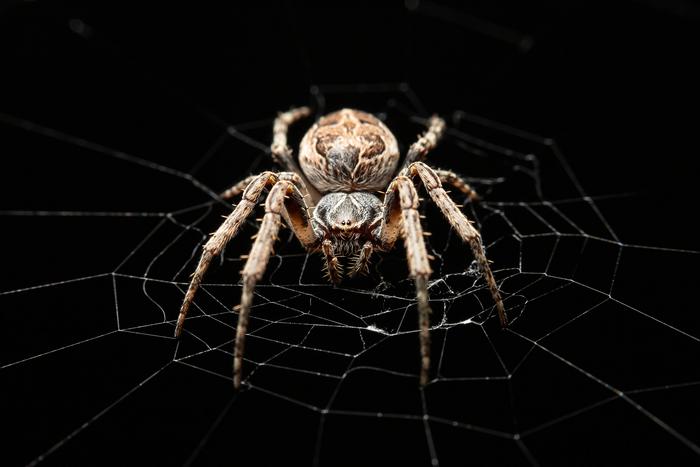
Credit: Junpeng Lai
OTTAWA, Ontario, May 16, 2024 – The best microphone in the world might have an unexpected source: spider silk. Spiders weave webs to trap their insect snacks, but the sticky strands also help spiders hear. Unlike human eardrums and conventional microphones that detect sound pressure waves, spider silk responds to changes in the velocities of air particles as they are thrust about by a sound field. This sound velocity detection method remains largely underexplored compared to pressure sensing, but it holds great potential for high-sensitivity, long-distance sound detection.
Researchers from Binghamton University investigated how spiders listen to their environments through webs. They found the webs match the acoustic particle velocity for a wide range of sound frequencies. Ronald Miles will present their work Thursday, May 16, at 10:00 a.m. EDT as part of a joint meeting of the Acoustical Society of America and the Canadian Acoustical Association, running May 13-17 at the Shaw Centre located in downtown Ottawa, Ontario, Canada.
“Most insects that can hear sound use fine hairs or their antennae, which don’t respond to sound pressure,” said Miles, a professor of mechanical engineering. “Instead, these thin structures respond to the motion of the air in a sound field. I wondered how to make an engineered device that would also be able to respond to sound-driven airflow. We tried various man-made fibers that were very thin, but they were also very fragile and difficult to work with. Then, Dr. Jian Zhou was walking in our campus nature preserve and saw a spiderweb blowing in the breeze. He thought spider silk might be a great thing to try.”
Before building such a device, the team had to prove spiderwebs truly responded to sound-driven airflow. To test this hypothesis, they simply opened their lab windows to observe the Larinioides sclopetarius, or bridge spiders, that call the windowsills home. They played sound ranging from 1 Hz to 50 kHz for the spiders and measured the spider silk motion with a laser vibrometer. They found the sound-induced velocity of the silk was the same as the particles in the air surrounding it, confirming the mechanism that these spiders use to detect their prey.
“Because spider silk is, of course, created by spiders, it isn’t practical to incorporate it into the billions of microphones that are made each year,” said Miles. “It does, however, teach us a lot about what mechanical properties are desirable in a microphone and may inspire entirely new designs.”
###
———————– MORE MEETING INFORMATION ———————–
Main meeting website: https://acousticalsociety.org/ottawa/
Technical program: https://eppro02.ativ.me/src/EventPilot/php/express/web/planner.php?id=ASASPRING24
ASA PRESS ROOM
In the coming weeks, ASA’s Press Room will be updated with newsworthy stories and the press conference schedule at https://acoustics.org/asa-press-room/.
LAY LANGUAGE PAPERS
ASA will also share dozens of lay language papers about topics covered at the conference. Lay language papers are summaries (300-500 words) of presentations written by scientists for a general audience. They will be accompanied by photos, audio, and video. Learn more at https://acoustics.org/lay-language-papers/.
PRESS REGISTRATION
ASA will grant free registration to credentialed and professional freelance journalists. If you are a reporter and would like to attend the hybrid / in-person meeting or virtual press conferences, contact AIP Media Services at [email protected]. For urgent requests, AIP staff can also help with setting up interviews and obtaining images, sound clips, or background information.
ABOUT THE ACOUSTICAL SOCIETY OF AMERICA
The Acoustical Society of America is the premier international scientific society in acoustics devoted to the science and technology of sound. Its 7,000 members worldwide represent a broad spectrum of the study of acoustics. ASA publications include The Journal of the Acoustical Society of America (the world’s leading journal on acoustics), JASA Express Letters, Proceedings of Meetings on Acoustics, Acoustics Today magazine, books, and standards on acoustics. The society also holds two major scientific meetings each year. See https://acousticalsociety.org/.
ABOUT THE CANADIAN ACOUSTICAL ASSOCIATION/ASSOCIATION CANADIENNE D’ACOUSTIQUE
• fosters communication among people working in all areas of acoustics in Canada
• promotes the growth and practical application of knowledge in acoustics
• encourages education, research, protection of the environment, and employment in acoustics
• is an umbrella organization through which general issues in education, employment and research can be addressed at a national and multidisciplinary level
The CAA is a member society of the International Institute of Noise Control Engineering (I-INCE) and the International Commission for Acoustics (ICA) and is an affiliate society of the International Institute of Acoustics and Vibration (IIAV). Visit https://caa-aca.ca/.
###