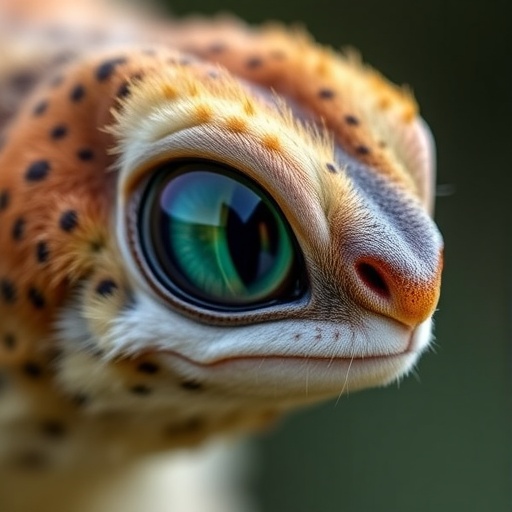
In the vast tapestry of life on Earth, animals perceive the world around them in ways that profoundly differ, not only in terms of sensory input but in the very fabric of temporal experience. A groundbreaking study involving 237 species across diverse animal groups reveals that the speed at which animals process visual information varies dramatically and is tightly linked to their ecological lifestyle and evolutionary history. This research highlights that animals’ perception of time itself differs, offering a fresh perspective on how they interact with their environments through vision.
This extensive study, conducted by scientists from Trinity College Dublin and the University of Galway, scrutinizes the relationship between ecological traits and visual temporal resolution. Temporal resolution, in this context, refers to how quickly an animal’s visual system can process information, essentially determining how fast its perception of the world is. The findings, published in the prestigious journal Nature – Ecology & Evolution, provide compelling evidence that the tempo of sensory perception is molded by evolutionary pressures and ecological demands.
At the heart of this research lies the concept of critical flicker fusion (CFF), a well-established metric used in neurobiology to measure the speed of visual processing. CFF defines the maximum frequency at which an intermittent light stimulus is perceived as flickering rather than continuous. Higher CFF values translate to an organism’s ability to perceive flickers at rapid frequencies, which implies a faster visual processing speed. Notably, while humans typically see flicker fusion at around 60 Hz, many animals, including certain insects and birds, can detect flickers exceeding 200 Hz, perceiving a significantly slower, more detailed unfolding of events.
The researchers compiled and analyzed extensive data on CFF across a broad phylogenetic range, from small insects to large aquatic animals and flying birds. Their aim was to identify how ecological variables such as mode of locomotion, predation strategy, body size, and ambient light environment influence temporal visual processing. This was no small task, as measuring CFF requires precise and consistent data collection methods to ensure comparability across such evolutionary distant species.
One of the most striking patterns that emerged is the elevated temporal visual acuity in flying species. Flight demands rapid processing of complex visual information for navigation, predator avoidance, and prey capture, necessitating a visual system tuned to high temporal resolution. In fact, the study found that flying animals exhibit CFF values nearly double those of their non-flying counterparts. This quantitative difference underscores the intense evolutionary pressure exerted by the demands of powered flight on sensory processing speed.
Predatory behavior also plays a crucial role. Animals that engage in pursuit predation—actively chasing fast and maneuverable prey—show significantly faster visual processing compared to species that feed on stationary or slowly moving organisms. This makes intuitive sense: to intercept agile prey, predators must detect and respond to rapid visual stimuli with minimal delay. Consequently, natural selection favors enhanced temporal perception capabilities in these species to maximize hunting success.
The light environment in which animals operate further influences their visual temporal resolution. Species active in bright, daylight conditions tend to possess faster vision than those inhabiting dim or dark environments such as deep water or nocturnal niches. Bright light availability seemingly enables the evolution of visual systems optimized for speed, whereas in low-light habitats the visual system may prioritize sensitivity over rapid temporal processing due to differing ecological trade-offs.
Interestingly, within aquatic habitats, the research highlights a negative correlation between body size and temporal visual resolution. Smaller, more agile species tend to have faster vision than larger, generally slower-moving ones. This relationship likely reflects the demands of maneuverability and prey capture in complex underwater environments, where swift visual processing confers a survival advantage to smaller fish and invertebrates.
These findings lend robust support to a classical idea in sensory ecology known as Autrum’s hypothesis. This hypothesis posits that sensory systems evolve in direct response to the ecological and behavioral needs of animals. While this has been demonstrated in limited taxonomic groups before, this study’s scale and breadth mark the first comprehensive, cross-kingdom validation of the principle, emphasizing that sensory evolution is fundamentally shaped by lifestyle and ecological context globally.
From a neurobiological standpoint, rapid visual processing relies on sophisticated neural circuitry capable of encoding and transmitting visual signals at high temporal fidelity. Such processing is metabolically expensive, demanding significant energy to maintain the speed and accuracy of perception. This cost-benefit balance means that fast vision is favored evolutionarily only when it confers tangible ecological advantages such as efficient predator evasion or successful prey capture, providing insight into why many slower or sessile species have evolved slower visual systems.
The implications of this research extend beyond understanding animal behavior and evolution. With the increasing prevalence of artificial lighting and flickering light sources in human-modified landscapes, animals with fast visual systems may be particularly vulnerable. Flickering artificial lights can interfere with their natural visual processing, potentially disrupting critical activities such as foraging, predator avoidance, and navigation. This underlines the importance of considering sensory ecology in conservation and urban planning efforts.
Moreover, the study reveals that despite sharing habitats, animals may inhabit vastly different sensory worlds, experiencing time and motion through eyes honed by millions of years of adaptation to specific ecological niches. This sensory divergence challenges anthropocentric perspectives on perception and highlights the rich complexity of life’s sensory landscapes.
The researchers emphasize that understanding how animals perceive time is not just a matter of sensory biology but a window into their behavior, evolutionary dynamics, and responses to environmental changes. This integrative framework enriches our grasp of biodiversity and can guide strategies for mitigating human impacts on wildlife by aligning conservation efforts with the sensory realities of different species.
In conclusion, this pioneering research elucidates the intricate interplay between ecology, neural processing, and evolution that shapes the speed of visual perception across the animal kingdom. It fundamentally reshapes our understanding of sensory diversity, revealing that the pace of the world as experienced through animal eyes varies widely and is intimately linked to how organisms move, hunt, and survive. As Dr. Clinton Haarlem of Trinity College Dublin aptly states, “The world we experience is just one version of many,” inviting us to appreciate the extraordinary sensory kaleidoscope that life on Earth embodies.
Subject of Research: Animal visual perception speed and its ecological and evolutionary determinants
Article Title: Animals perceive time at different speeds depending on their ecology and evolutionary adaptations
News Publication Date: (Not explicitly stated in the source)
Web References:
http://dx.doi.org/10.1038/s41559-026-02994-7
References:
Haarlem, C., Healy, K., et al. (2026). Nature Ecology & Evolution. DOI:10.1038/s41559-026-02994-7
Image Credits: Trinity College Dublin
Keywords: Visual perception, critical flicker fusion, temporal resolution, sensory ecology, animal cognition, evolution, neural processing, flight, predator-prey interaction, artificial lighting effects, sensory adaptation
Tags: animal vision and temporal perceptioncritical flicker fusion in animalscross-species comparison of temporal visionecological determinants of sensory tempoecological influence on sensory processingevolutionary adaptation of animal eyesightevolutionary pressures on sensory systemsimpact of lifestyle on perception speedneurobiology of vision in animalssensory ecology and animal behaviorspeed of visual information processingvisual temporal resolution across species