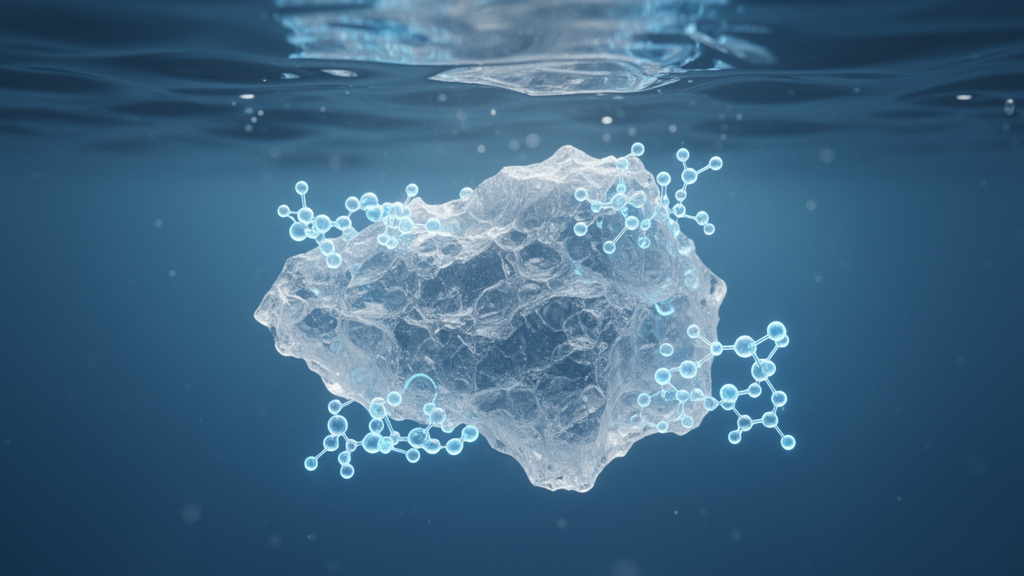
A new spectroscopic study published in Polymer Bulletin has evaluated the single and competitive adsorption behaviors of three polycyclic aromatic hydrocarbons onto polyvinyl chloride microplastics. The research team applied adsorption kinetics, isotherm modeling, Fourier transform infrared spectroscopy, and two-dimensional correlation spectroscopy to examine the behavior of naphthalene, phenanthrene, and benzo[ghi]perylene in both isolated and mixed settings.
The kinetic experimental results indicated that the competitive adsorption process of naphthalene, phenanthrene, and benzo[ghi]perylene onto the polyvinyl chloride microplastic particles adhered to pseudo-second-order kinetics. This kinetic modeling demonstrated that the retention process was predominantly governed by chemical adsorption. Across the tested compounds, the equilibrium adsorption capacity and adsorption rate exhibited a consistent relative order, decreasing from benzo[ghi]perylene to phenanthrene and finally to naphthalene. Furthermore, the overall interaction between the hydrocarbons and microplastics was regulated by hydrophobicity, molecular size, and solubility.
The experiments identified pronounced competitive interactions when multiple hydrocarbon species coexisted simultaneously. Specifically, benzo[ghi]perylene actively suppressed and inhibited the adsorption of both naphthalene and phenanthrene onto the polyvinyl chloride surfaces. In contrast, the presence of naphthalene and phenanthrene served to promote the adsorption of benzo[ghi]perylene. The researchers determined that this selective enhancement was driven by conjugated system-mediated pi-pi stacking among the aromatic ring structures.
Using two-dimensional correlation spectroscopy, the researchers tracked the precise sequential spectral responses of the polymer and the adsorbates. In single-component adsorption systems, the carbon-hydrogen stretching vibration of the polyvinyl chloride microplastics responded preferentially. In competitive adsorption environments, however, the carbon-chlorine stretching vibration exhibited an abnormal response advance. This shift was attributed directly to energy redistribution within the polymer matrix induced by multi-site competition.
The dynamic spectral response sequence across functional groups followed the order of carbon-chlorine stretching, followed by carbon-hydrogen stretching, and finally the response of the methylene groups. Meanwhile, the benzene ring skeletal vibration response priority among the three pollutants followed the order of benzo[ghi]perylene, naphthalene, and phenanthrene. Together, these spectroscopic and kinetic observations verified a synergistic adsorption mechanism dominated by hydrophobic interactions and supplemented by pore filling.
Subject of Research: Competitive adsorption of polycyclic aromatic hydrocarbons onto polyvinyl chloride microplastics
Article Title: Competitive adsorption mechanism of naphthalene, phenanthrene and benzo[ghi]perylene onto polyvinyl chloride microplastics: a two-dimensional correlation spectroscopy study
Article References: Long, J., Li, X., Qin, Y., Yang, R., & Dong, G. (2027). Competitive adsorption mechanism of naphthalene, phenanthrene and benzo[ghi]perylene onto polyvinyl chloride microplastics: a two-dimensional correlation spectroscopy study. Polymer Bulletin, 84(1), Article 60. https://doi.org/10.1007/s00289-026-06818-3
Image Credits: AI Generated
DOI: 10.1007/s00289-026-06818-3
Keywords: polyvinyl chloride, microplastics, polycyclic aromatic hydrocarbons, naphthalene, phenanthrene, benzo[ghi]perylene, adsorption kinetics, isotherm modeling, Fourier transform infrared spectroscopy, two-dimensional correlation spectroscopy, pseudo-second-order kinetics, chemical adsorption, pi-pi stacking, hydrophobic interactions, pore filling, multi-site competition
News Source: Bethany Barker. (November 24, 2026). Spectroscopy Reveals How Polycyclic Aromatic Hydrocarbons Compete on PVC Microplastics. Scienmag.