• HOME
  • NEWS
  • EXPLORE
    • CAREER
      • Companies
      • Jobs
    • EVENTS
    • iGEM
      • News
      • Team
    • PHOTOS
    • VIDEO
    • WIKI
  • BLOG
  • COMMUNITY
    • FACEBOOK
    • INSTAGRAM
    • TWITTER
Monday, February 9, 2026
BIOENGINEER.ORG
No Result
View All Result
  • Login
  • HOME
  • NEWS
  • EXPLORE
    • CAREER
      • Companies
      • Jobs
        • Lecturer
        • PhD Studentship
        • Postdoc
        • Research Assistant
    • EVENTS
    • iGEM
      • News
      • Team
    • PHOTOS
    • VIDEO
    • WIKI
  • BLOG
  • COMMUNITY
    • FACEBOOK
    • INSTAGRAM
    • TWITTER
  • HOME
  • NEWS
  • EXPLORE
    • CAREER
      • Companies
      • Jobs
        • Lecturer
        • PhD Studentship
        • Postdoc
        • Research Assistant
    • EVENTS
    • iGEM
      • News
      • Team
    • PHOTOS
    • VIDEO
    • WIKI
  • BLOG
  • COMMUNITY
    • FACEBOOK
    • INSTAGRAM
    • TWITTER
No Result
View All Result
Bioengineer.org
No Result
View All Result
Home NEWS Science News Health

Special report outlines actionable steps to address racial/ethnic, linguistic and socioeconomic disparities in telehealth models of care

Bioengineer by Bioengineer
July 26, 2022
in Health
Reading Time: 2 mins read
0
Visual Abstract
Share on FacebookShare on TwitterShare on LinkedinShare on RedditShare on Telegram

Researchers in San Francisco and New York have proposed a health equity framework to address growing disparities in the uptake of telehealth services across the United States during and after the COVID pandemic. Using the Institute for Healthcare Improvement as a benchmark, the authors present strategies to advance equity within a healthcare organization across the domains of: 1) making health and racial/ethnic equity in telemedicine a strategic priority, including having committed leaders across the organization and using robust data to identify disparities; 2) building structures and processes to support telemedicine equity, including ensuring more direct input from marginalized patients; 3) deploying telemedicine strategies to address social determinants of health and access barriers to telemedicine; 4) eliminating institutional racism in telemedicine provision, such as hiring and retaining a health care workforce that reflects the diversity of the patients served and; 5) partnering with patients and community organizations to implement telemedicine. 
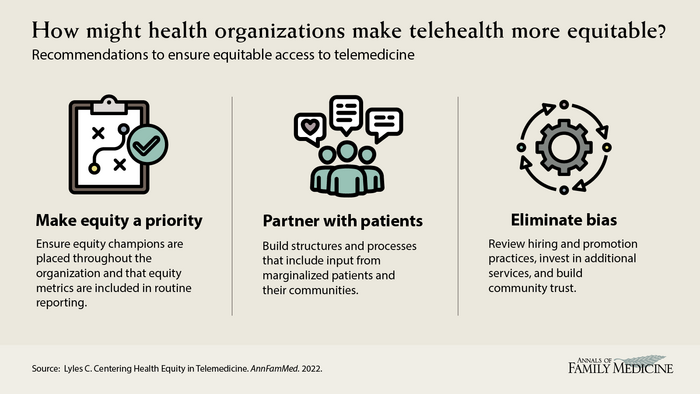
Visual Abstract

Credit: Annals of Family Medicine

Researchers in San Francisco and New York have proposed a health equity framework to address growing disparities in the uptake of telehealth services across the United States during and after the COVID pandemic. Using the Institute for Healthcare Improvement as a benchmark, the authors present strategies to advance equity within a healthcare organization across the domains of: 1) making health and racial/ethnic equity in telemedicine a strategic priority, including having committed leaders across the organization and using robust data to identify disparities; 2) building structures and processes to support telemedicine equity, including ensuring more direct input from marginalized patients; 3) deploying telemedicine strategies to address social determinants of health and access barriers to telemedicine; 4) eliminating institutional racism in telemedicine provision, such as hiring and retaining a health care workforce that reflects the diversity of the patients served and; 5) partnering with patients and community organizations to implement telemedicine. 

Most importantly, the researchers call for the integration of equity and innovation efforts to ensure all people have access to telemedicine and other digitally enabled health tools.


Journal

The Annals of Family Medicine

DOI

10.1370/afm.2823

Article Title

Centering health equity in telemedicine

Article Publication Date

20-Jul-2022

Share12Tweet8Share2ShareShareShare2

Related Posts

Triple Targeting Enhances CXCL16–CXCR6 Antitumor Response

February 9, 2026
Intensive Short-Duration Exercise Outperforms Standard Care in Treating Panic Disorder

Intensive Short-Duration Exercise Outperforms Standard Care in Treating Panic Disorder

February 9, 2026

Exercise’s Impact on SASP Biomarkers in Seniors Unexplored

February 9, 2026

UK’s Rising Synthetic Opioid Crisis: Nitazene-Linked Deaths May Be Underreported by Up to 33%

February 9, 2026

POPULAR NEWS

  • Robotic Ureteral Reconstruction: A Novel Approach

    Robotic Ureteral Reconstruction: A Novel Approach

    82 shares
    Share 33 Tweet 21
  • Digital Privacy: Health Data Control in Incarceration

    63 shares
    Share 25 Tweet 16
  • Mapping Tertiary Lymphoid Structures for Kidney Cancer Biomarkers

    50 shares
    Share 20 Tweet 13
  • Breakthrough in RNA Research Accelerates Medical Innovations Timeline

    53 shares
    Share 21 Tweet 13

About

We bring you the latest biotechnology news from best research centers and universities around the world. Check our website.

Follow us

Recent News

Private Sector Cuts Greenhouse Gases in Africa’s Livestock

Triple Targeting Enhances CXCL16–CXCR6 Antitumor Response

Intensive Short-Duration Exercise Outperforms Standard Care in Treating Panic Disorder

Subscribe to Blog via Email

Enter your email address to subscribe to this blog and receive notifications of new posts by email.

Join 74 other subscribers
  • Contact Us

Bioengineer.org © Copyright 2023 All Rights Reserved.

Welcome Back!

Login to your account below

Forgotten Password?

Retrieve your password

Please enter your username or email address to reset your password.

Log In
No Result
View All Result
  • Homepages
    • Home Page 1
    • Home Page 2
  • News
  • National
  • Business
  • Health
  • Lifestyle
  • Science

Bioengineer.org © Copyright 2023 All Rights Reserved.