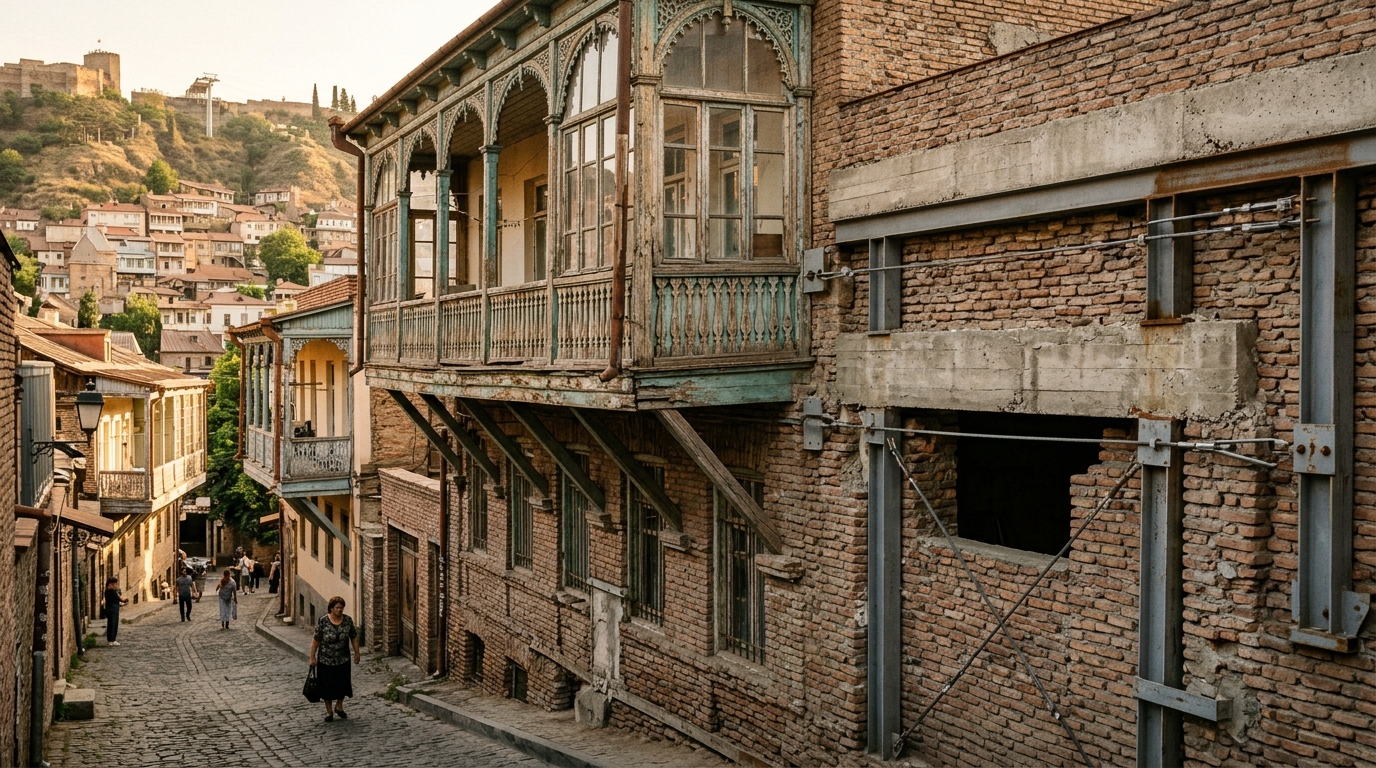
A research article published in the journal Built Heritage traces the enduring influence of Soviet-era urban conservation strategies on the transformation of Tbilisi, Georgia. The study, authored by Angela Wheeler, examines how a specific methodological framework developed in the late 1970s continues to dominate urban conservation projects in the city’s historic center. This approach, defined by Chief Architect Shota Kavlashvili as ‘reconstruction-plus-regeneration-plus-adaptation,’ prioritized aesthetic coherence over material authenticity, marking a significant departure from the modernist orthodoxy established by the 1964 Venice Charter. The article argues that while the 1990s are often dismissed as a dark age in Tbilisi’s architectural history, the period actually built upon and transformed Soviet precedents during a turbulent reconstruction process.
In the late 1970s, the Georgian Soviet Socialist Republic was widely recognized across the socialist world as a leader in urban heritage conservation. Tbilisi became a showcase for this expertise, particularly through the work of Shota Kavlashvili, who served as the city’s Chief Architect. Kavlashvili’s pilot project at Baratashvili Street, initiated in 1978, involved the removal of later additions to reveal medieval fortifications and the creation of a cohesive, ahistorical historic environment. This project converted historic vaulted cellars into commercial spaces, such as coffee shops and wine-tasting rooms, and adapted balconied houses for civic functions like wedding registration offices. The resulting landscape was designed to communicate the boundary of the protected historic zone through a combination of inventive restoration and ethnographically inspired public art.
Kavlashvili’s method departed significantly from the conservative guidelines of the Venice Charter, which advised that restoration must stop where conjecture begins. Instead, Kavlashvili used the city’s past to create a new image of its future, a decision that established methodological precedents persisting today. While the project received overwhelming public acclaim and contributed to the creation of the Tbilisoba holiday, it also provoked debate among Georgian architects and heritage specialists. Critics, including architectural historian Tengiz Kvirkvelia, argued that the approach created a homogenized neo-historical environment where historic layers became illegible. They advocated for a clearer distinction between old and new masonry, aligning more closely with international conservation standards that require additions to bear a contemporary stamp.
The political and economic collapse following the dissolution of the Soviet Union in 1991 brought immediate crisis to Tbilisi. The 1992 Civil War resulted in the near-total destruction of several historic buildings along Rustaveli Avenue, including the Hotel Majestic and the National Gallery. Under President Eduard Shevardnadze, the municipal authorities convened a Restoration-Reconstruction Committee that initially adopted a Soviet approach to the emergency. However, the introduction of a new model of urban intervention ensured that comprehensive planning projects were largely abandoned in favor of private development. The committee’s work proved to be the first and last comprehensive historic district planning project in postsocialist Tbilisi, as city officials sought private investors to take over reconstruction efforts rather than funding public projects.
During the 1990s, Soviet-era cultural and planning institutions began to wither in the absence of state funding. The Department of Monuments Protection operated on a mere 0.9% of its 1990 budget by 1999, lacking the resources to address urban-scale problems. Municipal authorities avoided approving any form of comprehensive plan, and protective zones remained nominally in force but functionally inoperative. This created a perennial state of exception, allowing elites to defer commitment to transparent urban planning mechanisms in the name of emergency response. Architects like Vazha Orbeladze continued to experiment with reconstruction-plus-regeneration-plus-adaptation in this new context, bringing Soviet-era design debates into the postsocialist cityscape through projects such as the Rustaveli Square McDonald’s, which echoed historic architectural features.
The arrival of President Mikheil Saakashvili in 2003 marked a new phase of mass urban restoration under the ‘New Life for Old Tbilisi’ program. This initiative, endorsed by the Saakashvili administration, was promoted as a comprehensive plan for architectural preservation, real estate development, and urban tourism. However, the program’s primary goal was to bolster Georgia’s construction industry after the 2008 global financial collapse. The financial mechanism involved City Hall guaranteeing bank loans to developers, who then negotiated with Old Tbilisi homeowners to swap properties. Residents would vacate their dilapidated historic homes and relocate to new housing projects, allowing developers to reconstruct or demolish the historic properties and sell the lots back to the city.
Vazha Orbeladze played a lead role in the New Life for Old Tbilisi program, particularly on Aghmashenebeli Avenue, where he oversaw the demolition and reconstruction of several dense blocks in 2012. His work often entailed the addition of mansard roofs to maximize rentable space while enhancing the European appearance of the historic landscape, a phenomenon critics referred to as mansardisation. The program prioritized the facade as the primary focus of restoration activity, often entailing the tearing down of historic buildings and replacing them with sham replicas or neo-historical replacements. This approach cultivated a curated, homogenized architectural heritage excised of undesirable elements, aiming to create an image of Tbilisi that was both aspirationally European and rooted in Georgian culture.
New Life for Old Tbilisi drew mounting criticism for its treatment of historic districts and their residents, as well as for its lack of public accountability. The program functioned as a state-subsidized gentrification scheme, requiring residents to relocate with no right of return. Developers frequently ignored the historic building classification system established in Georgia’s Law on Cultural Heritage, as the financial incentives encouraged the addition of extra floors or the outright demolition of buildings. Evictions and demolitions made without public consultation prompted widespread protests, leading to the growth of cultural heritage activist groups like Tiflis Hamkari. Investigations later revealed that the Old City Rehabilitation and Development Fund, established to enact these projects, received hundreds of millions of lari from the city budget with no clear accountability.
The research demonstrates that Soviet urban conservation approaches continue to exert a profound legacy on postsocialist Tbilisi. The current landscape of Old Tbilisi, characterized by pristinely restored facades and neo-historical additions, sanitizes the complex legacies of the city’s past. This curated environment conceals the grim realities of postsocialist transition and the seventy years of Soviet socialism, replacing them with a tidy narrative of a Georgian national capital or a European identity. Buildings from every epoch of Soviet design continue to face summary demolition or reconstruction, often as luxury hotels or vague multifunctional complexes, while the Soviet history of local cultural heritage practice is erased from public discourse.
Ultimately, the current approach to historic neighborhoods in Tbilisi overlooks their primary function as living communities. The celebrated Old Tbilisian sociability of the balcony and the courtyard has been supplanted by the generic consumerism of the themed outdoor mall and the Airbnb condo complex. While Soviet architects developed a template for commodifying Old Tbilisi, their projects still operated within comprehensive plans that balanced housing, transit, and cultural amenities. The tragedy for those who strove to preserve Old Tbilisi during the Soviet era was that the mechanisms for preserving Georgian cultural heritage disappeared along with the socialist regime. Today, Tbilisians must live with only the appearance of history, as the historic center is physically repossessed from its residents for the benefit of tourists and foreign investors.
Subject of Research: ‘Reconstruction-plus-regeneration-plus-adaptation’: transforming old Tbilisi during and after socialism
Article Title: ‘Reconstruction-plus-regeneration-plus-adaptation’: transforming old Tbilisi during and after socialism
Article References: Wheeler, A. (2026). ‘Reconstruction-plus-regeneration-plus-adaptation’: transforming old Tbilisi during and after socialism. Built Heritage, 10(1), Article 45. https://doi.org/10.1186/s43238-026-00275-7
Image Credits: AI Generated
DOI: 10.1186/s43238-026-00275-7
Keywords: Reconstruction-plus-regeneration-plus-adaptation, transforming, Tbilisi, during, socialism, scientific research
News Source: Margaret Porter. (November 8, 2026). Soviet Conservation Methods Reshape Tbilisi’s Historic Center. Scienmag.