• HOME
  • NEWS
  • EXPLORE
    • CAREER
      • Companies
      • Jobs
    • EVENTS
    • iGEM
      • News
      • Team
    • PHOTOS
    • VIDEO
    • WIKI
  • BLOG
  • COMMUNITY
    • FACEBOOK
    • INSTAGRAM
    • TWITTER
Wednesday, April 1, 2026
BIOENGINEER.ORG
No Result
View All Result
  • Login
  • HOME
  • NEWS
  • EXPLORE
    • CAREER
      • Companies
      • Jobs
        • Lecturer
        • PhD Studentship
        • Postdoc
        • Research Assistant
    • EVENTS
    • iGEM
      • News
      • Team
    • PHOTOS
    • VIDEO
    • WIKI
  • BLOG
  • COMMUNITY
    • FACEBOOK
    • INSTAGRAM
    • TWITTER
  • HOME
  • NEWS
  • EXPLORE
    • CAREER
      • Companies
      • Jobs
        • Lecturer
        • PhD Studentship
        • Postdoc
        • Research Assistant
    • EVENTS
    • iGEM
      • News
      • Team
    • PHOTOS
    • VIDEO
    • WIKI
  • BLOG
  • COMMUNITY
    • FACEBOOK
    • INSTAGRAM
    • TWITTER
No Result
View All Result
Bioengineer.org
No Result
View All Result
Home NEWS Science News Biology

Something to chew on: Researchers look for connections in how animals eat and digest food

Bioengineer by Bioengineer
October 26, 2023
in Biology
Reading Time: 2 mins read
0
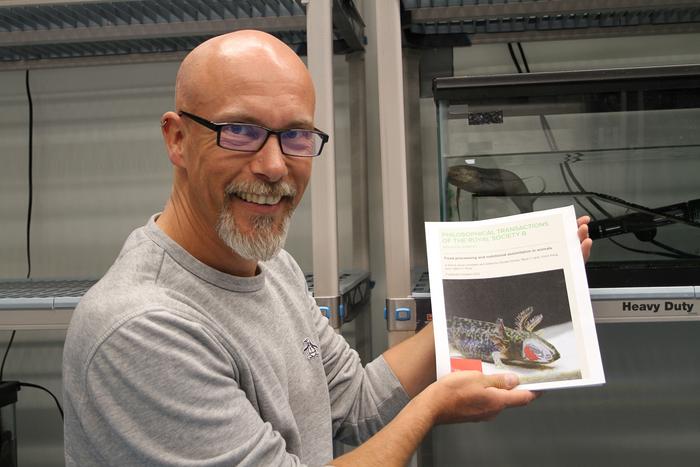
UMass Lowell's Nicolai Konow
Share on FacebookShare on TwitterShare on LinkedinShare on RedditShare on Telegram

Oct. 26, 2023

UMass Lowell's Nicolai Konow

Credit: Brooke Coupal/UMass Lowell

Oct. 26, 2023

Media contacts:
Emily Gowdey-Backus, director of media relations, [email protected]
Nancy Cicco, assistant director of media relations, [email protected]

UMass Lowell’s Nicolai Konow wants to bridge the gap between research on food processing and nutrient absorption.

“There is a divide between biomechanists, who study chewing and food transport, and physiologists, who examine what actually happens to food in the gastrointestinal tract,” said the assistant professor of biological sciences.

To help link the two fields, Konow edited and contributed to a special edition of Philosophical Transactions of the Royal Society, the world’s longest-running scientific journal. The issue, titled “Food processing and nutritional assimilation in animals,” includes 18 research papers that examine how animals, ranging from ants and sharks to monkeys, eat and digest food.

“This special issue is a call to arms for physiologists and biomechanists to start working together to get a more interdisciplinary angle on the effects of food processing on nutritional assimilation,” says Konow, a biomechanics expert. “There’s a crucial gap in our understanding of the journey of food.”

UMass Lowell alumnus and biological sciences teaching assistant Brian Richard worked with Konow to co-author a paper for the issue that establishes that all animal classes, such as mammals and amphibians, contain members that chew their food. Richard conducted research on rhythmic chewing for the publication while he was an undergraduate student at the university.

“It was very exciting to take part in research while an undergraduate, because it helped with my career development,” said Richard, whose goal is to become a professor, combining his passions for research and teaching. “Having this paper published made me feel like I’m a legit scientist now.”

Konow served as the co-author of two subsequent papers, one of which dispelled earlier studies that stated salamanders do not chew.

“Researchers back in the day didn’t have the technology that we have now,” says Konow, who used an X-ray video camera to show that salamanders chew. “Our research on salamanders substantiates the claim made in the previous paper (co-authored by Richard) that chewing is a general trait across the vertebrate tree of life.”

Konow’s other paper used salamanders as a model to understand feeding constraints among animals that transitioned from water to land more than 350 million years ago.

“Salamanders are a really powerful tool for understanding that critical transformation in evolutionary history,” he said.

Additional papers in the special issue, produced by dozens of researchers from around the world, touched upon diverse topics such as the amount of energy it takes for primates to feed, the effect of climate change on nutritional assimilation in marsupials and how ants generate bite force.

“It’s been a great honor to compile this issue,” Konow said.



Share12Tweet8Share2ShareShareShare2

Related Posts

Survey Reveals Many Dog Owners Overlook Subtle Pain Signs Like Nighttime Restlessness and Clinginess

Survey Reveals Many Dog Owners Overlook Subtle Pain Signs Like Nighttime Restlessness and Clinginess

April 1, 2026
Ancient 500-Million-Year-Old Clawed Predator Redefines the Evolution of Spiders and Horseshoe Crabs

Ancient 500-Million-Year-Old Clawed Predator Redefines the Evolution of Spiders and Horseshoe Crabs

April 1, 2026

Chikungunya Virus Lingers in Joint Macrophages, Causes Chronic Disease

April 1, 2026

Unveiling How Two Genes Collaborate to Shape Dental and Facial Features

April 1, 2026

POPULAR NEWS

  • blank

    Revolutionary AI Model Enhances Precision in Detecting Food Contamination

    96 shares
    Share 38 Tweet 24
  • Imagine a Social Media Feed That Challenges Your Views Instead of Reinforcing Them

    1006 shares
    Share 398 Tweet 249
  • Promising Outcomes from First Clinical Trials of Gene Regulation in Epilepsy

    51 shares
    Share 20 Tweet 13
  • Popular Anti-Aging Compound Linked to Damage in Corpus Callosum, Study Finds

    43 shares
    Share 17 Tweet 11

About

We bring you the latest biotechnology news from best research centers and universities around the world. Check our website.

Follow us

Recent News

Metabolic Enzyme Identified as Key Predictor of Cancer Immunotherapy Success—Opening Doors for Enhanced Patient Response

NYU Abu Dhabi and University of Denver Scientists Discover Promising Small Molecule Inhibitor for Parkinson’s and Other Brain Disorders

Quantum switches perform best in extreme cold, new research finds

Subscribe to Blog via Email

Enter your email address to subscribe to this blog and receive notifications of new posts by email.

Join 78 other subscribers
  • Contact Us

Bioengineer.org © Copyright 2023 All Rights Reserved.

Welcome Back!

Login to your account below

Forgotten Password?

Retrieve your password

Please enter your username or email address to reset your password.

Log In
No Result
View All Result
  • Homepages
    • Home Page 1
    • Home Page 2
  • News
  • National
  • Business
  • Health
  • Lifestyle
  • Science

Bioengineer.org © Copyright 2023 All Rights Reserved.