• HOME
  • NEWS
  • EXPLORE
    • CAREER
      • Companies
      • Jobs
    • EVENTS
    • iGEM
      • News
      • Team
    • PHOTOS
    • VIDEO
    • WIKI
  • BLOG
  • COMMUNITY
    • FACEBOOK
    • INSTAGRAM
    • TWITTER
Sunday, July 12, 2026
BIOENGINEER.ORG
No Result
View All Result
  • Login
  • HOME
  • NEWS
  • EXPLORE
    • CAREER
      • Companies
      • Jobs
        • Lecturer
        • PhD Studentship
        • Postdoc
        • Research Assistant
    • EVENTS
    • iGEM
      • News
      • Team
    • PHOTOS
    • VIDEO
    • WIKI
  • BLOG
  • COMMUNITY
    • FACEBOOK
    • INSTAGRAM
    • TWITTER
  • HOME
  • NEWS
  • EXPLORE
    • CAREER
      • Companies
      • Jobs
        • Lecturer
        • PhD Studentship
        • Postdoc
        • Research Assistant
    • EVENTS
    • iGEM
      • News
      • Team
    • PHOTOS
    • VIDEO
    • WIKI
  • BLOG
  • COMMUNITY
    • FACEBOOK
    • INSTAGRAM
    • TWITTER
No Result
View All Result
Bioengineer.org
No Result
View All Result
Home NEWS Science News Chemistry

Solving a mystery in 126 dimensions

Bioengineer by Bioengineer
March 5, 2020
in Chemistry
Reading Time: 2 mins read
0
IMAGE
Share on FacebookShare on TwitterShare on LinkedinShare on RedditShare on Telegram

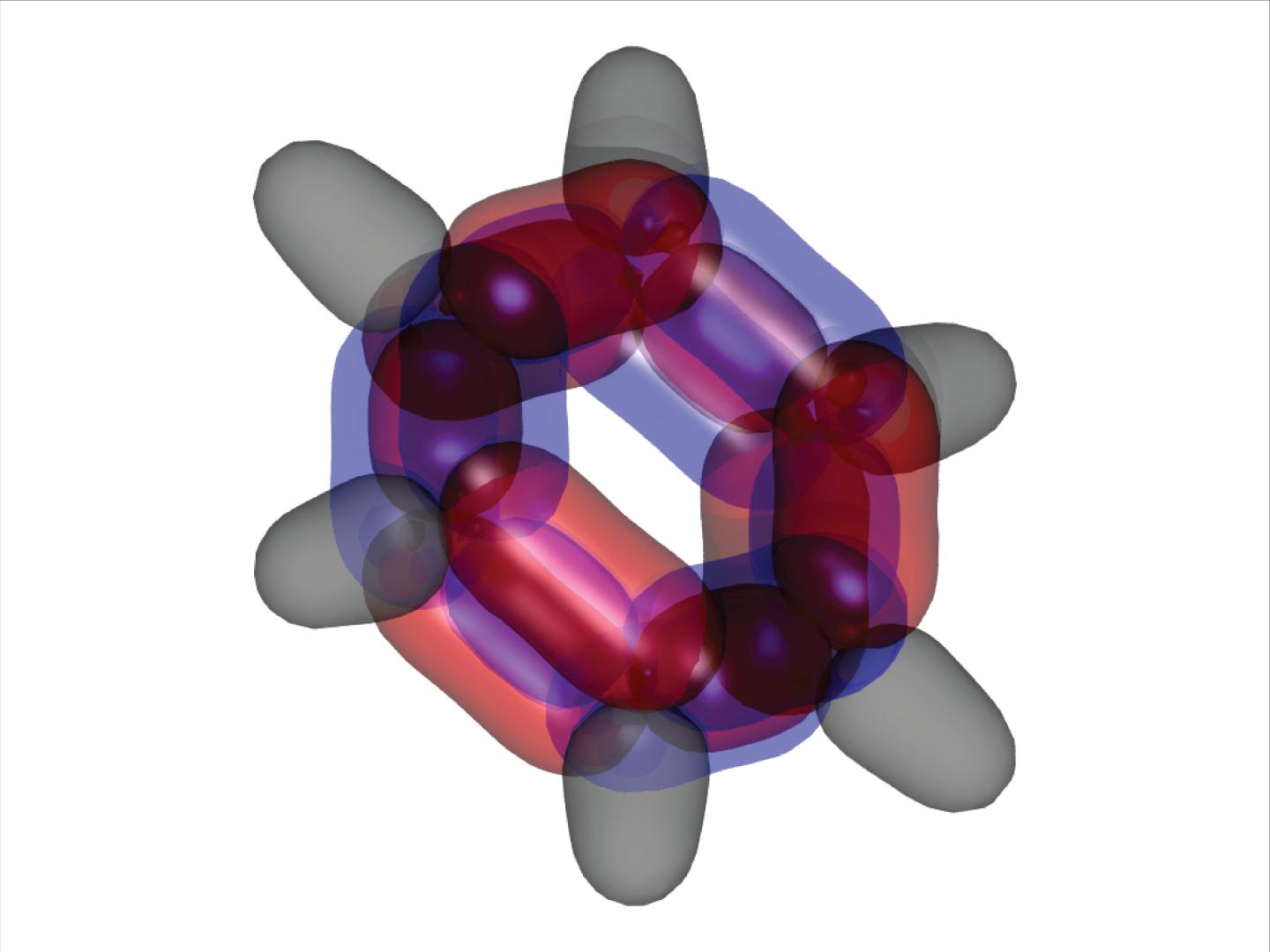
After 90 years, scientists reveal the structure of benzene
IMAGE

Credit: UNSW Sydney


One of the fundamental mysteries of chemistry has been solved by Australian scientists – and the result may have implications for future designs of solar cells, organic light-emitting diodes and other next gen technologies.

Ever since the 1930s debate has raged inside chemistry circles concerning the fundamental structure of benzene. It is a debate that in recent years has taken on added urgency, because benzene – which comprises six carbon atoms matched with six hydrogen atoms – is the smallest molecule that can be used in the production of opto-electronic materials, which are revolutionising renewable energy and telecommunications tech.

It is also a component of DNA, proteins, wood and petroleum.

The controversy around the structure of the molecule arises because although it has few atomic components it exists in a state comprising not just four dimensions – like our everyday “big” world – but 126.

Measuring a system that complex – and tiny – has until now proved impossible, meaning that the precise behaviour of benzene electrons could not be discovered. And that represented a problem, because without that information, the stability of the molecule in tech applications could never be wholly understood.

Now, however, scientists led by Timothy Schmidt from the ARC Centre of Excellence in Exciton Science and UNSW Sydney have succeeded in unravelling the mystery – and the results came as a surprise. They have now been published in the journal Nature Communications.

Professor Schmidt, with colleagues from UNSW and CSIRO’s Data61, applied a complex algorithm-based method called dynamic Voronoi Metropolis sampling (DVMS) to benzene molecules in order to map their wavefunctions across all 126 dimensions.

Key to unravelling the complex problem was a new mathematical algorithm developed by co-author Dr Phil Kilby from CSIRO’s Data61. The algorithm allows the scientist to partition the dimensional space into equivalent “tiles”, each corresponding to a permutation of electron positions.

Of particular interest to the scientists was understanding the “spin” of the electrons. All electrons have spin – it is the property that produces magnetism, among other fundamental forces – but how they interact with each other is at the base of a wide range of technologies, from light-emitting diodes to quantum computing.

“What we found was very surprising,” said Professor Schmidt. “The electrons with what’s known as up-spin double bonded, while those with down-spin remained single.

“That wasn’t what we were expecting, but it could be good news for future technological applications. Essentially it reduces the energy of the molecule, making it more stable, by getting electrons, which repel each other, out of each other’s way.”

Co-author Phil Kilby from Data61 added: “Although developed for this chemistry context, the algorithm we developed, for ‘matching with constraints’ can also be applied to a wide variety of areas, from staff rostering to kidney exchange programs.”

###

Media Contact
Isabelle Dubach
[email protected]
61-402-307-244

Related Journal Article

http://dx.doi.org/10.1038/s41467-020-15039-9

Tags: Atomic/Molecular/Particle PhysicsChemistry/Physics/Materials Sciences
Share12Tweet8Share2ShareShareShare2

Related Posts

Blue Light and Chemistry Simplify Complex Drug Production Steps

Blue Light and Chemistry Simplify Complex Drug Production Steps

July 10, 2026
New Discovery Promises Brighter, More Energy-Efficient Digital Displays

New Discovery Promises Brighter, More Energy-Efficient Digital Displays

July 10, 2026

New Crystalline 3D Frameworks Linked by Spiroborates Developed

July 10, 2026

IBEC Joins Major European Grant on Living Matter Physics

July 10, 2026
Please login to join discussion

POPULAR NEWS

  • Detection of EDCs in Breast Milk and Infant Urine Up to Six Months Highlights Early Exposure Risks

    77 shares
    Share 31 Tweet 19
  • New Drug Candidate Developed at McMaster Shows Potential for Treating Brain Cancer

    58 shares
    Share 23 Tweet 15
  • KTU Researchers Explore Ultrasound’s Role in Enhancing Blood Flow Beyond Diagnostics

    53 shares
    Share 21 Tweet 13
  • 高齢者の骨粗鬆症治療の持続性比較

    51 shares
    Share 20 Tweet 13

About

We bring you the latest biotechnology news from best research centers and universities around the world. Check our website.

Follow us

Recent News

Diverse Symptom Burdens and Care Needs in Older Ischemic Stroke Patients

KAIST Creates AI to Detect Early Cerebrovascular Disease Signs at Home

Anthropometric Traits and Metabolic Biomarkers Linked to Pancreatic Cancer Risk

Subscribe to Blog via Email

Enter your email address to subscribe to this blog and receive notifications of new posts by email.

Join 85 other subscribers
  • Contact Us

Bioengineer.org © Copyright 2023 All Rights Reserved.

Welcome Back!

Login to your account below

Forgotten Password?

Retrieve your password

Please enter your username or email address to reset your password.

Log In
No Result
View All Result
  • Homepages
    • Home Page 1
    • Home Page 2
  • News
  • National
  • Business
  • Health
  • Lifestyle
  • Science

Bioengineer.org © Copyright 2023 All Rights Reserved.