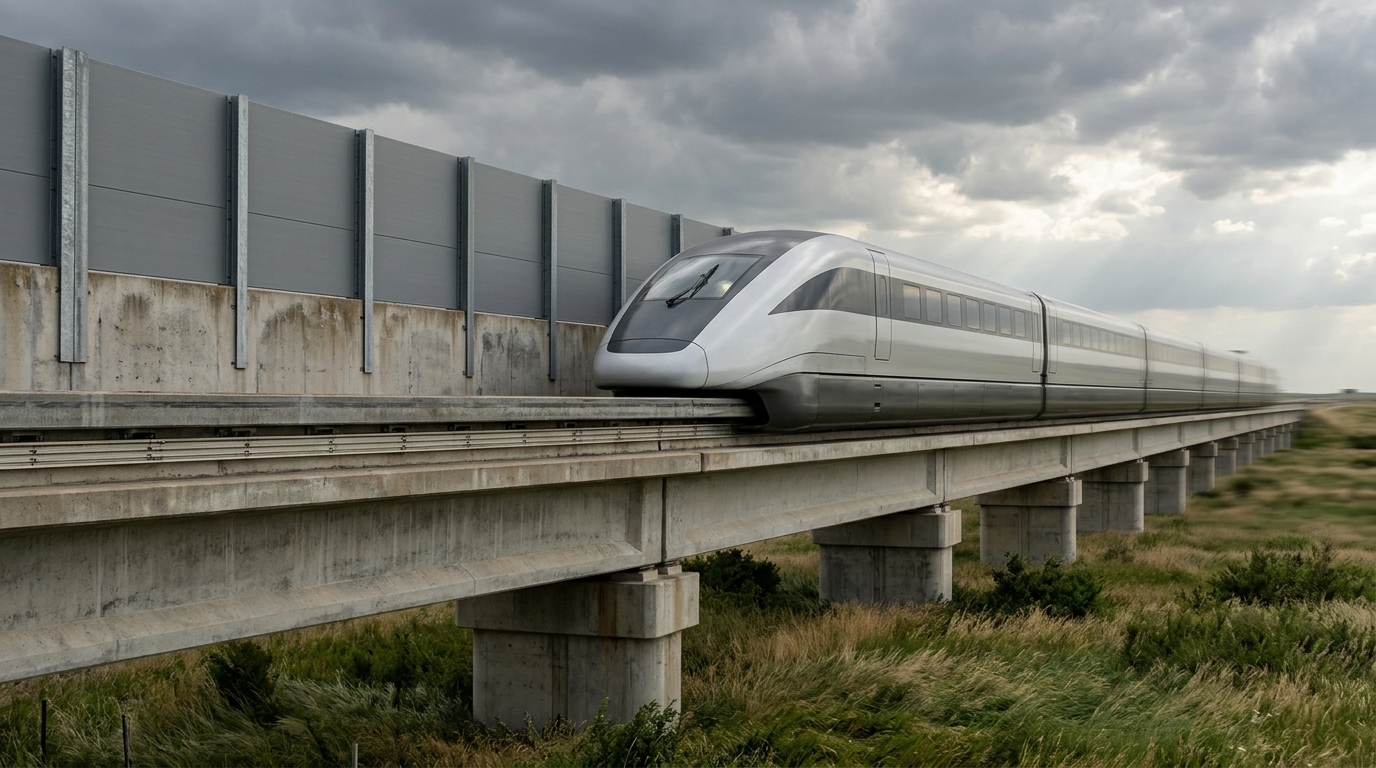
A comprehensive numerical modeling study published in Railway Engineering Science demonstrates that erecting solid windbreak walls along elevated guideways substantially mitigates unsteady aerodynamic loads and preserves electromagnetic levitation and guidance stability for high-speed maglev trains operating at 600 km/h under crosswind excitations. Using an integrated computational methodology that couples high-fidelity computational fluid dynamics with a fully nonlinear three-dimensional vehicle-track interaction framework, researchers evaluated the dynamic responses of a three-car maglev train traversing transitions between open viaduct segments and protected track sections. The simulation results revealed that operating behind a solid barrier reduces transient aerodynamic side forces and lift forces by approximately 98 to 140 kN and 78 to 140 kN, respectively, with the most pronounced load suppression occurring on the leading vehicle. These dramatic reductions in aerodynamic loading prevent excessive carbody swaying and suppress lateral offsets, thereby preventing electromagnetic guidance and levitation gaps from experiencing severe fluctuations that could otherwise jeopardize operational safety at ultra-high velocities.
Unlike conventional high-speed rail systems that rely on mechanical wheel-rail contact and frictional adhesion to maintain directional tracking and support vertical vehicle loads, high-speed maglev systems utilize non-contact electromagnetic levitation and guidance forces. Extreme meteorological events and severe crosswinds generate complex unsteady flow fields around the slender carbody, producing substantial lateral forces, vertical lift, and aerodynamic rolling moments. These turbulent crosswind excitations can trigger severe rolling and swaying motions, disturb the delicate equilibrium between active electromagnets and the track, induce violent gap oscillations, and degrade passenger ride comfort. Because previous dynamic investigations of railway crosswinds largely focused on conventional trains at speeds below 450 km/h or assumed steady wind fields over flat terrain, understanding the coupled aerodynamic and mechanical responses of a 600 km/h maglev traversing elevated infrastructure under realistic wind barriers has emerged as an urgent engineering priority.
To capture the complex fluid flow around the moving vehicle and line-side infrastructure, the researchers established an advanced computational fluid dynamics model within the commercial finite-volume solver Fluent using the mosaic poly-hexcore meshing methodology. The numerical domain enclosed a three-car maglev train, a single-line viaduct, and a continuous solid windbreak wall, maintaining a blockage ratio below 0.01 with a vertical clearance of 40 meters from the train bottom to the upper boundary and lateral clearances of 40 meters on the windward side and 80 meters on the leeward side. Because air travelling past the train body reaches a Mach number of approximately 0.49 at 600 km/h, the ambient airflow was treated as a compressible medium. Turbulence was resolved through an improved delayed detached eddy simulation approach based on the shear stress transport k-omega model, a hybrid strategy that mitigates modeled stress depletion in near-wall regions while capturing transient wake structures without the extreme computational burden of full large eddy simulation. Pressure-velocity coupling was achieved via the SIMPLEC scheme across a grid comprising approximately 63 million cells, with eight prism boundary layers and a first-layer thickness of 0.0002 meters ensuring non-dimensional wall distance values strictly between 0 and 5.
Accurately representing the vehicle’s rapid motion relative to stationary viaduct structures and windbreak boundaries required implementation of the sliding mesh technique. A dynamic computational sub-domain containing the three-car vehicle was translated through the stationary airflow grid at a constant velocity of 166.67 m/s, with data exchanged across non-conformal sliding interfaces. To ensure numerical stability and minimize spurious transients, a two-stage simulation protocol was executed: an initial steady-state computation running 1000 iterations until residuals converged below 10 to the power of negative four established a fully developed flow field, followed by a transient simulation advancing at a time step of 0.005 seconds with 30 inner iterations per increment. Incident crosswinds were modeled as uniform lateral velocity inlets across five discrete test speeds ranging from 10 to 30 m/s.
Transient aerodynamic forces and moments extracted from the fluid domain were subsequently fed directly into a three-dimensional spatial maglev train-track coupled dynamics model derived from vehicle-track system dynamics principles. The simulated three-car trainset treats each vehicle carbody, bolster, and four C-shaped levitation frames as independent rigid bodies possessing six spatial degrees of freedom, connected through linear spring-damper representations of secondary air springs, hanging rods, anti-roll rubber joints, lateral stoppers, and inter-car couplers. Below the vehicle, the elevated guideway was formulated as a continuous Timoshenko beam simply supported at span terminals to account for shear deformation, vertical deflection, lateral bending, and torsional distortion, while discrete guideway fasteners were modeled as uniform spring-damper supports along the longitudinal track axis. The complete differential equation systems governing train component motions and guideway deformations were solved simultaneously using the fast explicit Zhai integration algorithm with an integration time step of 10 to the power of negative five seconds, incorporating measured long-wave random track irregularities to replicate realistic running conditions.
Electromagnetic interaction between the moving train and the flexible guideway was governed by independent closed-loop proportional-integral-derivative control sub-models operating across discrete magnetic poles. Each levitation and guidance electromagnet was divided into independent front and rear modules equipped with dedicated sensors and controllers, establishing a nominal static equilibrium levitation gap of 8.0 mm. For the levitation control law, proportional, integral, and derivative gain coefficients were assigned values of 14,000, 500, and 175, respectively, dynamically adjusting coil current to restore nominal clearances whenever track deflections or external loads produced vertical displacement errors. The guidance control framework observed differential gaps between opposing lateral electromagnet pairs to maintain precise vehicle alignment along the guideway centerline. By discretizing the electromagnetic forces across twelve distinct longitudinal poles per electromagnet and applying concentrated CFD-derived wind forces at each vehicle carbody’s center of mass, the model captured non-contact electromechanical coupling during turbulent crosswind encounters.
The computational framework underwent extensive multi-stage numerical and experimental validation prior to production evaluations. A mesh independence assessment comparing coarse grids of 32 million cells, medium grids of 63 million cells, and fine grids of 82 million cells demonstrated that the medium poly-hexcore mesh achieved near-identical surface pressure coefficients and force histories to the finest grid while preserving computational tractability. Aerodynamic simulation fidelity was corroborated against experimental wind tunnel data obtained from a 1:40 scale model of the Shanghai TR08 maglev train subjected to a 15-degree crosswind at 15 m/s, yielding close agreement between measured and computed surface pressure distributions across critical vehicle cross-sections.
Detailed examination of the numerical aerodynamic datasets revealed that when the 600 km/h maglev travels along an unprotected viaduct, aerodynamic side force, lift force, and rolling moments increase drastically with wind velocity, concentrating overwhelmingly on the leading vehicle. Under a severe crosswind of 25 m/s, the unshielded head car experienced violent force oscillations and peak root-mean-square loads far exceeding those of the middle and tail vehicles. However, as the train entered the section shielded by the solid windbreak wall, root-mean-square values of side and lift forces dropped precipitously. The head car exhibited the most significant relief, with lateral aerodynamic forces dropping nearly to zero behind the barrier.
These sharp aerodynamic load reductions directly improved the electromechanical regulation of levitation and guidance clearances. In the absence of wind protection, crosswinds generated substantial carbody roll and lateral translation, widening the guidance gap difference on the leading electromagnet pair to a hazardous peak of 7.3 mm and causing dynamic levitation gaps on the right-side magnets to deviate from equilibrium by as much as 3.8 mm. When traversing the windbreak zone, the guidance gap difference of the head car’s leading electromagnet was reduced by 2.3 to 7.4 mm relative to open-viaduct operation, effectively centering the vehicle on the track.
Dynamic analysis of carbody acceleration histories demonstrated that the solid windbreak wall successfully suppresses low-frequency vehicle vibrations across the critical 0 to 10 Hz spectrum. Under unprotected crosswinds, spectral analysis indicated that lateral and vertical carbody vibrations concentrated predominantly within the 1 to 5 Hz and 2 to 7 Hz bands, respectively, displaying expanded phase-plane trajectory orbits that signify severe lateral unsteady swaying. Inside the windbreak enclosure, carbody lateral displacements and vibration amplitudes contracted markedly. However, the simulation also uncovered a critical operational vulnerability: transient aerodynamic shock loads emerged as the train traversed the abrupt entrance and exit boundaries of the windbreak wall. As the streamlined nose crossed into the windbreak portal, the instantaneous disruption of the incident crosswind triggered a severe pressure transient and induced brief, sharp spikes in lateral acceleration, demonstrating that barrier termination geometries represent critical dynamic impact zones.
Flow field streamlines and vortex topologies elucidated the underlying aerodynamic mechanisms governing these performance shifts. Under steady crosswind conditions in open air, the train’s slender cylindrical geometry induces classical Karman vortex street shedding along the leeward surface, generating quasi-periodic vortex-induced lateral forces that drive violent carbody swaying. Inside the windbreak zone, the barrier intercepts incident wind streams, creating a quiescent pocket that eliminates primary leeward vortex shedding around the head car. When navigating the narrow portal boundary, strong localized pressure gradients between the train flank and the wall structure generate intense Bernoulli suction effects that abruptly deflect upstream flow lines and stimulate transient low-frequency vehicle shaking. While the study provides foundational insights into wind protection design, the authors noted several modeling simplifications, including assuming concentrated vehicle aerodynamic loads, treating bridge foundations as rigid supports, neglecting air spring suspension hysteresis, and simulating uniform crosswinds rather than turbulent atmospheric gusts. Future design optimization will require coupled wind-train-bridge frameworks that incorporate flexible substructures, multi-point aerodynamic load distributions, and contoured wall portal transitions.
Subject of Research: Aerodynamic and dynamic stability of 600 km/h maglev trains protected by windbreak walls under crosswinds
Article Title: Wind-induced dynamic performances of high-speed maglev train subjected to wind-break wall: Illustrations based on a composite methodology
Article References: Yang, Y., Peng, C., & Chen, Z. (2026). Wind-induced dynamic performances of high-speed maglev train subjected to wind-break wall: Illustrations based on a composite methodology. Railway Engineering Science. https://doi.org/10.1007/s40534-026-00437-4
Image Credits: AI Generated
DOI: 10.1007/s40534-026-00437-4
Keywords: High-speed maglev train, Wind-break wall, Crosswind dynamics, Aerodynamic loads, Levitation gap, Guidance gap, Computational fluid dynamics, IDDES turbulence model, Vehicle-track coupled dynamics, Zhai integration method, Timoshenko beam, Sliding mesh technique, Vortex shedding, Carbody vibration, Railway Engineering Science, PID control system
News Source: Denise Maddox. (November 27, 2026). Solid Windbreak Walls Stabilize Levitation Gaps on High-Speed Maglev Trains. Scienmag.