A newly synthesized solid membrane offers an effective approach for the selective extraction of copper(II) cations from aqueous media at room temperature, according to research published on November 5, 2026, in the journal Discover Materials. Experimental testing demonstrated that the resulting membrane achieved a copper(II) transport flux of 34.5 × 10⁻³ mol/h×m2 under neutral pH conditions while operating at room temperature, establishing the material as a potential candidate for selective copper isolation in aqueous solutions.
In their study, the authors noted that many liquid membranes were evaluated for the selective extraction of cesium cation. Nevertheless, liquid membrane configurations present major drawbacks that severely limit their use in practical industrial applications, most notably their chemical instability over time and relatively low diffusion flux.
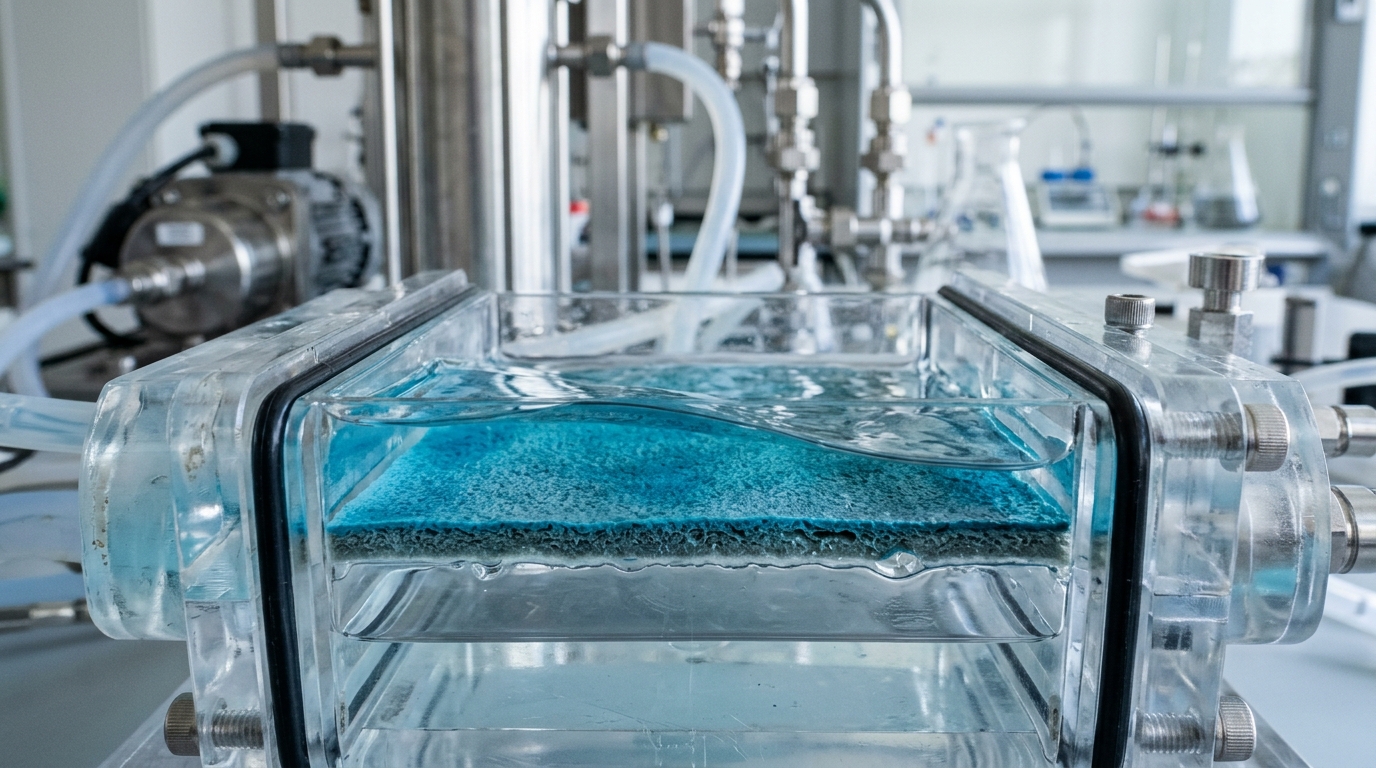
The solid membrane, designated PAN/Sty-Met(Py-Tet), incorporates a tetrapodal tetrazole-pyrazole conjugate molecule that functions as the transporter for target metal ions. The researchers prepared the solid membrane by photopolymerizing a formulation of the tetrazole-pyrazole conjugate monomer directly onto a polyacrylonitrile support. This photopolymerization process successfully generated a thin membrane structure characterized by an asymmetric and amorphous morphology.
Thermogravimetric analysis (TGA) revealed that the PAN/Sty-Met(Py-Tet) solid membrane possesses thermal stability up to 330 °C, confirming the thermal integrity of the polymer matrix. Transport experiments conducted under competitive conditions further demonstrated that the membrane selectively transports Cu2+ cations in the presence of several competing divalent species, successfully transporting copper over zinc (Zn2+), lead (Pb2+), cobalt (Co2+), and cadmium (Cd2+) cations.
Experimental evaluations demonstrated that the transport performances of the PAN/Sty-Met(Py-Tet) solid membrane remained stable over eight consecutive operational cycles. Based on these observed separation results, thermal stability up to 330 °C, and multi-cycle durability, the authors concluded that the membrane represents a viable candidate for the selective isolation of Cu2+ from aqueous media at room temperature.
Subject of Research: Selective extraction of copper(II) using a solid polymer membrane
Article Title: New thin solid membrane for selective extraction of Cu(II) from aqueous media
Article References: Cherfi, M., Harit, T., Boulehya, O., Alzahrani, A. Y. A., Triki, S., & Malek, F. (2026). New thin solid membrane for selective extraction of Cu(II) from aqueous media. Discover Materials. https://doi.org/10.1007/s43939-026-01068-6
Image Credits: AI Generated
DOI: 10.1007/s43939-026-01068-6
Keywords: membrane separation, copper extraction, solid membrane, polyacrylonitrile, selective transport, photopolymerization, Discover Materials, coordination chemistry, thin, solid, membrane, selective
News Source: Denise Maddox. (November 7, 2026). Solid Membrane Selectively Extracts Copper Ions from Aqueous Media at Room Temperature. Scienmag.