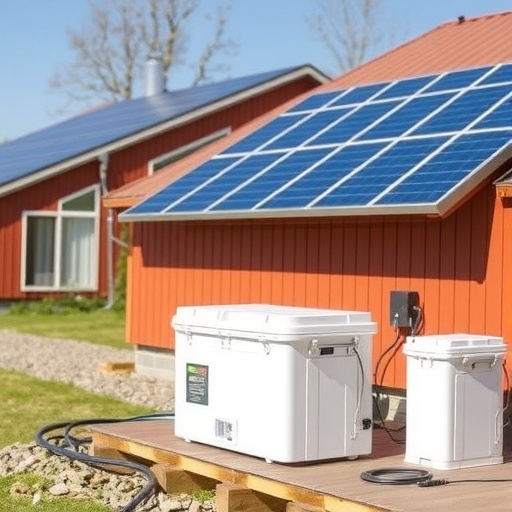

In the face of increasing climate volatility and the aging condition of electrical grid infrastructure, the pursuit of enhanced energy affordability and resilience for households has emerged as an urgent priority. Distributed energy resources, particularly solar photovoltaic systems combined with battery storage technology, are rapidly gaining traction as promising answers to these challenges. A landmark nationwide study conducted across more than half a million United States households offers an unprecedented, comprehensive evaluation of the economic and operational viability of integrating solar and battery systems into residential energy frameworks. This research not only quantifies potential cost savings but also explores the critical capability of these systems to provide reliable backup power during outages, illuminating both the immense promise and the striking disparities underlying this energy transition.
At its core, the study presents a rigorous analysis that illustrates how 60% of US households have the potential to significantly reduce their electricity expenditures by adopting solar–battery configurations. On average, these households could realize savings amounting to approximately 15% on their electricity bills, a figure that translates into substantial annual financial relief amid rising energy costs. These findings underscore the economic appeal of transitioning toward distributed energy solutions, particularly as conventional utility rates fluctuate and energy demands continue to surge.
Beyond mere cost savings, the resilience benefits afforded by solar–battery systems are equally compelling. The research reveals that 63% of households could secure affordable backup power during grid outages, with the stored energy capable of covering an average of 51% of essential household needs. This robust level of outage coverage marks a transformative shift in how American households can self-manage energy reliability, drastically reducing vulnerability during natural disasters, extreme weather events, or systemic grid failures. The ability of distributed energy resources to mitigate blackout impacts introduces a new paradigm for energy security at the residential level.
.adsslot_inlRDjM8Nu{width:728px !important;height:90px !important;}
@media(max-width:1199px){ .adsslot_inlRDjM8Nu{width:468px !important;height:60px !important;}
}
@media(max-width:767px){ .adsslot_inlRDjM8Nu{width:320px !important;height:50px !important;}
}
ADVERTISEMENT
However, despite this optimistic outlook, the study identifies a disconcerting disconnect between benefits and need. Regions experiencing the highest frequency and severity of power outages do not always coincide with areas where solar–battery systems are most economically viable or accessible. This misalignment suggests that those communities most exposed to grid risks may not fully reap the protective advantages offered by distributed energy, highlighting a critical gap in equitable energy resilience.
Further compounding this issue is the revelation of persistent disparities in access to solar and battery technologies. Households in less densely populated and socioeconomically disadvantaged communities consistently exhibit lower viability for solar–battery adoption. Factors such as upfront installation costs, limited financing options, inadequate local policy support, and infrastructural barriers contribute to these inequities. This persistent gap raises pressing concerns about the inclusivity of the energy transition and the risk of deepening existing social and economic divides.
Methodologically, the research employed advanced data integration techniques, combining geospatial outage records, solar irradiance mapping, household energy consumption profiles, and economic modeling to evaluate system viability on a granular scale. This multifaceted approach allows for precision in estimating financial returns and backup coverage potential across a diverse demographic landscape. By leveraging vast datasets and cutting-edge modeling, the study delivers a detailed depiction of how distributed energy can function in realistic, location-dependent scenarios.
The economic modeling component of the study accounts for various electricity tariff structures, including the traditional net energy metering (NEM) policies that have historically incentivized rooftop solar adoption. Notably, as states begin transitioning away from NEM toward more complex tariff designs that may devalue excess solar generation, the economic calculus for residential solar–battery systems becomes significantly altered. This policy evolution presents both risks and opportunities, making it essential to comprehend how tariff shifts could influence the affordability and attractiveness of distributed energy investments.
Technological advancements in battery chemistry, storage capacity, and system integration also form a crucial backdrop to the study’s insights. Improvements in lithium-ion battery technology, coupled with decreasing costs and enhanced energy management software, have bolstered the operational efficacy of home energy storage. These developments facilitate longer duration backup power and more effective load shifting, optimizing not only cost savings but also resilience capacity during outages. The research conditions and results implicitly reflect these technological trajectories, suggesting growing competitiveness of solar–battery systems.
Nevertheless, the study highlights a need for focused policy interventions to align distributed energy benefits with community needs more precisely. Strategic incentives, targeted outreach, and subsidized financing options may be imperative to close the viability gap in underserved and high-outage regions. Ensuring equitable participation in the distributed energy revolution will require collaborative efforts between utilities, regulators, technology providers, and policymakers, with an emphasis on inclusivity and resilience.
Crucially, this nationwide assessment serves as a diagnostic tool, illuminating the complex interplay between decentralized energy solutions, grid vulnerabilities, economic incentives, and social equity. It reveals that while solar and battery technologies can substantially reduce household energy burdens and mitigate outage risks, their benefits are neither uniformly distributed nor automatically accessible. The findings challenge stakeholders to consider how best to deploy these emerging resources to maximize societal benefit and energy justice.
Public awareness and consumer education also emerge as pivotal elements in fostering widespread adoption. Households must receive transparent information about the cost-saving potential, reliability improvements, and longer-term value propositions of solar–battery systems. Overcoming misinformation and addressing barriers related to technical literacy, trust, and upfront investment are vital components of accelerating penetration among diverse populations.
The environmental implications of expanding distributed solar–battery systems are profound as well. By reducing reliance on fossil-fuel-based centralized generation and enabling self-sufficient energy use, these systems contribute to decarbonization goals and greenhouse gas emissions reduction. As climate change exacerbates the frequency of grid-disturbing events, the decentralization of energy generation and storage stands out as a critical adaptation and mitigation strategy.
Looking ahead, continued innovation in storage technologies, including emerging chemistries and grid-interactive smart inverters, promises to enhance the functional integration of solar-battery systems with utility operations. The convergence of distributed energy with advanced grid management techniques will likely reshape how power is generated, distributed, and consumed at multiple scales, from individual households to entire communities.
In sum, this comprehensive analysis underscores the transformative potential of distributed solar and battery storage in fostering a more affordable, resilient, and environmentally sustainable household energy ecosystem across the United States. Yet, it also clearly signals the imperative for intentional, equity-focused policies to ensure that the benefits do not bypass the most vulnerable and high-risk populations. As states continue revising electricity tariff structures and as technology evolves, the challenge lies in crafting frameworks that align innovation with inclusion, ultimately advancing a clean and just energy future for all American households.
Subject of Research: Economic and outage resilience viability of residential solar and battery systems in the United States.
Article Title: Solar and battery can reduce energy costs and provide affordable outage backup for US households.
Article References:
Sun, T., Feng, Y., Zanocco, C. et al. Solar and battery can reduce energy costs and provide affordable outage backup for US households.
Nat Energy (2025). https://doi.org/10.1038/s41560-025-01821-w
Image Credits: AI Generated
Tags: backup power during outagesbattery storage technologyclimate change energy resiliencedistributed energy resourceseconomic viability of solar systemselectricity cost reductionhousehold energy affordabilityintegration of solar and battery systemsrenewable energy household benefitsresidential energy solutionssolar energy savingsUS energy transition