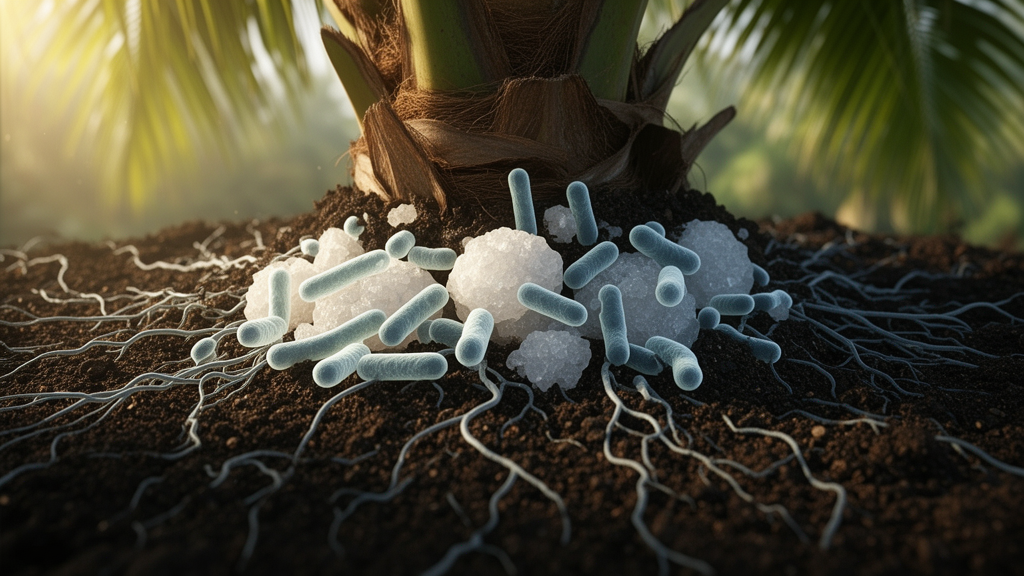
Biological suppression of the destructive fungal pathogen Ceratocystis paradoxa in tropical coconut soils is driven by an interplay between beneficial bacterial communities and specific soil chemical properties, notably calcium carbonate and neutral pH levels. In an extensive comparative evaluation of agricultural soils collected from commercial coconut plantations across Brazil, investigators demonstrated that disease-suppressive soils naturally limit the establishment and reproduction of C. paradoxa through high bacterial abundance and favorable soil chemistry. The fungal pathogen causes stem bleeding disease, a lethal condition that threatens perennial plantation systems and multiple tropical crops worldwide. By systematically characterizing fifty-four composite soil samples alongside controlled laboratory substrates, the research team identified that naturally suppressive soils substantially reduce pathogen colonization on organic tissues.
Environmental stressors and routine mechanical management practices, such as harvesting and frond pruning, produce mechanical entry wounds that facilitate opportunistic colonization by fungal propagules. Disease management remains notoriously difficult due to the complete absence of genetically resistant commercial coconut cultivars, while traditional synthetic fungicide applications demonstrate minimal efficacy against internal vascular infections in mature perennial palms.
To investigate the environmental and microbial determinants governing soil suppressiveness against this pathogen, researchers gathered fifty-four distinct composite soil samples from commercial coconut cultivation systems located in northeastern and northern Brazil. Sampling targeted two major commercial plantation areas spanning approximately two hundred hectares each, situated at Platô de Neópolis in Sergipe state and Moju in Pará state. Both agricultural sites exclusively cultivated the dwarf coconut variety Anão Verde under uniform planting configurations of seven-point-five meters between individual palms managed with continuous automated irrigation. At each production site, investigators collected upper-horizon topsoil at depths between zero and ten centimeters beneath the canopy drip lines of healthy palms and palms exhibiting pronounced stem bleeding symptoms. Five discrete subsamples were systematically collected and pooled per sampling station to yield representative five-hundred-gram composite samples, generating twenty-five distinct samples from Sergipe and twenty-nine from Pará. Subsamples were partitioned immediately, with dedicated aliquots stored at four degrees Celsius for biological bioassays and minus twenty degrees Celsius for metagenomic nucleic acid extractions.
Pathogen suppressiveness across all field soils was quantified through standardized laboratory bioassays employing ripe banana peel fragments as susceptible decoy baits for fungal recovery. Soil aliquots of thirty grams were arrayed in sterile ninety-millimeter Petri dishes and artificially inoculated with an eight-milliliter conidial suspension containing one hundred thousand spores per milliliter of C. paradoxa strain TCTL003. Surface-sterilized banana peel squares measuring one square centimeter each, sourced from Prata cultivar bananas, were placed onto the infested soils following a seven-day pre-incubation period at twenty-eight degrees Celsius. Pathogen colonization on the bait tissues varied drastically across the evaluated soils, spanning an overall recovery range between four-point-six percent and ninety-eight-point-five percent across all test samples and experimental controls. Statistical cluster separation grouped the samples into seven distinct performance tiers, identifying a highly suppressive tier characterized by bait colonization below twenty percent.
Comprehensive physical characterization of contrasting soil samples revealed that physical texture and particle size distributions exerted a pronounced influence on the suppression of C. paradoxa. Detailed comparative evaluations between five suppressive soils and five conducive soils showed that soil particle architecture separated cleanly under principal component analysis, accounting for seventy-eight-point-thirty percent of total physical variance. Naturally suppressive coconut soils exhibited significantly higher coarse sand fractions, averaging eighty-six-point-eighty percent sand content compared to an average of seventy-one-point-forty percent in disease-conducive soils. In contrast, fine-textured clay soils promote poor oxygen diffusion and prolonged water retention, conditions that favor pathogen survivability and facilitate vegetative proliferation across organic substrates.
Chemical profiling of the experimental soils established clear associations between enhanced soil fertility, elevated base saturation, and the suppression of fungal colonization. Principal component analysis of chemical parameters explained seventy-eight-point-sixteen percent of total chemical variance, with principal component one accounting for sixty-two-point-seventy-four percent. In contrast, disease-conducive soils were strongly characterized by high levels of extractable aluminum and iron, along with severe potential acidity and elevated aluminum saturation. Exploratory correlation matrices revealed that soil pH correlated strongly and positively with total bacterial abundance, sum of bases, and cation exchange capacity. Higher soil pH and abundant divalent cations, such as calcium and magnesium, help buffer rhizosphere fluctuations and enhance mineral nutrient bioavailability for beneficial organisms.
Microbial enumeration via selective culture media confirmed that total bacterial abundance, rather than general fungal population size, differentiated suppressive soils from disease-conducive agricultural profiles. Culturable bacterial populations were significantly greater in suppressive soils, displaying strong positive correlations with soil calcium levels, base saturation, sum of bases, and total cation exchange capacity. Selective plating specifically demonstrated that Bacillus species densities correlated positively with culturable Trichoderma populations, both of which exhibited strong negative correlations with C. paradoxa bait colonization rates. Interestingly, overall fungal densities and specific populations of fluorescent Pseudomonas species did not show statistically significant differences when comparing suppressive soils directly to conducive soils. The biological data indicate that disease suppression in coconut soils does not depend on a broad, unspecific increase in all soil microorganisms. Instead, it relies on specific bacterial guilds that flourish under calcium-rich, well-buffered soil conditions, establishing competitive boundaries that restrict the establishment of saprophytic and parasitic fungal structures in the rhizosphere.
High-throughput metataxonomic profiling of the bacterial sixteenth-S ribosomal RNA gene revealed distinct taxonomic shifts between highly suppressive and conducive soil environments. Amplicon sequencing targeting the V3-V4 hypervariable region demonstrated that Actinobacteria, Proteobacteria, Firmicutes, and Acidobacteria collectively comprised more than eighty percent of total bacterial relative abundance across both soil types. However, Actinobacteria represented twenty-eight-point-six percent of the microbial community in suppressive soils compared to twenty-two-point-four percent in conducive soils, representing a significant compositional enrichment. Conversely, Proteobacteria dominated conducive soils at thirty-one-point-two percent compared to twenty-five-point-eight percent in suppressive profiles. Differential abundance testing via DESeq2 and ANCOM-BC identified two hundred twelve distinct amplicon sequence variants that separated the soils, highlighting substantial enrichment of chitinolytic Streptomyces and biocontrol-associated Paenibacillus in suppressive samples.
Controlled soil amendment trials utilizing varying concentrations of calcium sources revealed that chemical speciation and pH modification dictate the efficacy of calcium-mediated disease suppression. Amending acidic subsoil with calcium carbonate at concentrations between one and three-point-five centimoles of charge per cubic decimeter raised soil pH from five-point-twenty up to seven-point-thirty-six. The initial calcium carbonate application caused a ninety-five-point-eighty-nine percent reduction in C. paradoxa perithecia formation and reduced bait colonization by forty-one percent, with higher doses suppressing colonization to one percent. In stark contrast, parallel applications of calcium sulfate and calcium chloride failed to reduce pathogen colonization or perithecia production, with calcium chloride maintaining acidic conditions near pH four-point-twenty-one. Statistical analysis identified strong negative correlations between soil pH and both bait colonization and perithecia counts. These contrasting responses demonstrate that calcium ions alone are insufficient to arrest pathogen development; rather, the alkaline buffering capacity and neutralization of soil acidity provided by carbonate ions are essential for inducing suppressiveness.
Transplantation experiments confirmed that suppressiveness can be successfully transferred to conducive subsoils by inoculating extracted microbial communities from suppressive soils. Introducing the washed microbial fraction from suppressive soil T2 into sterilized Latosol subsoil reduced pathogen perithecia formation by up to ninety-three-point-eight percent compared to untreated control soils. Interestingly, combining the transferred microbial suspension with calcium carbonate amendments caused an unexpected increase in perithecia formation relative to the microbiome treatment alone, indicating potential biological disruption during rapid chemical transitions. This suggests that abrupt pH shifts during initial microbial colonization may destabilize sensitive antagonist guilds before functional rhizosphere equilibrium is achieved. Overall, the research highlights that sustainable control of C. paradoxa relies on an integrated strategy combining balanced liming practices with the stewardship of antagonistic Actinobacteria and Firmicutes communities. Future management must prioritize field-scale validation of calcium carbonate amendments and biological inoculants to effectively protect perennial coconut agroecosystems against stem bleeding disease.
Subject of Research: Soil suppressiveness mechanisms against Ceratocystis paradoxa in tropical coconut plantation soils
Article Title: Rhizosphere microbiome and calcium synergy drive suppression of Ceratocystis paradoxa in tropical coconut soils
Article References: Almeida, K. A., de Fátima Pereira, P., Guimarães, R. A., Afridi, M. S., da Silva, J. C. P., Andrade, B., Quensen, J., Tiedje, J., de Souza, J. T., Talamini, V., de Arruda Carvalho, E., & de Medeiros, F. H. V. (2026). Rhizosphere microbiome and calcium synergy drive suppression of Ceratocystis paradoxa in tropical coconut soils. Archives of Microbiology, 208(11), Article 586. https://doi.org/10.1007/s00203-026-05108-w
Image Credits: AI Generated
DOI: 10.1007/s00203-026-05108-w
Keywords: Ceratocystis paradoxa, stem bleeding disease, coconut palms, soil suppressiveness, calcium carbonate, soil microbiome, Actinobacteria, Firmicutes, Streptomyces, Bacillus, banana peel baiting, soil pH, cation exchange capacity, soil chemistry, biological control, agroecology, soil texture
News Source: Kristina Jarvis. (November 26, 2026). Soil Bacteria and Calcium Carbonate Suppress Destructive Coconut Stem Bleeding Pathogen. Scienmag.