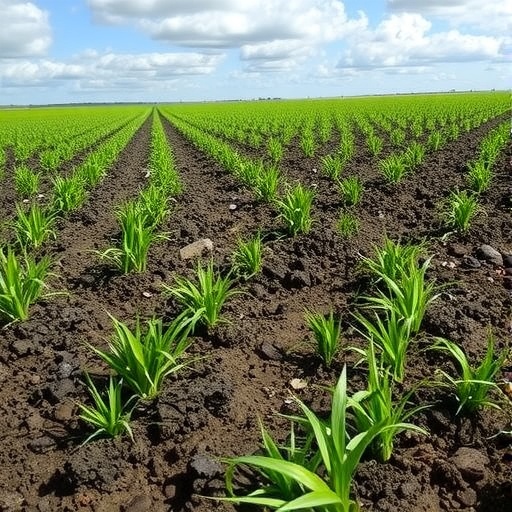
In the ever-evolving landscape of agricultural science, one of the most pressing challenges we face is the impact of climate change on crop production. While rapid industrial growth has contributed to our ability to feed billions, the effects of soil salinization have emerged as a significant limiting factor in global agriculture, particularly in arid regions. Recent research has shed new light on this issue, focusing on barley’s salinity tolerance – an important finding given barley’s role as a staple crop in many countries. The study, undertaken by Hammami et al., explores the interplay between soil characteristics, climate conditions, and the salinity tolerance of barley, an area that, until now, has not received sufficient attention.
Barley, scientifically known as Hordeum vulgare L., is one of the oldest cultivated crops and is primarily grown in areas with cooler climates. It stands out for its versatility and resilience, qualities that make it a valuable asset in agricultural practices. The research conducted by Hammami and colleagues delves into the nuances of how varying environmental factors affect barley’s ability to withstand saline conditions. The increasing salinization of soils, exacerbated by climate change and mismanagement of irrigation practices, poses a considerable threat to barley yields, making the findings of this study especially pertinent.
The researchers adopted a comprehensive methodology, combining field studies and laboratory experiments to collect data from various locations characterized by differing salinity levels and climatic conditions. By analyzing soil samples, the team aimed to establish a direct correlation between the physical and chemical composition of the soil and barley’s performance under salinity stress. Parameters such as electrical conductivity, sodium content, and moisture retention were meticulously measured, providing a clear picture of how these elements interact with barley’s growth and development.
One significant aspect of the research was its focus on identifying the specific traits that confer salinity tolerance to barley. The researchers employed techniques such as quantitative trait locus (QTL) mapping to pinpoint genetic markers associated with salinity resilience. These markers offer potential avenues for future breeding programs, allowing agricultural scientists to develop barley varieties that are better suited for cultivation in salinized soils. By enhancing our understanding of barley’s genetic makeup, the study paves the way for innovative solutions to meet the challenges posed by salinity.
Moreover, another layer to this research involves the impact of climate variables such as temperature and rainfall patterns on barley’s salinity tolerance. Observations highlighted that extreme weather events and prolonged drought conditions worsen salinity in soils, creating an urgent need to adapt barley cultivation practices accordingly. How barley’s physiological responses to varying climatic extremes interact with soil salinity creates a complex dynamic that is critical to comprehend for future agricultural sustainability.
It’s important to note that the findings are not isolated to barley; they extend into the broader context of crop resilience in a time of rapid environmental change. By examining salinity tolerance in barley, researchers can infer strategies that may apply to other crucial crops, aiming to safeguard food security in regions vulnerable to climate-induced aridity and soil degradation. The adaptability of crops like barley in diverse conditions offers a ray of hope that can inform policy and practice, especially in agricultural sectors of developing nations.
The study’s implications reach far beyond academic interest; they touch the lives of farmers who rely on barley as a staple food and a source of income. For instance, in regions where barley farming is challenged by increasing salinity, the introduction of more resilient varieties can lead to improved yields, ensuring the sustenance of families and communities. The economic benefits of investing in barley research are profound, indicating a path toward greater agricultural productivity and food security across arid landscapes.
Furthermore, this research aligns with global initiatives aimed at sustainable development in agriculture. With the United Nations proclaiming the decade of action towards achieving the Sustainable Development Goals, studies like these are pivotal. They highlight the importance of scientific research in creating resilient agricultural systems that can withstand the pressures of climate change while contributing to food security and sustainable practices.
In conclusion, Hammami et al.’s research on barley’s salinity tolerance serves as a critical entry point into understanding how crops interact with their environment amid the escalating challenges of climate change. As scientists continue to unravel the mechanisms of plant resilience, they open avenues for agricultural innovation that transcend mere survival; they inspire future generations of farmers and researchers alike to adapt and thrive under changing conditions.
The research underscores an essential message: understanding the science behind our crops can lead to practical solutions that not only benefit agriculture but also the overall health of the planet. In an era where food security is increasingly fragile, the studies of barley’s salinity tolerance offer meaningful insights that could guide policy, breeding, and sustainable farming practices for years to come.
We stand at a crucial juncture where insights gleaned from groundbreaking research can enhance agricultural resilience, providing a foundation for future strategies to combat soil salinity while ensuring the viability of essential crops like barley. As the global community continues to grapple with the dual challenges of overpopulation and environmental change, studies such as this shine a light on the path forward, directing our attention toward solutions founded on robust scientific understanding and innovation.
Subject of Research: The impact of soil and climate on barley salinity tolerance.
Article Title: Impact of soil and climate on barley (Hordeum vulgare L.) salinity tolerance in diverse arid and saline conditions.
Article References:
Hammami, Z., Jallouli, S., Ayadi, S. et al. Impact of soil and climate on barley (Hordeum vulgare L.) salinity tolerance in diverse arid and saline conditions.
Sci Rep (2025). https://doi.org/10.1038/s41598-025-30584-3
Image Credits: AI Generated
DOI: 10.1038/s41598-025-30584-3
Keywords: Barley, Salinity Tolerance, Climate Change, Soil Science, Agricultural Resilience.
Tags: agricultural challenges in arid regionsagricultural science and climate impactbarley cultivation in cooler climatesbarley salinity tolerance researchclimate change and crop productionenvironmental factors affecting barleyHordeum vulgare L. resilienceinterplay of soil characteristics and climateirrigation practices and salinitysalinity management in agriculturesalinity resilience in staple cropssoil salinization effects on barley