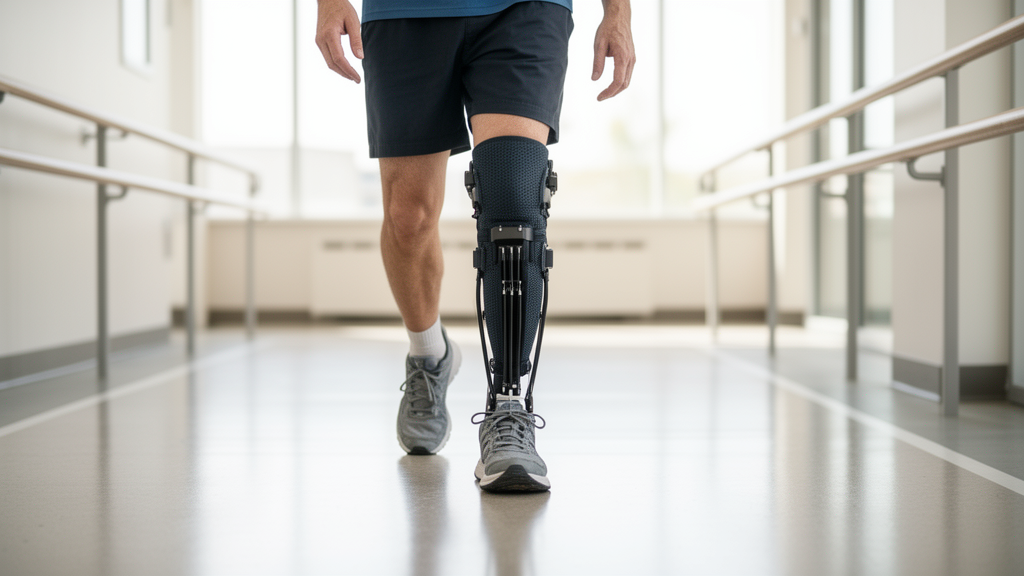
A lightweight, cable-driven soft ankle exoskeleton capable of providing simultaneous assistance across two anatomical planes can partially correct dropfoot gait impairments and improve step symmetry in individuals recovering from chronic stroke, according to a clinical feasibility study published in Wearable Technologies. Dropfoot is an enduring and widespread secondary complication following a stroke, characterized by an impaired ability to lift and control the foot during locomotion due to muscular weakness and pathological motor control. The condition is frequently exacerbated by involuntary ankle inversion arising from spasticity in the tibialis posterior muscle, creating instability and a severe risk of dragging the paretic foot or tripping over floor obstacles. Emerging active robotic exoskeletons have sought to restore mobility, yet rigid powered variants often suffer from mechanical joint misalignment and suppress voluntary muscular engagement. To address these functional shortcomings, researchers evaluated a novel dual-cable soft exoskeleton designed to provide coordinated assistive torques that actively elevate and stabilize the foot during walking.
The experimental trial was conducted at the Promobilia MoveAbility Lab at the KTH Royal Institute of Technology in Stockholm, following ethical approval granted by the Swedish Ethical Review Authority. The researchers recruited five adult participants in the chronic stage of stroke, comprising two men and three women with a median age of 46 years, ranging between 42 and 58 years, a median body mass of 93 kilograms, and a median height of 168 centimeters. Eligible volunteers were required to be at least one year post-stroke, exhibit impaired dorsiflexion, and possess the functional capacity to walk independently without manual support or a wheeled walker. All participants were capable of controlling excessive foot supination on flat terrain when walking in athletic shoes without an orthosis, ensuring a safe testing profile. Prior to gait trials, a licensed physiotherapist conducted rigorous clinical assessments, recording lower-extremity motor recovery and sensory perception via the Fugl-Meyer Assessment, passive ankle ranges of motion with a goniometer at full knee extension, and muscle spasticity of the ankle plantarflexors and supinators using the Modified Ashworth Scale.
The evaluated robotic system relies on an integrated hardware configuration with a total structural weight of 3.6 kilograms, comprising a compact backpack unit, two Bowden cables, an engineered textile calf wrap, and peripheral gait-monitoring sensors. The backpack enclosure houses an actuation assembly driven by two independent ninety-watt brushless direct-current motors fitted with 123-to-one planetary gearboxes, paired with custom three-dimensional printed fourteen-millimeter radius pulleys. An onboard Raspberry Pi 4B microcomputer delivers control signals to dedicated motor drivers, all powered by an integrated twenty-four-volt battery equipped with a step-down converter. Mechanical force transmission is achieved through twin Bowden cables originating at the backpack actuators, guided along the leg through outer sheaths anchored to the calf wrap, and secured directly to bilateral anchor points on the forefoot of standardized footwear. One cable connects to the medial aspect and the other to the lateral aspect of the forefoot, allowing the system to exert up to 396 newtons of linear retraction force per cable to dynamically rotate the ankle.
To coordinate assistive timing with human locomotion, the engineering team implemented a hierarchical three-level control framework operating across distinct sensing and execution layers. The high-level supervisory controller detects real-time transitions between stance and swing phases using input transmitted over TCP and IP protocols from an in-shoe foot switch containing four pressure transducers attached beneath the paretic foot. The mid-level controller incorporates a dual-mode structure consisting of an assistive torque profile generator active during swing and a force-free controller active during stance. The profile generator dictates overall dorsiflexion torque magnitude as well as a differential torque ratio between the lateral and medial motors, specifically modulating frontal plane foot eversion and inversion. Swing duration was continuously estimated from the mean duration of the participant’s preceding three strides, with torque ramp ascent and descent profiles each occupying approximately twenty-five percent of the total swing window. The low-level controller tracks these profiles within the motor drivers, while serial load cells provide continuous feedback to cancel inherent cable friction and actuator inertia during pre-swing.
Biomechanical data were acquired within a dedicated ten-meter walkway laboratory using a ten-camera motion capture system operating at one hundred hertz to track forty-three retroreflective markers placed on bony landmarks in accordance with the CGM 2.4 kinematic model. Neuromuscular activity was captured concurrently using a wireless surface electromyography sensor placed over the tibialis anterior muscle of the paretic limb in line with standardized SENIAM placement guidelines. All participants completed walking trials at self-selected, preferred walking speeds wearing standardized unisex running shoes under four distinct experimental conditions. The protocol established a baseline walking state with shoes alone, followed by a thirty-minute familiarization walking session with the powered exoskeleton to facilitate natural accommodation without coaching. The participants were then evaluated while wearing the exoskeleton in an unpowered condition with slackened transmission cables to isolate the structural mass penalty, and finally under fully active powered assistance across ten parameterized torque profiles ranging from 45 to 69 newton-millimeters per kilogram with rest periods between walking bouts.
Kinematic evaluation revealed substantial improvements in swing phase foot clearance and ankle trajectory under the powered exoskeleton condition when contrasted with walking in shoes alone. Peak ankle dorsiflexion during swing increased by a statistically significant median of 4.4 degrees, with individual patient improvements spanning from 1.1 to 5.9 degrees, comfortably exceeding the established minimal detectable change threshold of 0.9 degrees for stroke populations. Concurrently, vertical foot clearance height measured at the fifth metatarsal head marker increased by a median of 16.8 millimeters, exhibiting a range between 9.2 and 20.6 millimeters across the cohort. Frontal plane control was similarly demonstrated, as maximum ankle inversion during swing decreased notably among the three participants who presented with the highest degree of baseline inversion when wearing shoes alone, while remaining largely stable in the remaining two participants. Meanwhile, surface electromyography recordings revealed only minor, non-significant fluctuations in mean normalized tibialis anterior muscle activity across all conditions, indicating that robotic assistance did not induce neuromuscular silence or passive dependency.
Kinematic benefits extended directly into the initial contact phase, establishing a safer and more functionally advantageous limb posture at the moment of heel touchdown. When walking with active robotic assistance, the participants exhibited an average increase in foot-to-floor inclination angle of 3.0 degrees, ranging from 0.2 to 8.6 degrees, while ankle dorsiflexion angle at touchdown demonstrated a median enhancement of 5.9 degrees, spanning from 1.1 to 13.9 degrees. These combined angular shifts effectively facilitated the restoration of heel rocker mechanics, which were visibly restored in two individuals whose baseline gait lacked proper initial heel strikes. Excessive ankle inversion at touchdown was also neutralized in the three individuals who suffered from pronounced frontal plane malalignment at baseline. In contrast, trials conducted with the unpowered exoskeleton demonstrated that passive structural mass and interface components did not induce meaningful alterations in joint angles or swing clearance, confirming that observed kinematic corrections were driven entirely by active robotic torque transmission rather than altered walking mechanics from wearing the physical apparatus.
Beyond localized joint kinematics at the ankle and foot, active assistance elicited positive systemic adaptations across the entire gait pattern, as evidenced by a marked reduction in bilateral step length asymmetry. Step length asymmetry index values, calculated as the absolute difference between paretic and nonparetic step lengths normalized to their average value, decreased significantly across all five participants by a median reduction of 4.8 percentage points, with individual decreases ranging between 3.8 and 10.3 percentage points compared to walking in shoes alone.
Subjective usability and participant-reported experiences were evaluated through two standardized instruments: the validated Quebec User Evaluation of Satisfaction with Assistive Technology questionnaire and a customized study-specific inquiry. Across the Quebec satisfaction scale, participants reported an overall mean score of 3.88 out of five, reflecting clear positive satisfaction with the system. Domain-specific medians were consistently high, with device weight, stability and security, mechanical effectiveness, and overall comfort each receiving median scores of four, while device dimensions were rated neutrally at a median score of three. On the study-specific questionnaire, participants recorded favorable median ratings of zero on ten-point scales measuring pain, skin irritation, and general physical discomfort, indicating high tolerance during walking. However, one participant reported localized discomfort, attributing it to concentrated pressure from the textile calf wrap exacerbated by the surface electromyography sensor situated underneath. Overall perceived walking ease scored neutrally at a median of six, while ratings of perceived benefit for the robotic exoskeleton and the participants’ habitual ankle orthoses were closely matched at median scores of eight and seven, respectively.
While these initial experimental findings confirm the technical feasibility and therapeutic potential of biplanar soft robotic assistance, the investigators noted several methodological limitations that temper broader clinical generalization. The feasibility investigation was intentionally restricted to a small cohort of five participants evaluated during a single laboratory visit, and strict enrollment criteria excluded stroke survivors who require walking frames or exhibit severe balance impairments. Furthermore, testing was confined to a level, obstruction-free laboratory walkway, which cannot replicate the complex environmental demands, variable walking cadences, and irregular terrains encountered during community ambulation. The investigators also acknowledged that a slight reduction in ankle plantarflexion was observed during the pre-swing phase, resulting from residual mechanical resistance within the Bowden cable drive during push-off.
Subject of Research: Biomechanical feasibility of a dual-actuated soft ankle exoskeleton for correcting post-stroke dropfoot and inversion gait deviations
Article Title: Feasibility of a new soft ankle exoskeleton on people with dropfoot post-stroke
Article References: Zhang, X., Fredriksen, A., Gutierrez-Farewik, E. M., & Palmcrantz, S. (2026). Feasibility of a new soft ankle exoskeleton on people with dropfoot post-stroke. Wearable Technologies, 7, Article e7. https://doi.org/10.1017/wtc.2026.10043
Image Credits: AI Generated
Keywords: stroke rehabilitation, soft exoskeleton, dropfoot gait, ankle kinematics, assistive technology, cable-driven robotics, dorsiflexion, ankle inversion, foot clearance, step length asymmetry, wearable robotics, biomechanics, QUEST 2.0, tibialis anterior, gait analysis, rehabilitation engineering
News Source: Denise Maddox. (November 23, 2026). Soft Robotic Ankle Exoskeleton Corrects Post-Stroke Dropfoot in Five-Person Feasibility Study. Scienmag.