A novel tablet-based neurocognitive assessment designed around dynamic soccer video clips demonstrated marked stability across repeated administrations, showing minimal vulnerability to the practice effects that routinely complicate baseline concussion testing in sports medicine. Investigating the prototype tool known as SENIC, an acronym for Simulation ENgageante Immersive et Cognitive, researchers from Université Laval in Canada and Cardiff Metropolitan University in the United Kingdom tracked competitive soccer players over multiple testing sessions across an athletic season. Their findings revealed that key performance markers, specifically stimulus detection accuracy, false alarm rates, and response times, remained remarkably steady across three to five testing intervals. Because conventional baseline concussion batteries frequently suffer from artificial score inflation as athletes become familiar with testing environments and procedural routines, this demonstrated stability offers a promising technological pathway for clinicians seeking dependable pre-injury reference points against which future traumatic brain injuries can be objectively evaluated.
Sport-related concussions represent an enduring public health challenge across competitive youth and amateur athletics, with published epidemiological surveillance indicating an estimated 4.36 concussive incidents per 1000 player hours across seven collision-heavy sporting disciplines. When athletes sustain impacts to the head, clinical management often depends on cognitive baseline evaluations to guide critical return-to-play decisions. Because players and team coaches often under-report subjective neurological symptoms to hasten a return to competition, standardized neuropsychological testing provides clinicians with an objective diagnostic anchor. In standard clinical protocols, an athlete whose post-injury cognitive scores match their established pre-season baseline is generally presumed to have experienced symptom resolution, whereas suppressed scores signal persistent neurological dysfunction. However, repeated administrations of traditional neurocognitive batteries introduce substantial confounding variables, most notably the practice effect, in which an individual athlete improves performance simply through repeated exposures to identical or similar test items, testing environments, procedural memory, or statistical regression toward the mean.
When practice effects artificially elevate test scores over time, they present a profound clinical hazard by potentially masking or canceling out subtle cognitive impairments caused by an actual concussive event. Longitudinal evaluations of widely used neuropsychological batteries have shown that performance improvements can persist for up to three months across repeated testing before reaching a plateau. Even established commercial computerized platforms, such as the Immediate Post-Concussion Assessment and Cognitive Testing system known as ImPACT, exhibit documented learning trajectories, particularly across their visual and verbal memory modules where test scores have been documented to rise significantly across multiple successive testing sessions spaced several months apart. Compounding this challenge is the widespread clinical phenomenon of sandbagging, wherein competitive athletes intentionally depress their baseline scores during pre-season screening so that any subsequent post-injury deficits will go unnoticed during clinical evaluations. While self-reported intentional underperformance among collegiate athletes is estimated at around six percent, failure rates on embedded computerized validity indicators fluctuate between six and forty-eight percent, and experimental trials demonstrate that approximately twenty percent of participants instructed to underperform evade detection.
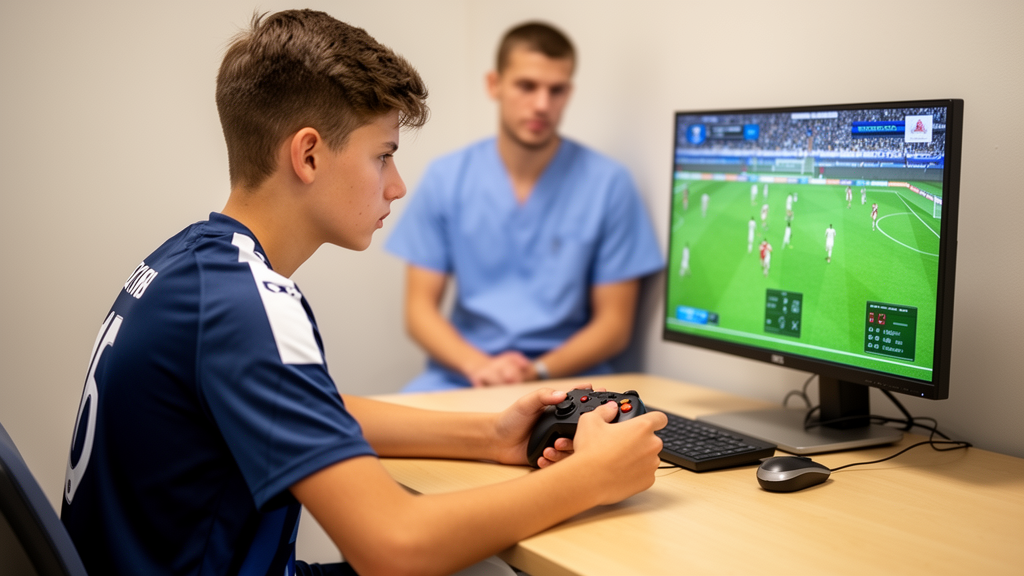
To overcome both test-retest learning improvements and deliberate underperformance, the research team investigated SENIC as an ecologically grounded prototype that embeds neurocognitive assessment within the visual environment of the athlete’s specific sport. Developed in direct collaboration with sporting stakeholders, the SENIC tool presents participants with video recordings of competitive soccer matches, challenging them to detect rapid transitions in ball possession between teams and immediately tap the touch-sensitive screen at the precise spatial location where the exchange occurs. Prior neuropsychological research has identified response time as a particularly sensitive behavioral index of concussion-related impairment, reflecting not merely basic motor execution speed but also the coordinated efficiency of perceptual, attentional, and decisional networks that are exceptionally vulnerable to concussive trauma. By utilizing an extensive repository of dynamic video sequences selected at random rather than static memory items, SENIC was structured to minimize item memorization while presenting a realistic, fast-paced visuospatial task that makes deliberate score manipulation substantially more difficult to execute convincingly.
The experimental study evaluated a cohort of 107 competitive soccer players comprising 39 male and 68 female athletes, with an overall mean age of 17.56 years, a standard deviation of 3.10 years, and an age range spanning from 13 to 26 years. The participant sample drew from competitive high school and collegiate institutions, including Division 1 and Division 2 programs within the Quebec student sports network, known as the Réseau du sport étudiant du Québec, as well as elite varsity university competitors representing the Rouge et Or program at Université Laval. All participating athletes were actively competing at a highly trained or national level during the investigation. Before formal enrollment, prospective participants underwent structured self-report screening to exclude individuals with attention-deficit/hyperactivity disorder, pre-existing neurological conditions, an active concussion at the time of enrollment, or any concussive recovery within the preceding three months, and none had prior familiarity with the SENIC assessment platform.
Data collection took place across the autumn 2019 and winter 2020 competitive semesters under an ethics protocol approved by the Human Research Ethics Committee of Université Laval. The software was deployed on sixth-generation iPad tablets equipped with 9.7-inch displays, maintaining strict hardware and operating system uniformity across every administration site. Before each formal testing trial, participants read standardized instructions, completed an interactive software tutorial, and undertook a two-minute practice trial accompanied by performance feedback to ensure task comprehension and offset initial environmental familiarization. The formal testing protocol lasted 12 minutes and presented 45 distinct video sequences drawn randomly from a larger bank of 150 clips previously verified by investigators for reliable possession detection. Each video clip contained between zero and four ball possession transitions, and two research assistants supervised each testing session to ensure participant silence and address technical questions, with athletes receiving immediate terminal feedback regarding their detection percentage, false alarm frequency, and median response time.
Although the original protocol aimed for each athlete to complete five distinct testing sessions spaced approximately two weeks apart over an 8-to-13-week athletic schedule, external circumstances including athletic scheduling conflicts, physical injuries, and the societal emergence of the COVID-19 pandemic truncated sample sizes across later sessions. Overall, 103 athletes successfully completed three sessions, comprising 39 males and 64 females with a mean age of 17.50 years; 40 participants completed four sessions, comprising 12 males and 28 females with a mean age of 19.45 years; and 27 participants completed all five scheduled sessions, consisting entirely of female athletes with a mean age of 19.93 years. Before formal statistical analysis, data from three participants were excluded because their detection rates or false alarm counts were identified as statistical outliers using Tukey’s method of three times the interquartile range beyond the quartiles, indicating an inadequate understanding of the task mechanics during testing.
Statistical evaluation using mixed-effects regression models implemented in R version 4.5.1 confirmed high performance stability across the repeated sessions. A linear mixed-effects model examining detection accuracy revealed no statistically significant effect of session across testing, with estimated marginal means demonstrating stability from 71.26 percent in the first session to 73.52 percent in the second, 72.38 percent in the third, 73.32 percent in the fourth, and 72.08 percent in the fifth session. Age emerged as a statistically significant predictor of detection accuracy, with older athletes exhibiting superior target identification, whereas sex demonstrated no significant influence on accuracy. A generalized linear mixed-effects model applying a negative binomial distribution to false alarms revealed a statistically significant omnibus session effect, with marginal means declining from 15.00 false alarms in the initial session to 13.60, 13.50, 13.20, and 13.10 across subsequent administrations, though no pairwise differences remained significant following Bonferroni correction. Age significantly predicted lower false alarm rates, while female players recorded higher overall false alarm frequencies than male peers.
Analysis of log-transformed response times revealed a significant overall session effect in linear mixed-effects modeling, characterized by marginal means showing slightly accelerated responses during the second session and marginally slower latencies during the fifth session, with estimated values of 6.04 on the logarithmic scale in session one, 5.99 in session two, 6.04 in sessions three and four, and 6.14 in session five. Bonferroni-adjusted pairwise comparisons indicated that responses in session five were significantly slower than in session two, whereas no other session comparisons achieved statistical significance, and neither chronological age nor biological sex significantly predicted response speed. The authors noted that the slight slowing observed in the fifth session occurred within a smaller, exclusively female subsample and might reflect diminished psychological engagement or subtle task fatigue following repeated bi-weekly exposures, underscoring the clinical importance of balancing pre-season baseline verification against athlete apathy.
Despite strong group-level stability across repeated assessments, test-retest reliability estimated through intraclass correlation coefficients remained moderate across the battery. Intraclass correlation coefficients derived from linear mixed-effects models were 0.51 for detection accuracy, 0.47 for false alarms, and 0.55 for response time, aligning closely with the 0.28 to 0.74 range commonly documented for conventional concussion tools while falling short of the strict reliability thresholds typically demanded for high-stakes individual diagnostic decisions. The investigators noted that sample homogeneity among highly trained competitive athletes naturally depresses intraclass correlation estimates by narrowing between-subject variance. Consequently, clinical adoption will likely require averaging multiple pre-season testing sessions to establish stable personal baselines, while future research must validate the tool in concussed cohorts, explore tablet latency differences across platforms, and test potential software expansions incorporating working memory rules, inhibitory response demands, and integrated eye-tracking metrics.
Subject of Research: Test-retest stability of the SENIC neurocognitive task for baseline concussion assessment in soccer players
Article Title: Test-retest stability of a sport-specific neurocognitive task in soccer players: implications for baseline concussion assessment
Article References: Croteau, C., Hodgetts, H. M., Chamberland, C., & Tremblay, S. (2026). Test-retest stability of a sport-specific neurocognitive task in soccer players: implications for baseline concussion assessment. Frontiers in Sports and Active Living, 8, Article 1985768. https://doi.org/10.3389/fspor.2026.1985768
Image Credits: AI Generated
DOI: 10.3389/fspor.2026.1985768
Keywords: sports concussion, neurocognitive assessment, SENIC, baseline testing, practice effect, sandbagging, test-retest reliability, soccer players, response time, detection accuracy, false alarms, intraclass correlation, Université Laval, sports medicine, injury prevention, cognitive evaluation, computerized testing, return to play
News Source: Ophelia Keating. (November 12, 2026). Soccer Video Simulation Shows Stable Performance Across Repeated Baseline Concussion Testing. Scienmag.