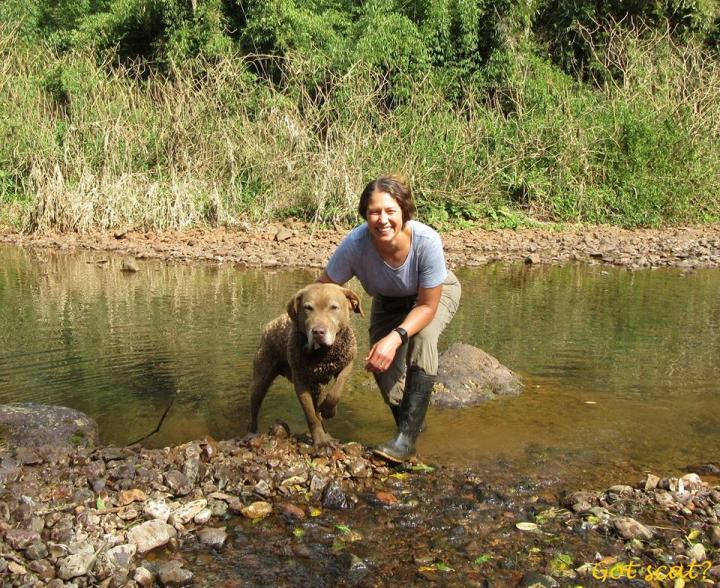
Credit: Courtesy of Karen DeMatteo/Washington University
A new study in the journal Scientific Reports gets to the bottom of it: Why do dogs that are trained to locate poop sometimes find the wrong kind of poop?
It happens anywhere from 4 percent to 45 percent of the time, said Karen DeMatteo, a biologist in Arts & Sciences at Washington University in St. Louis. Her new research confirms that there are three viable, alternative explanations beyond errors in handler or dog training that can explain the collection of non-target scats with detection dogs in some ecosystems.
Detection dogs are trained to use scent, not their eyes, to locate specific kinds of scat. They're useful partners in conservation projects as an alternative to camera photo traps or other more invasive means of identifying which individual animals are present in an area.
And while finding the wrong kind of poop doesn't ultimately muck up research results — researchers who use scat to track animals usually use DNA tests to confirm the identity of target and non-target evacuators — collecting and testing false positives costs a project time and resources.
"To date, when non-target samples are found in detection dog studies, it is assumed it may be due to errors in detection dog or handler training; however, our study determined that this is not always the case," DeMatteo said. "Instead, the complexity of ecosystems where a study is conducted can affect the perceived accuracy of detection dog studies because the natural behaviors of non-target species, like coyotes in our study, can alter the genetic profile of target scat, like that from a puma."
In her own work, DeMatteo has successfully used scat-detection dogs to identify the routes traveled by endangered pumas and other reclusive carnivores along a biologically important corridor in Argentina.
Detection dogs are great at determining the presence of specific animals because they can find droppings hidden in grass, droppings that have been rained on and disintegrated into the mud — or even droppings that have been eaten and then recycled.
Yes, that's right, and it's a normal part of life for many animals, DeMatteo said.
"Humans have a natural aversion to coprophagy, which is reflected in the visual horror on an owner's face when they see their dog gobble down their own scat or the scat of another dog or cat," DeMatteo said. "Once this shock subsides, the owner typically worries that the scat will cause health problems or there is something psychologically wrong with their four-legged friend."
"While the reasons underlying coprophagy in domestic dogs are still fuzzy, it is known in wild canids that coprophagy is natural and is often associated with territoriality or nutritional benefits," she said. "So while the finding that coyotes will consume puma scat is novel and has various ecological implications, coprophagy occurs naturally under a variety of circumstances."
The tendency of one animal to eat another's scat is one of three behaviors that might alter the type of scat, or the state of the scat, that a detector dog might encounter, and thus affect the perceived accuracy of the technique.
Researchers also considered how urine-marking by non-target species might affect a detector dog's ability to locate scat from a species of interest, and also what happens if one animal picks up another's scat and moves it using its mouth, potentially bringing it into contact with saliva. Field trials were conducted in the St. Louis area and in northwest Nebraska.
The researchers found that each of the proposed behaviors alters the genetic profile of the scat in question, and all were confirmed to play a role in the detection dog indicating on non-target scats.
The pool of conservation-trained detection dogs is constantly growing in number, as are the types of target species and the areas where they are being used, DeMatteo said. One of the continuing questions surrounding their use for these types of projects is how to maintain a high quality standard for training detection dogs and their handlers.
"In reality, the dog is easier to train then the handler, with the latter having a higher chance of introducing error," DeMatteo said. "Even with these variables, these results are extendable to other dog-handler teams with less experience, as long as consistency is used."
While this study, "How behavior of nontarget species affects perceived accuracy of scat detection dog surveys," demonstrates that there are alternative explanations for why dogs sometimes collect non-target samples, it also shines a light on behaviors that humans may not understand — but that could play a role in ecosystem functioning.
"Genetic testing can eliminate these samples and maintain accuracy in the [detection dog-assisted] studies," DeMatteo said. "However, this non-target interaction with target scat potentially has important implications for other ecological questions, including parasite/disease transmission, zoonotic diseases and general health of wild populations."
###
Media Contact
Talia Ogliore
[email protected]
314-935-2919
@WUSTLnews