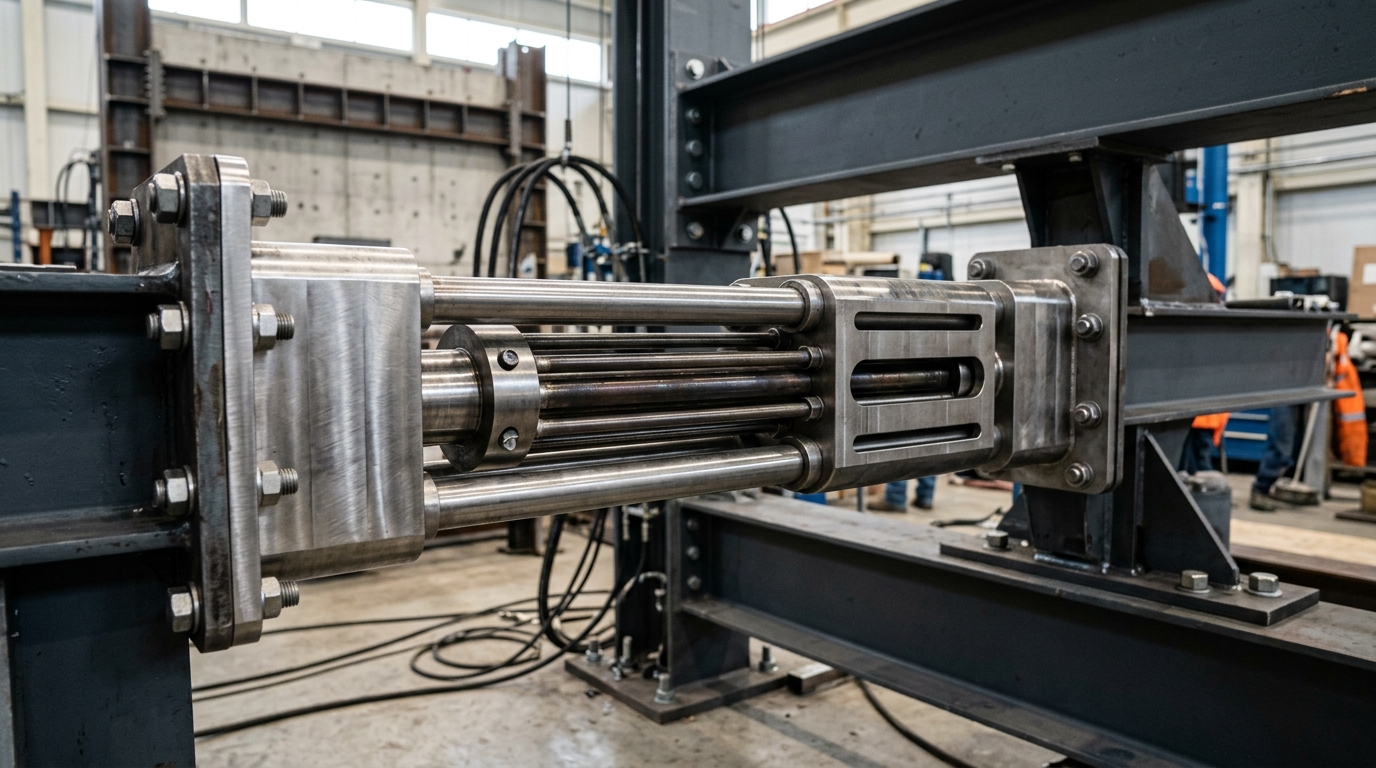
Civil engineers evaluating post-earthquake structural resilience have demonstrated that an innovative smart damper device fabricated from superelastic nickel-titanium shape memory alloys and polyurethane springs successfully sustains repeated cyclic loading without requiring post-disaster replacement. Traditional seismic vibration control systems, which rely on conventional structural steel components to absorb destructive ground motions, frequently experience severe plastic deformation and yielding during major tremors, necessitating costly maintenance, component renewal, or complete device replacement. To overcome these critical structural vulnerabilities, researchers designed, assembled, and experimentally tested a compact member-level damper capable of maintaining mechanical integrity and functional self-centering capacity after exposure to intense seismic events. Through controlled uniaxial cyclic compression experiments, the experimental smart damper demonstrated substantial energy dissipation capacity alongside remarkable elastic restoring forces when evaluated against an identical device manufactured from standard structural steel. The experimental findings indicate that integrating phase-transforming superelastic alloy plates with durable polyurethane elastic restoration elements provides a resilient, sustainable alternative for mitigating structural damage across modern civil engineering infrastructure.
The development of advanced vibration mitigation technology addresses a documented escalation in seismic risk across regions historically characterized by moderate ground motion activity, particularly South Korea. Meteorological records compiled between 1978 and 1998 documented an annual regional average of only 19.1 earthquakes, whereas data spanning 1999 through 2023 revealed a pronounced surge to an annual average of 72.2 seismic occurrences. Damaging high-magnitude events centered near Gyeongju and Pohang highlighted that vulnerable civil infrastructure requires robust protective interventions against catastrophic failures. Although South Korea established mandatory seismic design standards in 1988 and subsequently enacted continuous regulatory updates for new construction, extensive inventories of older buildings and bridges constructed prior to these stringent codes remain unreinforced and acutely susceptible to dynamic seismic forces. Installing energy-dissipating damper devices within structural brace frames offers a practical and cost-effective retrofitting strategy across existing buildings regardless of structural height. However, conventional dampers frequently sacrifice their own structural members to safeguard primary columns and beams, triggering substantial post-event maintenance expenses.
At the core of the experimental smart damper device is a superelastic nickel-titanium alloy, commonly known as Nitinol, selected for its extraordinary ability to recover completely from substantial plastic deformations beyond normal elastic yield limits. Unlike conventional shape memory alloys manufactured with copper or iron bases, which provide economic advantages but exhibit inferior strain recovery and compromised cyclic fatigue life, nickel-titanium systems offer superior superelasticity, exceptional cyclic stability, and robust corrosion resistance. The alloy operates through reversible, stress-induced solid-state phase transformations occurring between parent austenite and deformed martensite crystal lattices. In its austenite state, the material exhibits high mechanical resistance to applied stress; when subjected to elevated external loading, it transforms into martensite, allowing large mechanical deformations. Upon complete load removal, provided the ambient operating temperature remains above the material’s specific austenite finish temperature, the alloy spontaneously reverts to its original austenitic crystalline structure. By selecting an alloy with an austenite finish temperature near or below ambient laboratory conditions, the investigators ensured consistent superelastic restoring behavior throughout physical testing.
To complement the superelastic recovery of the shape memory alloy plates and maximize hysteretic energy dissipation, the experimental device incorporates specialized polyurethane springs. Conventional vibration dampers and isolation mounts predominantly employ metallic helical steel springs to provide predictable linear restoring stiffness, but steel components remain perpetually vulnerable to environmental corrosion, structural fatigue, and sudden mechanical fracture under sustained dynamic operations. In contrast, solid polyurethane springs deliver exceptional volumetric durability, substantial compressive strength, and robust tensile resilience under severe repeated cyclic loading regimes. Furthermore, polyurethane structures feature superior cross-sectional rigidity and exhibit strong natural resistance to adverse environmental degradation, ensuring prolonged functional reliability in demanding structural environments. Within the assembled damper housing, the polyurethane springs act in concert with the superelastic alloy plates, absorbing compressive stresses and storing mechanical strain energy that assists in driving the moving damper assembly back toward its neutral resting position once dynamic seismic displacements subside.
The structural architecture of the smart damper utilizes an approximate design scheme where external frame elements serve primarily to guide motion, ensuring applied external forces are channeled directly into the active material specimens. Central vertical displacements are governed by an internal high-strength steel rod aligned along the longitudinal axis of the damper housing. Repetitive cyclic loads act relative to a designated central neutral axis, generating alternating tension and compression states across the internal working components. During downward displacement cycles, the plate-type shape memory alloy specimens progressively elongate below the neutral axis, while the opposing polyurethane springs undergo significant vertical compression until appearing visibly flattened. As displacement peaks and the mechanical drive reverses toward the neutral axis, the combined restoring actions of the elongating alloy plates and compressed polyurethane springs generate rapid recentering forces. When kinematic momentum pushes the device upward beyond the neutral axis, internal mechanical stress distributions seamlessly reverse, producing balanced bidirectional counteracting forces.
To rigorously quantify operational performance, the research team installed the smart damper within an advanced uniaxial compression cyclic testing apparatus, applying controlled vertical loading histories. Displacement-controlled loading proceeded at an actuator speed of 0.33 millimeters per second, subjecting the internal shape memory alloy plates to progressively expanding cyclic displacements that culminated at a maximum tensile strain threshold of 8 percent. For direct comparative benchmarking, the investigators fabricated and evaluated an identical control damper utilizing standard structural steel specimens configured with matching physical dimensions and geometry. Both damper configurations underwent identical loading protocols, allowing direct evaluation of continuous load-displacement hysteretic loops, energy absorption capacities, peak force limits, and cyclic degradation profiles across repeated loading sequences. By enforcing identical boundary conditions, instrumentation rates, and geometric constraints between the superelastic and steel damper assemblies, the experimental protocol isolated the specific mechanical influence of the smart materials under severe cyclic conditions.
Experimental force-displacement data revealed distinct mechanical behaviors between the smart device and the conventional structural steel baseline under full cyclic loading histories. Analysis of the primary load-displacement hysteretic curve for the smart damper demonstrated a peak tensile resistance of 344.89 kilonewtons in the first quadrant, where pre-compression occurred relative to the neutral axis. In the opposite direction, corresponding to third-quadrant compression and subsequent unloading recovery, the smart damper recorded a minimum load value of negative 310.46 kilonewtons. These nearly symmetrical peak magnitudes confirmed that the smart damper maintained balanced bidirectional resistance and smooth kinematic transitions about its central neutral axis. Conversely, the structural steel damper attained a maximum first-quadrant load of 377.49 kilonewtons and a minimum third-quadrant load of negative 340.07 kilonewtons. Although the steel damper initially sustained marginally higher peak loads, its hysteretic profile revealed pronounced geometric asymmetry, consistently failing to reach equivalent resistance values across opposing loading trajectories.
Detailed cyclic evaluations across three consecutive loading repetitions at a fixed displacement amplitude further underscored the operational superiority of the superelastic smart assembly over structural steel. Across repeated cycles at identical displacement limits, the smart damper exhibited exceptional cycle-to-cycle repeatability, maintaining nearly identical peak forces, stable hysteretic loop areas, and consistent energy dissipation in both directions. In sharp contrast, the conventional steel damper demonstrated severe cyclic instability: its highest absolute load resistance occurred solely during the initial loading cycle, followed by steep performance degradation across the second and third repetitions. Because the structural steel specimens experienced irreversible plastic yielding during early cycle excursions, the steel damper suffered significant stiffness loss and progressive load degradation under repeated deformations. This pronounced inability to maintain load-carrying capacity across successive cycles indicates that conventional steel yielding dampers are fundamentally ill-suited for sustaining the extended multi-cycle ground motions typical of complex seismic events.
Post-test physical disassemblies and residual displacement analyses highlighted stark contrasts in post-event serviceability between the two tested damper systems. When the smart damper was disassembled following cyclic testing, the superelastic shape memory alloy plates completely preserved their original unbent geometry, exhibiting zero permanent plastic deformation, while the polyurethane springs fully regained their initial uncompressed physical dimensions. The minor residual displacements recorded in the smart damper assembly were traced directly to Coulomb friction generated at connecting bolt interfaces, governed by clamping forces and the static friction coefficient, rather than internal material damage. In dramatic contrast, disassembling the conventional steel damper revealed extensive, irreversible plastic deformation concentrated around circular bolt holes within the steel specimens. This structural damage prevented the steel damper from re-establishing its neutral axis equilibrium, resulting in substantial permanent residual displacement that would necessitate complete device replacement in real-world infrastructure installations.
During high-amplitude cyclic excursions approaching the 8 percent maximum recoverable strain limit, the smart damper exhibited a noticeable plateau effect characterized by the gradual flattening of its hysteretic load-displacement curves. The investigators determined that this behavior stems from intrinsic material phenomena in superelastic nickel-titanium alloys, specifically cyclic upper plateau stress degradation and transformation saturation under high-strain repetitive cycles, rather than structural failure or instrumentation discrepancies. While structural steel remains less expensive to source, configuring steel plates within elastic limits requires dramatically bulkier assemblies, whereas post-yield structural damage incurs expensive replacement operations. Superelastic alloys involve higher upfront material and processing costs, yet their exceptional self-centering capacity and fatigue endurance offer profound structural maintenance efficiencies. By mitigating bolt interface friction through optimized mechanical connections, civil engineers can deploy smart shape memory dampers as highly sustainable retrofits for aging structures exposed to recurring seismic hazards.
Subject of Research: Seismic performance evaluation of a superelastic shape memory alloy and polyurethane smart damper under cyclic loading
Article Title: Performance evaluation of a smart damper device under cyclic loading for structural maintenance
Article References: Cho, H.-M., Kang, M.-S., Jung, K.-S., & Park, K.-T. (2026). Performance evaluation of a smart damper device under cyclic loading for structural maintenance. Asian Journal of Civil Engineering, 27(11), 5239-5248. https://doi.org/10.1007/s42107-026-01767-8
Image Credits: AI Generated
DOI: 10.1007/s42107-026-01767-8
Keywords: shape memory alloys, smart damper device, structural vibration control, cyclic loading, superelasticity, nickel titanium, polyurethane springs, seismic retrofitting, earthquake engineering, energy dissipation, self-centering systems, residual displacement, structural maintenance, austenite phase, martensitic transformation, load displacement response, Coulomb friction
News Source: Denise Maddox. (November 23, 2026). Smart Shape Memory Alloy Damper Sustains Cyclic Seismic Loads Without Replacement. Scienmag.