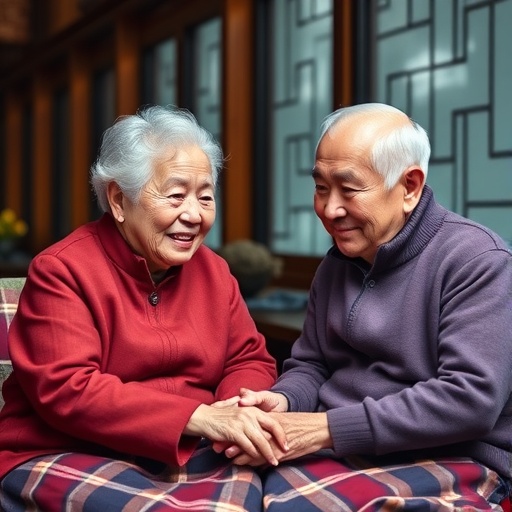
In an era marked by rapid technological advancement and an aging global population, the intersection of smart elderly care and subjective well-being has become a pivotal area of research. A recent study conducted by Huang, Chen, Zhou, and colleagues delves deeply into this relationship, exploring how modern smart care solutions influence the well-being of older adults in China. This investigation not only sheds light on the direct effects of smart elderly care but also highlights the nuanced mediating roles played by health status and social engagement. The findings resonate far beyond the borders of China, providing critical insights for geriatric care models worldwide.
The demographic shift towards an older population represents a universal phenomenon, and China, with its vast elderly community, epitomizes this challenge. Smart elderly care, which integrates cutting-edge technologies like Internet of Things (IoT) devices, mobile health applications, and AI-driven monitoring systems, is increasingly being adopted to address the complex needs of this group. These technologies offer unprecedented opportunities to enhance safety, promote independence, and improve health management among seniors. Yet, the direct impact of these innovations on individuals’ subjective well-being — their personal assessment of happiness and life satisfaction — remains insufficiently understood.
Huang and colleagues approach this knowledge gap by formulating a comprehensive framework that accounts for both direct and indirect pathways through which smart elderly care affects well-being. The study operationalizes subjective well-being as a multifaceted construct encompassing emotional, cognitive, and social dimensions, moving beyond simplistic health outcomes. The researchers posit that smart care’s influence operates significantly through enhancing physical health and fostering active social participation, thereby mediating the overall quality of life for older adults.
Data collection involved a large-scale survey of elderly participants across diverse regions of China, reflecting an encompassing demographic profile. This robust dataset enabled detailed statistical analyses, including structural equation modeling, designed to elucidate the complex interactions among variables. Crucially, health status and social activities were treated not merely as confounding factors but as active mediators, providing a sophisticated understanding of how smart care interventions cascade into subjective well-being improvements.
Health status emerged as a critical mediator in the study’s findings. Elderly individuals engaged with smart care technologies reported better management of chronic conditions, improved mobility, and enhanced self-care abilities. These health improvements were, in turn, strongly correlated with elevated levels of subjective well-being. Such evidence underscores the transformative potential of integrating health monitoring devices and telemedicine into elderly care paradigms, fostering not only physical resilience but psychological contentment.
Equally compelling was the mediating role of social activities in shaping well-being outcomes. The study reveals that smart elderly care facilitates greater social engagement by mitigating barriers such as mobility limitations and geographic isolation. Technologies enabling virtual communication, social networking, and community involvement amplified social connectedness among older adults. The restoration or enhancement of social ties appeared to significantly ameliorate feelings of loneliness and isolation, key predictors of subjective well-being in geriatric populations.
The researchers also meticulously examined the bidirectional interplay between health and social participation. Improved health enabled more robust social activity, which in turn reinforced positive health behaviors and mental health outcomes. This feedback loop suggests that smart elderly care’s benefits extend holistically across multiple dimensions of life, advocating for integrated care solutions that address both physical and social determinants of well-being.
Importantly, the study addresses the typically overlooked heterogeneity within the elderly population. Differential impacts of smart care were noted among subgroups characterized by age, gender, education, and urban versus rural residency. For instance, older adults in urban areas benefitted more noticeably from smart care in terms of social activities, likely reflecting better infrastructure and technology access. This nuanced insight directs policymakers and practitioners toward more tailored approaches that consider demographic variability in care delivery.
Technological sophistication notwithstanding, the adoption of smart elderly care is contingent upon user acceptance and digital literacy. The authors emphasize the importance of designing user-friendly interfaces and providing training to mitigate the “digital divide” prevalent among older populations. Furthermore, privacy and data security considerations are paramount to fostering trust and sustained engagement with these technologies, aspects critically discussed in the study’s technical framework.
The implications of this research extend into public health strategy and the economics of elderly care. By highlighting subjective well-being as a vital outcome alongside traditional health metrics, the study advocates for broader evaluative criteria in care effectiveness. Investments in smart care technologies can yield dividends not only in reduced healthcare costs but also in enhanced life satisfaction, signaling a paradigm shift in how success is measured in geriatric care.
From a technological innovation perspective, the findings encourage the development of integrated smart care ecosystems. These systems should combine health monitoring, social connectivity, cognitive stimulation, and personalized feedback to optimize user experience and well-being. The research provides empirical backing for multidisciplinary collaborations involving engineers, healthcare providers, social scientists, and policymakers to design holistic, user-centered elderly care solutions.
In conclusion, the research by Huang et al. offers a sophisticated, evidence-based narrative on the transformative potential of smart elderly care in enhancing subjective well-being among older adults in China. The dual mediating roles of health status and social activity articulate a comprehensive mechanism through which technology can positively influence aging experiences. As societies globally grapple with demographic aging, these insights provide a critical roadmap for integrating smart care into the fabric of eldercare strategies, promising not just longer lives, but better, more fulfilling ones.
This study not only broadens our theoretical understanding but also poses actionable directives for technological implementation and policy formulation. Prioritizing health improvement and social engagement ensures that smart care efforts resonate authentically with older individuals’ lived realities. The convergence of technology and holistic care reflected in this research heralds a promising frontier in nurturing psychological well-being alongside physical health for aging populations worldwide.
The delicate balance of autonomy, connection, and health empowerment highlighted in this research resonates as a blueprint for the future of elderly care. It invites a reimagining of aging, framed by dignity and enriched by intelligent technology. As smart elderly care technologies continue to evolve, research such as this will remain indispensable in navigating the complexities and opportunities arising at the intersection of human experience and technological innovation.
Subject of Research: The relationship between smart elderly care and subjective well-being among older adults, with a focus on the mediating roles of health status and social activities.
Article Title: The association between smart elderly care and subjective well-being among older adults in China: the mediating roles of health status and social activities.
Article References:
Huang, K., Chen, H., Zhou, J. et al. The association between smart elderly care and subjective well-being among older adults in China: the mediating roles of health status and social activities. BMC Geriatr 26, 827 (2026). https://doi.org/10.1186/s12877-026-07708-z
Image Credits: AI Generated
DOI: https://doi.org/10.1186/s12877-026-07708-z
Tags: AI-driven elderly monitoring systemsgeriatric care models in Asiaglobal insights on smart elderly carehealth status mediation in elderly careimpact of technology on aging populationindependence promotion in elderly careInternet of Things for senior caremobile health applications for elderlysmart elderly care in Chinasocial engagement and senior well-beingsubjective well-being of older adultstechnological solutions for aging challenges