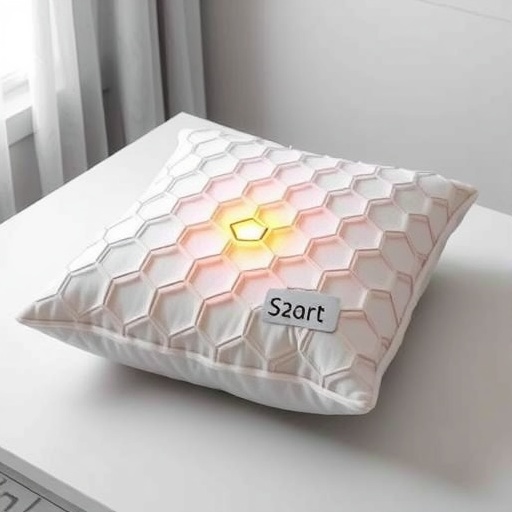
In an era where technology seamlessly intertwines with daily life, the demand for smart, adaptable systems intensifies across diverse sectors, from wearable technology to advanced medical devices. A remarkable breakthrough in this continuum emerges from the collaborative research work of Minamide, Naritomi, Okamoto, and their colleagues, documented in their 2026 publication in npj Flexible Electronics. Their study details an innovative smart cushioning device that marries the marvels of origami-inspired engineering with sophisticated wireless sensing technologies. This integration delivers a multifunctional system that is not only adaptive and responsive but also offers real-time data monitoring through passive wireless communication, setting an ambitious benchmark for next-generation flexible electronics.
At the heart of this pioneering device lies a self-folding origami honeycomb structure. The design draws from centuries-old Japanese paper folding traditions yet adapts these principles using cutting-edge materials and engineering techniques. This honeycomb structure is pivotal because of its exceptional mechanical properties—it offers enhanced deformation control, superior energy absorption, and an inherent ability to revert to its original shape after mechanical stresses. Unlike conventional cushioning materials relying on foams or gels, this origami-based design can dynamically modulate its shape and stiffness, providing tailored cushioning responses appropriate for a range of applications such as impact protection in sports gear or sensitive surface interfaces in prosthetics.
The genius of this design extends beyond mere structural mechanics. The research team’s integration of inductor-capacitor (LC) passive wireless sensors into the cushioning matrix introduces a new dimension of functionality. These sensors are ingeniously embedded within the origami honeycomb, forming a lattice capable of responding to mechanical deformations by altering their electrical characteristics—primarily resonant frequency shifts—as the cushioning device compresses or decompresses. This passive wireless sensing method eliminates the need for batteries or wired connections, enhancing the practicality and durability of the device, particularly in environments where maintenance access is limited or where lightweight form factors are essential.
The operational principle of the LC passive wireless sensor is elegantly simple yet technically sophisticated. As the origami structure undergoes mechanical deformation—whether from impact or sustained pressure—the capacitance or inductance of the embedded components shifts. This resonates at different frequencies that can be detected wirelessly. Consequently, the device transmits real-time deformational information to an external reader without requiring an onboard power source, exemplifying the potential of energy-efficient sensing systems. This technical harmony between mechanical adaptability and electronic responsiveness could revolutionize how cushioning and protection are conceptualized in smart materials.
One of the particularly striking aspects of this research is the self-folding nature of the origami honeycomb. The fabrication process employs stimuli-responsive materials that naturally fold into precise configurations upon exposure to environmental triggers, such as temperature changes or humidity variations. This autonomous folding process allows for scalable manufacturing and potentially self-repairing structures that maintain their efficacy over prolonged use cycles. Such capabilities foster significant advantages over manually assembled or static cushioning materials, promising adaptable devices that can be customized post-fabrication or adjust dynamically during operation.
The multifaceted design strategy also addresses a vital challenge in flexible electronics—mechanical-electrical integration. Conventional approaches often struggle to maintain sensor performance under repetitive mechanical stresses or complex deformations. The origami honeycomb framework inherently distributes mechanical stresses evenly while preserving electronic integrity, enabling the passive LC sensors to operate reliably throughout extensive use. This synergy between mechanical resilience and electrical stability is key to the device’s practicality in real-world scenarios, where unpredictable mechanical loads could otherwise deteriorate sensor efficacy.
Beyond impact protection, the smart cushioning device exhibits immense potential across multiple domains. In healthcare, wearable implants or prosthetics equipped with this technology could monitor pressure distributions continuously, preventing tissue damage or enhancing comfort for patients. In sports and automotive sectors, helmets and seats designed with this cushioning system could provide critical feedback during collisions or mechanical stress events, informing injury prevention strategies and optimizing safety designs with unprecedented precision. The possibility to integrate such devices into a wireless network infrastructure further extends their utility in the burgeoning Internet of Things (IoT) ecosystem.
The researchers highlight the sustainability aspect of this technology. Unlike conventional cushioning materials with limited recyclability due to complex composites or chemical additives, the origami-based structure relies on environmentally benign materials that can be folded, unfolded, and refolded with minimal wear. Moreover, the absence of batteries in the sensing system reduces electronic waste and enhances the device’s overall life cycle sustainability. This environmentally conscious approach aligns with increasing global demands for sustainable technology solutions without compromising performance or functionality.
From a fabrication standpoint, the team’s methods showcase remarkable precision and innovation. Advanced microfabrication techniques facilitate the embedding of inductors and capacitors within flexible substrates, while 3D printing and laser-cutting technologies define the intricate geometry of the origami honeycomb. The result is a reproducible manufacturing pipeline suitable for mass production, which could accelerate the transition of this technology from laboratory prototypes to commercial products. This blend of traditional craftsmanship concepts with modern fabrication highlights the ingenuity driving contemporary material science.
The research also undertakes meticulous characterization and validation phases, employing state-of-the-art mechanical testing and wireless sensing evaluation. Deformation patterns, resonant frequency responses, and durability tests collectively reaffirm the device’s robustness and sensitivity. These rigorous assessments not only establish the proof-of-concept but also lay the groundwork for future refinements in sensor precision, folding complexity, and cushioning adaptability. Such comprehensive evaluation demonstrates the research’s maturity and readiness for practical implementation across various industries.
Additionally, the device exemplifies the emerging trend in passive electronics—the art of harvesting or autonomously utilizing ambient energy or structural changes for sensing purposes. By eliminating power sources and integrating sensing capabilities within structural elements themselves, this technology addresses critical challenges in wearable and embedded systems, where weight, size, and energy consumption pose significant constraints. This strategy could spark new design paradigms in smart devices, influencing future developments in adaptive materials, robotics, and health monitoring systems.
Notably, the interdisciplinary nature of this innovation cannot be overstated. The confluence of material science, mechanical engineering, electrical engineering, and design thinking creates a platform that surpasses incremental advances, venturing instead into holistic system design. The closing of traditionally isolated research silos, evidenced by such integrative efforts, propels the field towards intelligent materials that are not only functionally rich but also intuitively responsive. This research sets a precedent for future projects aimed at harmonizing mechanical structure and electronic function.
Looking ahead, the implications for further research and commercialization are broad and exciting. Refinements in material chemistry might augment self-folding speeds and environmental sensitivity, while enhancements in LC sensor design could facilitate multiplexed sensing arrays capable of detecting diverse stimuli simultaneously. The vision is an ecosystem of smart cushioning devices embedded ubiquitously across consumer products, medical devices, and industrial equipment, providing continuous feedback to enhance safety, comfort, and performance seamlessly. This journey from concept to reality underscores the transformative power of interdisciplinary innovation.
In the broader scope of flexible electronics, the study feeds into a rapidly evolving narrative where devices transcend fixed forms and rigid functionalities. Flexible, conformable, and intelligent systems redefine human-device interaction paradigms, enabling personalized experiences with enhanced longevity and sustainability. The integration of origami structures with wireless passive sensors exemplifies the creative potential unlocking in this field—a potential poised to influence sectors beyond cushioning, including foldable displays, adaptive robotics, and dynamic surface engineering.
As the boundaries between physical form and informational function blur, devices like this smart cushioning system herald a future where materials themselves become active participants in sensing and communication networks. They transform from passive substrates into interactive, multifunctional entities, broadening the horizons of technological utility and user experience. Such advancements herald a new epoch in the design and functionality of materials, promising smarter, safer, and more sustainable technological ecosystems worldwide.
In conclusion, the smart cushioning device integrating a self-folding origami honeycomb structure with an inductor-capacitor passive wireless sensor stands as a testament to the ingenuity inherent in merging traditional design philosophies with modern technological demands. It represents a significant step forward in the development of responsive, resilient, and sustainable flexible electronics, offering vast potential to revolutionize impact absorption and real-time sensing technologies. As the scientific community and industry embrace such innovations, the journey towards fully intelligent and adaptive materials inches closer to reality, promising profound impacts across multiple facets of technology and daily life.
Subject of Research: Development of a smart cushioning device combining origami-inspired mechanical structures with passive wireless sensing technology.
Article Title: Smart cushioning device integrating self-folding origami honeycomb structure and inductor-capacitor passive wireless sensor.
Article References:
Minamide, H., Naritomi, D., Okamoto, S. et al. Smart cushioning device integrating self-folding origami honeycomb structure and inductor-capacitor passive wireless sensor. npj Flex Electron (2026). https://doi.org/10.1038/s41528-025-00527-z
Image Credits: AI Generated
Tags: adaptive cushioning solutionsadvanced medical devicesenergy absorption mechanismsflexible electronics innovationsmechanical properties of materialsorigami honeycomb structurepassive wireless communicationreal-time data monitoringself-folding engineering techniquessmart cushioning technologywearable technology advancementswireless sensing systems