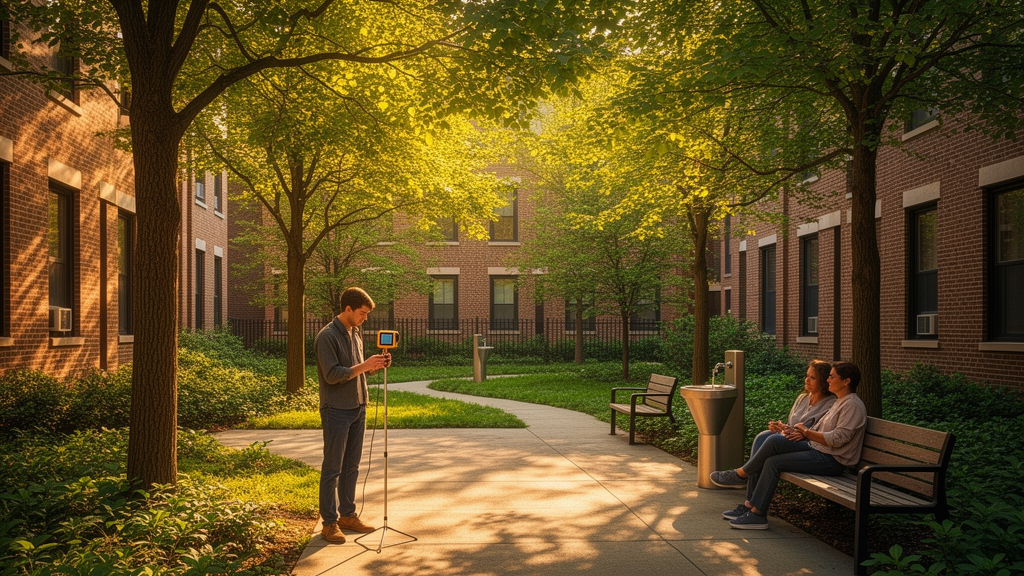
Pocket parks—the small, dispersed green spaces tucked into dense city blocks—have become a favourite tool of urban climate adaptation, but the science behind their thermal comfort benefits has been scattered across methods, climates and study designs. A new systematic review published in the journal City and Built Environment pulls that fragmented literature together and finds a field in transition: maturing rapidly, yet still hampered by uneven climate coverage, inconsistent reporting and variable evidence quality.
Following the PRISMA 2020 reporting standard, researchers Zhuqing Xin and Xuechuan Geng searched four bibliographic databases—Web of Science Core Collection, Scopus, EBSCOhost and the China National Knowledge Infrastructure—using search strings that were harmonised at the conceptual level but adapted to each platform’s indexing rules. After deduplication and two-stage screening of 685 records, 26 studies made it into the final qualitative synthesis. Each was then run through a structured quality appraisal covering reporting transparency, data quality, validity and reproducibility, scored across four domains on a zero-to-two scale.
The quality results are notable in themselves: 13 of the 26 studies were rated high quality and 13 moderate, with none classified as low. The authors used these ratings to interpret evidence strength rather than to exclude weaker studies, a choice that preserves local insights from case studies and conference papers while flagging where caution is needed. Many of the moderate-rated entries were theses or context-specific case studies that report boundary conditions, calibration procedures or uncertainty handling less completely than recent peer-reviewed work combining field evidence with explicit simulation protocols.
Perhaps the review’s central insight is that pocket-park research has organised itself into three co-existing orientations rather than a single linear progression. The first is baseline cooling and benefit verification: studies asking whether pocket parks measurably mitigate heat exposure relative to surrounding built-up environments. These rely mainly on field measurement, surveys or simple spatial comparison, cluster in warm-season contexts, and remain largely descriptive—with stronger evidence for summer daytime cooling than for year-round comfort performance.
The second and largest orientation is mechanism attribution and design optimisation. Here the park is treated not as an observed green space but as a design system whose thermal behaviour can be tested and tuned. Simulation-based workflows, often using the ENVI-met microclimate model, combine with orthogonal experimental design and field–simulation hybrids to examine how canopy structure, layout, materials, surrounding morphology and planting composition shape thermal outcomes. Across these simulation-led studies, a consistent pattern emerges: increasing tree canopy density or vertical layering and reducing sky view factor generally lower mean radiant temperature and heat-stress indices, though the magnitude varies with surrounding building height, street canyon geometry and wind conditions.
The third orientation is human-centred and multi-domain assessment, encompassing behavioural observation, user-group differentiation, questionnaires and composite comfort indicators. Studies in this strand cover children, activity-based users, thermo-acoustic conditions, visual perception and overall comfort. Their key message is that thermal improvement is not always equivalent to a better overall experience: once adaptation, perception, activity patterns and multi-sensory context become central, physiological indices alone often fail to explain how people actually respond to a space.
On the measurement side, two indices dominate: the Physiological Equivalent Temperature (PET) and the Universal Thermal Climate Index (UTCI). Both integrate air temperature, humidity, wind speed and mean radiant temperature into interpretable heat-stress levels, which is why they have become the field’s default currency for comparing designs and sites. The Wet Bulb Globe Temperature (WBGT) appears in a smaller subset of studies, typically where the focus is thermal safety and heat-risk thresholds during extreme heat. These objective metrics are routinely paired with subjective votes—thermal sensation, thermal comfort and overall comfort votes—collected through questionnaires to capture real-time user perception.
The review’s second research question probed how methodological choices vary with context, and the answer is that method selection is anything but random. Summer and heatwave studies are dominated by simulation and PET/UTCI-based analyses, because their goal is comparing design alternatives or quantifying peak heat mitigation. Winter, user-group-specific and multi-domain studies lean more heavily on field monitoring, questionnaires and mixed-method designs, since comfort in those settings depends visibly on adaptation, expectations, activity patterns and local behavioural context—factors that simulation alone captures poorly. Spatial configuration acts as a second filter: point-based monitoring suffices when the park is analysed as an internal microclimate, but once the focus expands to park–street interfaces or cooling beyond the park boundary, simulation and spatial analysis become necessary, especially because edge effects are proportionally stronger in small parks.
Geographically, the evidence remains concentrated but is no longer exclusively domestic. China dominates the study contexts, reflecting rapid pocket-park programmes in high-density urban renewal and the urgency of summer heat mitigation in compact neighbourhoods, but studies from Japan, Italy, Serbia, Spain, Australia and other settings signal widening international relevance. The authors caution against over-generalising results derived mainly from East Asian and Mediterranean contexts. Temporally, publication output rose sharply after 2022, which they attribute to stronger urban heat-risk governance, wider use of pocket parks in neighbourhood renewal, and growing accessibility of micro-scale modelling and portable sensing tools.
Several cross-cutting warnings run through the synthesis. Denser greening often improves radiant conditions but can weaken ventilation in compact urban settings, meaning design should be understood as a shade–ventilation balance rather than a simple increase in planting density. No single method is sufficient for all questions: field measurement offers ecological validity but suffers temporal sampling constraints and measurement uncertainty; simulation enables systematic scenario testing but is sensitive to vegetation parameterisation and boundary-condition assumptions; remote sensing and GIS provide coverage but relate only indirectly to pedestrian-level comfort. The review closes with a forward agenda—expanding cross-season comparability, transparent reporting of vegetation and boundary conditions, and tighter integration of thermal, behavioural and multi-sensory evidence—arguing that pocket parks should not be treated as scaled-down large parks but as a distinct research object requiring their own minimum reporting standards for morphology, exposure timing and user context.
Subject of Research: Systematic review of methodological approaches in pocket park thermal comfort research
Article Title: A review of pocket park thermal comfort research
Article References: Xin, Z., & Geng, X. (2026). A review of pocket park thermal comfort research. City and Built Environment, 4(1), Article 13. https://doi.org/10.1007/s44213-026-00079-6
Image Credits: AI Generated
DOI: 10.1007/s44213-026-00079-6
Keywords: pocket parks, thermal comfort, urban heat, PET, UTCI, ENVI-met, microclimate, urban green infrastructure, systematic review, PRISMA, shading, urban design
News Source: Sloane Callahan. (October 29, 2026). Small parks, big questions: review maps how pocket park heat comfort is studied. Scienmag.