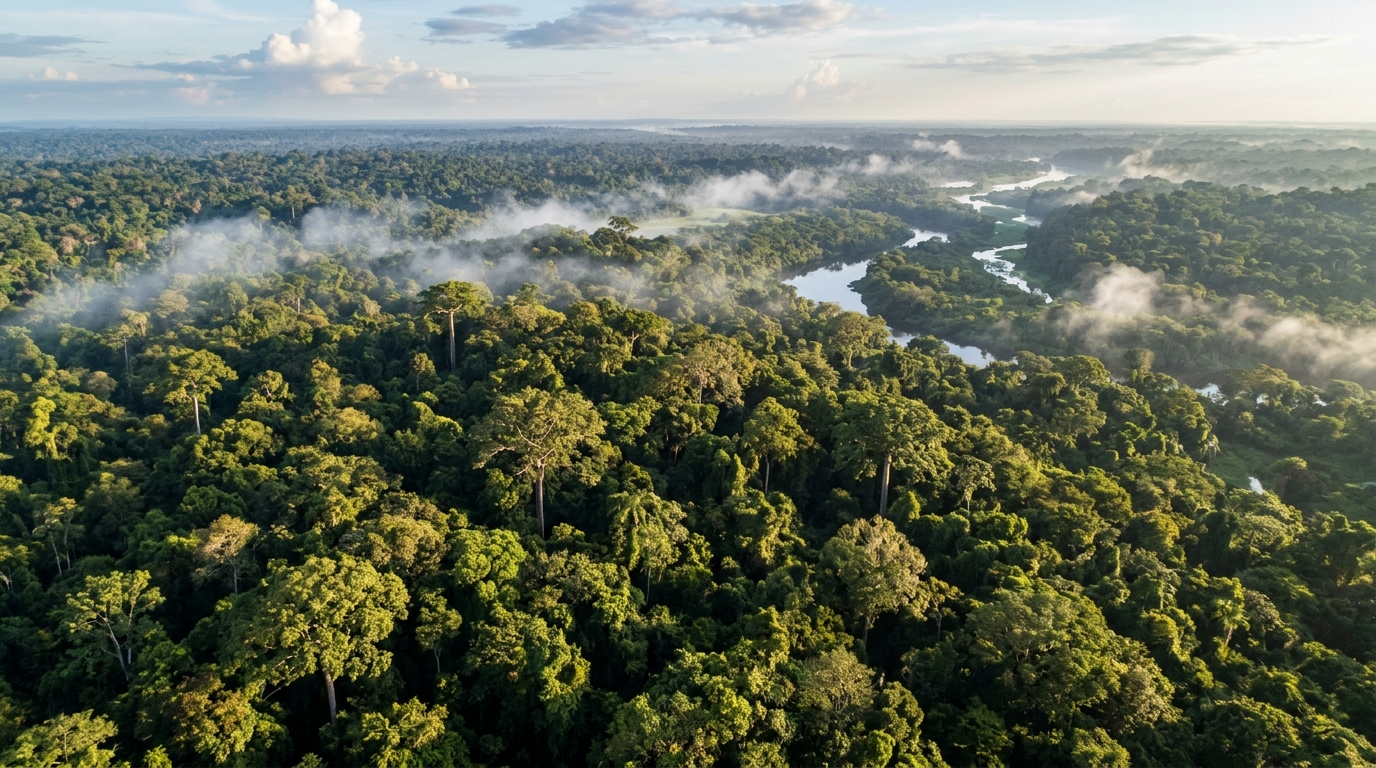
In a Matters Arising analysis published in Nature Plants, researchers Sebastian Leuzinger and Christian Körner evaluate permanent-plot monitoring across the Amazon, concluding that small plots cannot reliably identify an enduring forest carbon sink. The analysis reassesses findings from an earlier study by A. Esquivel-Muelbert and colleagues, which monitored 188 Amazonian forest parcels averaging 1.2 hectares over an average duration of 13 years. The earlier study reported that mean tree basal area increased by 3.3 percent per decade while the number of stems larger than 10 centimeters declined, with large trees expanding in both size and abundance and suppressed understorey trees showing comparable relative growth. While the original authors interpreted those structural changes as evidence that elevated atmospheric carbon dioxide has stimulated tree growth to outweigh climate-driven tree mortality, Leuzinger and Körner demonstrate that these observations reflect standard forest development rather than a persistent carbon sink.
The authors argue that the documented patterns match the expected progression of closed-canopy stands along a classic self-thinning trajectory, an ecological process occurring in mature tropical forests irrespective of atmospheric changes. In undisturbed forests, individual trees continuously accumulate basal area and height throughout their lifespans until stochastic collapse resets the cycle. Because the carbon stock of all undisturbed forests is controlled by gap dynamics, biomass accumulation in surviving stems cannot be evaluated without accounting for the sudden structural loss that occurs when large emergent trees fall. By following stands along this self-thinning path, plot censuses capture the continuous upward trajectory of growing trees while systematically under-sampling the abrupt biomass losses that characterize natural forest turnover.
The analysis details how observational scale introduces a profound sampling bias in monitoring networks comprised of roughly 1-hectare parcels. In mature tropical forests, the largest emergent trees have a typical mean lifespan ranging from 150 to 300 years and occur at low densities of only one to two stems per hectare. At this density and longevity, the annual probability of a single 1-hectare plot experiencing the death of one of its few large trees is approximately 1 in 200. Because observation windows across permanent plots typically span only 3 to 30 years, these rare, abrupt carbon-release events are missed in the vast majority of small plots during monitoring intervals, whereas the ongoing biomass carbon gained by surviving trees is recorded in every census. The abrupt death of even older emergent trees is rarer still, producing a strong observational bias toward net carbon gain and systematically omitting the downward strokes of the natural saw-tooth carbon cycle.
Leuzinger and Körner highlight critical gaps in the baseline metrics provided by the plot-network study, noting that the investigation offers no direct statistics on tree mortality, including standing deaths or uprooting and trunk snapping. Furthermore, the underlying paper provides no data on liana infestation, a factor recognized to indicate an increased probability of structural collapse, and offers no quantitative estimates of carbon residence time or overall turnover rates. The researchers emphasize that without robust measurements of mortality and turnover, observed growth increments cannot be directly translated into sustained increases in forest carbon stocks. They note that when trees experience accelerated growth for any reason, this faster accumulation is commonly traded off against a reduced lifespan, which largely neutralizes any potential long-term terrestrial carbon sink.
The analysis also questions the physiological and global plausibility of large-scale live biomass expansion across tropical forests. The authors observe that sustaining higher biomass carbon stocks requires substantial nutrient inputs, yet it remains stoichiometrically unclear where the additional nutrients necessary to support widespread biomass increases would originate. In addition, Leuzinger and Körner point to a comprehensive reanalysis of the global terrestrial carbon budget showing that the putative missing carbon sink can be fully explained by the accumulation of dead organic carbon, including submerged deposits and landfills, without requiring an extensive rise in live forest biomass. Consequently, attributing local growth gains in tropical trees to a widespread, resource-demanding expansion of living carbon reserves conflicts with stoichiometric realities and global carbon budget assessments.
While acknowledging that Esquivel-Muelbert and colleagues provide valuable documentation of structural dynamics across an extensive array of humid tropical parcels, Leuzinger and Körner stress that median tree size increases must be evaluated against the true probability of tree collapse. Small permanent plots around the 1-hectare scale are well suited for tracking tree growth and sapling recruitment, but they are structurally incapable of capturing representative gap-phase turnover in old-growth tropical ecosystems or determining shifts in tree longevity, as the original authors partly acknowledge. To establish whether observed forest growth rates translate into lasting landscape-scale carbon sinks, researchers require plots of sufficient spatial extent, specifically 50 hectares or larger, or observational records spanning centuries to quantify both carbon influx and residence time simultaneously.
Subject of Research: Amazon forest carbon sink monitoring and plot size limitations
Article Title: Trees grow until they fall: why small permanent plots cannot identify an Amazon carbon sink
Article References: Leuzinger, S., & Körner, C. (2026). Trees grow until they fall: why small permanent plots cannot identify an Amazon carbon sink. Nature Plants. https://doi.org/10.1038/s41477-026-02433-2
Image Credits: AI Generated
DOI: 10.1038/s41477-026-02433-2
Keywords: Amazon rainforest, carbon sink, forest biomass, permanent plots, tree mortality, gap dynamics, tropical forests, carbon cycle, Trees, grow, until, they
News Source: Drew Townsend. (November 7, 2026). Small Forest Plots Cannot Accurately Identify an Amazon Basin Carbon Sink. Scienmag.