• HOME
  • NEWS
  • EXPLORE
    • CAREER
      • Companies
      • Jobs
    • EVENTS
    • iGEM
      • News
      • Team
    • PHOTOS
    • VIDEO
    • WIKI
  • BLOG
  • COMMUNITY
    • FACEBOOK
    • INSTAGRAM
    • TWITTER
Tuesday, January 13, 2026
BIOENGINEER.ORG
No Result
View All Result
  • Login
  • HOME
  • NEWS
  • EXPLORE
    • CAREER
      • Companies
      • Jobs
        • Lecturer
        • PhD Studentship
        • Postdoc
        • Research Assistant
    • EVENTS
    • iGEM
      • News
      • Team
    • PHOTOS
    • VIDEO
    • WIKI
  • BLOG
  • COMMUNITY
    • FACEBOOK
    • INSTAGRAM
    • TWITTER
  • HOME
  • NEWS
  • EXPLORE
    • CAREER
      • Companies
      • Jobs
        • Lecturer
        • PhD Studentship
        • Postdoc
        • Research Assistant
    • EVENTS
    • iGEM
      • News
      • Team
    • PHOTOS
    • VIDEO
    • WIKI
  • BLOG
  • COMMUNITY
    • FACEBOOK
    • INSTAGRAM
    • TWITTER
No Result
View All Result
Bioengineer.org
No Result
View All Result
Home NEWS Science News Biology

Small animals with big impact

Bioengineer by Bioengineer
March 8, 2019
in Biology
Reading Time: 2 mins read
0
IMAGE
Share on FacebookShare on TwitterShare on LinkedinShare on RedditShare on Telegram

IMAGE

Credit: Erik Selander

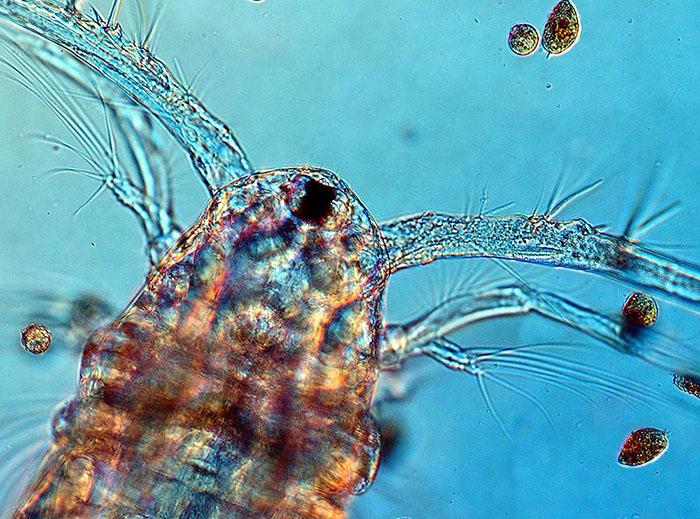
Copepods, the world’s most common animal, release unique substances into the oceans. Concentrations of these substances are high enough to affect the marine food web, according to new research from the University of Gothenburg. The studies also show that phytoplankton in the oceans detect the special scent of copepods and do their utmost to avoid being eaten.

The substances that copepods release into seawater are called copepodamides.

When phytoplankton in the water sense copepodamides, they activate their defence mechanisms to avoid being eaten. Some phytoplankton then produce light, bioluminescence; other plankton use chemical warfare and produce toxins or shrink in size.

“Since the phytoplankton in the ocean are the basis of all marine life, the effects become large-scale,” says Erik Selander at the Department of Marine Sciences at the University of Gothenburg, who heads the research team.

Increased understanding of algal blooms

Selander compares the effect of copepodamides with the effect of hormones in the body.

“The substances are remarkably potent. Very small quantities produce large systemic effects. The amount of copepodamide that would fit in a grain of salt are enough to cause phytoplankton in a whole swimming pool to mobilise their defences. Some of the defences involve very strong toxins, and as a result copepodamides can have far-reaching effects such as toxic algal blooms.”

The article, which has now been published in Science Advances, also shows that copepodamides affect more of the ocean’s inhabitants than researchers previously recognised.

“Including a diatom that produces the domoic acid neurotoxin. It is toxic for many organisms and causes memory loss, among other things, in humans. Other diatoms respond by changing their appearance, going from long, contiguous chains of cells to shorter or single-celled variations.”

Size matters

Size is an important property in the ocean. When it changes, there are repercussions in a series of other processes.

“For example, the amount of carbon exported from the surface to deeper water or who eats whom in the plankton community.”

The new discoveries increase our understanding of the marine food web, and especially the mechanisms that lead to toxic algal blooms.

“We previously have not been able to understand why and when toxic algal blooms occur. Copepodamides seem to be an important and overlooked mechanism that contributes to the occurrence of toxic algal blooms by causing producers of toxins to produce as much as 10 times more toxins than normal.”

###

Name of the article: Copepods drive large-scale trait-mediated effects in marine plankton

Link to article: http://advances.sciencemag.org/content/5/2/eaat5096

Contact: Erik Selander, associate professor in the Department of Marine Sciences, University of Gothenburg; telephone: +46(0)31-786 26 27, mobile: +46 (0)766-18 26 27, e-mail: [email protected]

Media Contact
Erik Selander
[email protected]

Original Source

https://www.gu.se/english/about_the_university/news-calendar/News_detail//small-animals-with-big-impact.cid1617920

Tags: BiologyEcology/EnvironmentEvolution
Share15Tweet8Share2ShareShareShare2

Related Posts

blank

Gene Expression Changes in Freeze-Tolerant Vertebrates

January 13, 2026
Two Divergent Effectors Control Pm4 Resistance Virulence

Two Divergent Effectors Control Pm4 Resistance Virulence

January 12, 2026

Gene Expression and Growth in Sunit Lambs Analyzed

January 12, 2026

Next-Gen Gluten-Free Noodles: Hydrocolloids & Bioactives

January 12, 2026
Please login to join discussion

POPULAR NEWS

  • Enhancing Spiritual Care Education in Nursing Programs

    154 shares
    Share 62 Tweet 39
  • PTSD, Depression, Anxiety in Childhood Cancer Survivors, Parents

    146 shares
    Share 58 Tweet 37
  • Robotic Ureteral Reconstruction: A Novel Approach

    72 shares
    Share 29 Tweet 18
  • Study Reveals Lipid Accumulation in ME/CFS Cells

    51 shares
    Share 20 Tweet 13

About

We bring you the latest biotechnology news from best research centers and universities around the world. Check our website.

Follow us

Recent News

Carvacrol and Chloroquine Synergistically Halt Melanoma Metastasis

Venetoclax plus ML385 defeats AML chemotherapy resistance

Hesperidin Nanoparticles Boost Kidney and Cancer Defense

Subscribe to Blog via Email

Enter your email address to subscribe to this blog and receive notifications of new posts by email.

Join 71 other subscribers
  • Contact Us

Bioengineer.org © Copyright 2023 All Rights Reserved.

Welcome Back!

Login to your account below

Forgotten Password?

Retrieve your password

Please enter your username or email address to reset your password.

Log In
No Result
View All Result
  • Homepages
    • Home Page 1
    • Home Page 2
  • News
  • National
  • Business
  • Health
  • Lifestyle
  • Science

Bioengineer.org © Copyright 2023 All Rights Reserved.