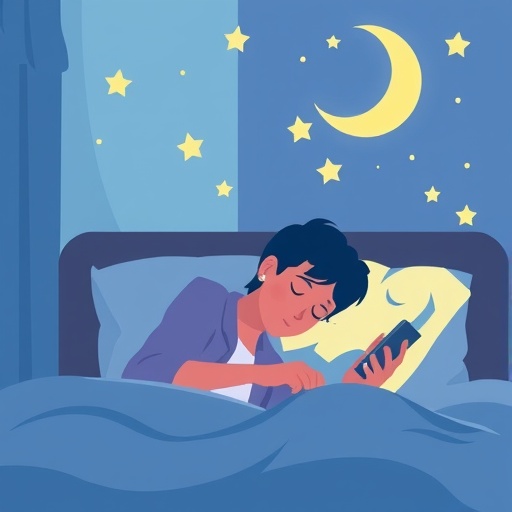
In an era increasingly defined by digital immersion, the intricate relationship between sleep disturbances and problematic mobile phone use has garnered considerable scientific attention. A groundbreaking study, published in the International Journal of Mental Health and Addiction, provides new insights into this dynamic by applying sophisticated network analysis techniques across multiple sample populations. This research elucidates how specific symptoms linked to sleep disruption intertwine with various facets of mobile phone dependence, offering a novel perspective on a pervasive public health issue.
At the heart of this study lies an innovative methodological framework that transcends traditional correlation-based approaches. By employing cross-sample validation and symptom-level network analysis, the researchers uncovered a complex web of associations that map out the mutual reinforcement between sleep irregularities and excessive mobile phone usage. This approach allowed for a granular understanding of how individual symptoms influence one another, bolstering the predictive power of the findings and enhancing their generalizability across diverse demographic groups.
The significance of these discoveries becomes particularly salient when considering contemporary lifestyle patterns. Mobile devices have entrenched themselves as indispensable tools, yet their overuse often triggers a cyclical pattern of behavioral and physiological responses. The network analysis revealed that specific symptoms such as difficulty initiating sleep, frequent awakenings, and daytime fatigue are closely linked with compulsive phone checking, anxiety around device access, and loss of control over phone use. This bidirectional relationship suggests that the behavioral addiction to smartphones directly exacerbates sleep quality, which in turn may intensify problematic phone behaviors.
One of the pivotal revelations of the study is the identification of “bridge symptoms”—key nodes within the symptomatic networks that serve as conduits bridging sleep disturbances and mobile phone problems. These bridge symptoms act as fulcrums where interventions could be strategically targeted to disrupt the reinforcing cycle. For instance, reducing nighttime phone usage emerged as a critical leverage point, likely to yield significant improvements in sleep hygiene and reduce the compulsion towards problematic phone engagement.
Furthermore, this research reinforces the notion that the psychological underpinnings of sleep and technology-related issues are intricately intertwined. The interplay of anxiety, cognitive preoccupation, and physiological arousal forms a feedback loop where sleep deprivation fuels stress responses that exacerbate reliance on mobile devices as coping mechanisms. The network’s topology highlights clusters of symptoms that co-activate, suggesting that isolated treatments addressing only one facet may fall short compared to integrated therapeutic strategies.
The cross-sample validation component of the study enhances its clinical relevance by demonstrating the robustness of symptom-level connections across distinct population samples. By validating these symptom networks in different cohorts, the researchers effectively ruled out sample-specific biases, solidifying the universality of the identified core mechanisms. This consistency underscores the urgency for public health systems to develop scalable interventions that address both behavioral and physiological dimensions in tandem.
From a neuroscientific perspective, these findings implicate the circadian regulation system and its vulnerability to external stimuli, particularly blue light emitted by screens, as critical factors mediating the observed relationships. The disruption of melatonin secretion patterns likely compounds the incidence of insomnia and restless sleep in individuals exhibiting problematic phone use. This biological interference aligns with the behavioral findings, creating a comprehensive biopsychosocial model that may underlie a subset of modern sleep disorders.
The research’s implications extend beyond individual health outcomes, hinting at broader societal consequences. Chronic sleep deficits linked to mobile phone overuse can impair cognitive functioning, reduce productivity, and exacerbate mental health disorders such as depression and anxiety. The study’s network analysis thus equips policymakers and healthcare providers with actionable data to design preventive measures, educational campaigns, and technology usage guidelines that encourage healthier digital habits.
Technologically, the study leverages emergent computational tools to tackle complex psychometric data, setting a precedent for the marriage of data science with psychological research. By dissecting symptom interconnectivity through advanced network algorithms, the approach transcends the limitations of traditional psychological assessments that often treat symptoms as isolated phenomena. This paradigm shift aligns with modern trends in precision psychiatry and personalized medicine.
Critically, the study also touches upon the temporal dynamics governing the evolution of these symptom networks. Patterns suggest that initial mobile phone overuse may precipitate mild sleep disturbances that, if unchecked, amplify into severe, intertwined pathology. Understanding this temporal progression lays the groundwork for early detection models and real-time monitoring through wearable devices and ecological momentary assessments.
Moreover, the research invites further exploration into demographic moderators such as age, gender, and cultural context, which could moderate or mediate the relationship between sleep disturbance and problematic mobile phone use. Although the current study validated findings cross-sample, the granularity of such moderators remains an open question, ripe for subsequent investigations that could tailor prevention strategies with greater nuance.
This comprehensive exploration into the symptom-level connections between sleep and mobile phone use signals a paradigm where behavioral addictions are not merely lifestyle choices but complex biopsychological phenomena requiring nuanced unraveling. The integration of network analysis with robust cross-sample validations heralds a new dawn in behavioral health research that emphasizes connectivity, complexity, and precision over reductive causal models.
In conclusion, the findings presented by Yuan, Li, Li, et al. illuminate critical pathways linking sleep impairment with problematic mobile phone habits. By transcending simple bivariate analyses and harnessing network science, the study pioneers a multidimensional understanding that is essential for developing targeted interventions. As mobile technologies continue to evolve and permeate every facet of modern life, research of this calibre paves the way for fostering healthier interactions with our digital environments and securing better sleep health globally.
Future research directions prompted by this study include longitudinal tracking to assess causal directions more definitively, experimental designs to test intervention efficacy on identified bridge symptoms, and integrating neuroimaging modalities to map the neural substrates underpinning these symptom networks. As the boundary between human cognition and technology blurs, such multifaceted approaches will be indispensable in mitigating emerging digital public health challenges.
Ultimately, as we navigate the complexities of the 21st century, bridging the chasm between behavioral addictions and physiological health remains paramount. The deployment of network analysis in this domain exemplifies how computational methodologies can unravel the subtle interdependencies in human health, guiding clinicians and individuals alike towards more informed, effective, and holistic solutions.
Subject of Research: Cross-sample symptom-level associations between sleep disturbances and problematic mobile phone use using network analysis.
Article Title: Cross-Sample Validation of Symptom-Level Links Between Sleep Disturbance and Problematic Mobile Phone Use Using Network Analysis.
Article References:
Yuan, Y., Li, M., Li, M. et al. Cross-Sample Validation of Symptom-Level Links Between Sleep Disturbance and Problematic Mobile Phone Use Using Network Analysis. International Journal of Mental Health and Addiction (2026). https://doi.org/10.1007/s11469-026-01636-0
Image Credits: AI Generated
DOI: https://doi.org/10.1007/s11469-026-01636-0
Tags: behavioral responses to mobile usecross-sample validation in researchdigital immersion and sleep qualityexcessive screen time effects on sleepintricate relationship between sleep and technologynetwork analysis in mental healthproblematic mobile phone dependencepublic health implications of mobile usesleep disruption symptomssleep disturbances and mobile phone usesmartphone addiction and sleep issues