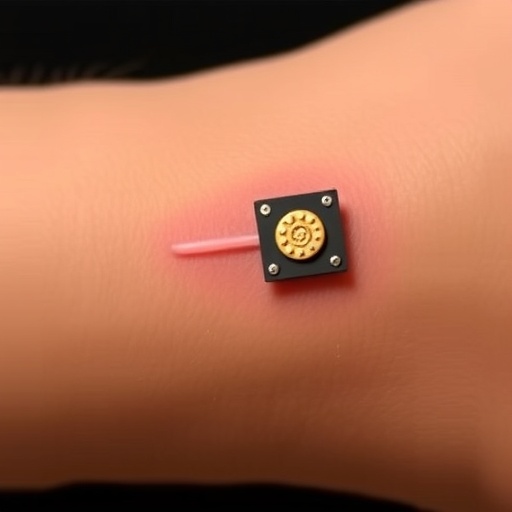
In a groundbreaking convergence of biotechnology and wearable technology, researchers have unveiled an extraordinary innovation: a living sensor display that can be implanted directly onto human skin for the purpose of continuous, long-term biomarker monitoring. This pioneering development, as reported in a recent study published in Nature Communications, marks a significant leap toward real-time health monitoring, enabling unprecedented access to physiological data with exceptional sensitivity and stability over extended periods.
The innovation centers around a bioengineered living sensor embedded within a flexible, skin-compatible display system. Unlike conventional wearable devices that rely heavily on electronic components and often face issues such as skin irritation, limited operational lifespan, and disposability, this living sensor exploits the intrinsic biological characteristics of living cells, allowing for more natural interfacing with human tissue. This approach mitigates many of the biocompatibility concerns and promises a level of adaptability and durability previously unattainable in conventional sensors.
At the heart of this technology lies the sophisticated engineering of genetically modified organisms that can detect specific biomarkers — molecules that can indicate physiological or pathological states. These biomarkers can include glucose levels, pH changes, or the presence of specific metabolites or proteins indicative of disease or metabolic shifts. By integrating these living cells into a skin-implantable matrix, the sensor can provide continuous, real-time data about the wearer’s internal biochemistry without the need for invasive procedures or frequent device replacement.
The living sensor display operates through a bio-electronic mechanism where detected biomarkers trigger luminescent signals emitted by the living cells themselves. This bio-luminescence is then visually observable through the semi-transparent interface of the device, allowing users or healthcare providers to monitor changes dynamically and intuitively. The researchers have demonstrated successful functionality of this system over weeks, showcasing its ability to maintain cell viability and sensing accuracy within the challenging environment of human skin.
The team addressed several critical challenges in making this technology feasible. One major hurdle was ensuring that the living cells could survive the harsh conditions of the skin surface, which includes exposure to immune responses, fluctuating moisture, temperature, and mechanical stress. They overcame this by designing a micro-encapsulation matrix, providing both nourishment and protection to the cells while maintaining the necessary permeability for biomarker detection and luminescent signal emission.
Furthermore, the device’s architecture was optimized for seamless integration onto various body parts, featuring a flexible, lightweight design that conforms to the skin without compromising sensitivity. This adaptability is crucial for daily wear and long-term implantation, ensuring that the sensor remains functional regardless of user movement or environmental conditions.
Clinical and real-world implications of this living sensor display technology are vast. Chronic disease management, for instance, stands to benefit immensely. Diseases such as diabetes, cardiovascular conditions, and chronic inflammatory disorders require continuous monitoring of specific biomarkers for effective treatment and prevention of acute episodes. With this living sensor, patients could receive real-time feedback on their physiological status, potentially in a straightforward visual format that reduces dependence on bulky, electronic devices.
Moreover, the sensor’s ability to adapt biologically opens avenues for personalized medicine, as genetic modifications in the sensing cells can be tailored to detect biomarkers specific to an individual’s health profile or medical history. This customization could revolutionize how medical diagnostics and monitoring are approached, transitioning from generic, intermittent testing to personalized, continuous surveillance powered by living bioengineered systems.
The researchers also underscore the sustainable and eco-friendly aspects of this technology. Unlike disposable electronic sensors laden with batteries and rare metals, the living sensor is inherently biodegradable and self-sustaining, relying on minimal external power and leveraging biological energy conversion mechanisms within the cells. This aligns well with increasing demands for environmentally responsible tech amidst growing electronic waste concerns.
Looking forward, the research lays a foundation for integrating such living sensor displays with broader health monitoring ecosystems. By potentially interfacing with smartphones and medical cloud platforms, the bioluminescent signals could be captured, quantified, and analyzed in detail, furnishing healthcare providers with critical insights needed for timely interventions. This integration is poised to create a new paradigm of digital health intertwined with living biological systems.
The innovation also paves the way for further interdisciplinary research combining synthetic biology, materials science, and electronic engineering. For example, future iterations may incorporate multiple cell types engineered to sense a wider range of biomarkers simultaneously or even include cells programmed to respond therapeutically by delivering drugs or biochemical modulators in response to detected abnormalities.
A particularly fascinating aspect of this living sensor technology is its potential role in advancing personalized wellness and fitness tracking. Beyond pathologic biomarker detection, the sensor could monitor metabolic shifts and hormonal changes related to exercise, diet, stress, and sleep in real time, giving users unprecedented control and awareness over their health and lifestyle choices through a simple, visible interface on their skin.
While the results so far are highly promising, the researchers acknowledge several future challenges ahead. These include managing long-term immune responses beyond the current study’s duration, scaling up manufacturing processes for widespread clinical application, and navigating regulatory pathways for devices that blur the line between biologics and electronics. Nonetheless, the successful demonstration in living skin models and early human-compatible frameworks positions this work firmly at the vanguard of next-generation wearable sensors.
This study exemplifies the powerful potential of harnessing living systems for human health technologies. The living sensor display not only redefines what a skin-worn device can achieve but also embodies the growing trend toward biohybrid devices that seamlessly combine living cells with engineered materials. Such innovations promise to shift healthcare toward more proactive, continuous, and precise monitoring, thereby enhancing patient outcomes and quality of life.
In conclusion, the living sensor display implant developed by Sawayama and colleagues represents a transformative step in biomarker monitoring technology. By leveraging living cells engineered for detection and luminescent reporting, incorporated into a flexible, skin-conformable device, this platform offers a new vision for long-term, real-time health sensing. Its implications span clinical diagnostics, personalized medicine, wellness monitoring, and sustainable device design, highlighting a compelling future where our very skin becomes a window into our internal biological states at all times.
As this technology advances toward larger clinical trials and eventual commercialization, it could redefine key aspects of medical care, patient engagement, and personal health management. Importantly, the living sensor display signifies that the interface between biology and technology is becoming ever more intimate and sophisticated, unlocking potentials that once belonged solely in the realm of science fiction. The seamless integration of living cells into wearable devices may soon become a central pillar of health innovation in the years to come.
Subject of Research: Living sensor displays implanted on skin for long-term biomarker monitoring.
Article Title: Living sensor display implanted on skin for long-term biomarker monitoring.
Article References:
Sawayama, J., Takeo, M., Takayama, Y. et al. Living sensor display implanted on skin for long-term biomarker monitoring. Nat Commun 17, 56 (2026). https://doi.org/10.1038/s41467-025-67384-2
Image Credits: AI Generated
DOI: https://doi.org/10.1038/s41467-025-67384-2
Tags: adaptive living technology for monitoringadvancements in health monitoring technologybiocompatibility in wearable devicesbioengineered living sensorsbiotechnology and wearable technologycontinuous biomarker monitoringflexible skin-compatible displaysgenetically modified organisms for healthliving skin-implanted sensorslong-term physiological data trackingreal-time health monitoring innovationssensitivity and stability in biomarker detection