SSCs are essential for bone development, homeostasis, and repair. Recent studies have identified distinct SSC populations in long bones, craniofacial bones, and spine. Techniques like single-cell sequencing have mapped SSC lineage commitment trajectories. SSCs also play roles in bone repair and diseases.
Credit: Guixin Yuan, Xixi Lin, Ying Liu, Matthew B Greenblatt, Ren Xu
SSCs are essential for bone development, homeostasis, and repair. Recent studies have identified distinct SSC populations in long bones, craniofacial bones, and spine. Techniques like single-cell sequencing have mapped SSC lineage commitment trajectories. SSCs also play roles in bone repair and diseases.
Highlights from the review include:
- Diversity of SSCs
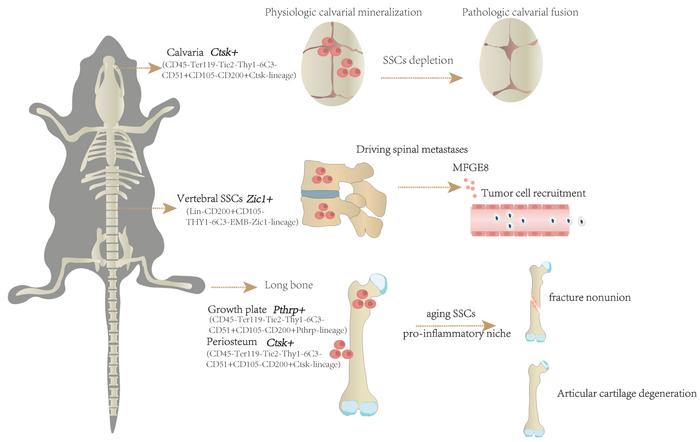
Recent studies have shown that SSCs are not a homogeneous group but consist of distinct populations depending on their location and the stage of bone development. For instance, SSCs in long bones differ from those in craniofacial bones, which have unique properties essential for specific bone formation processes. Techniques such as single-cell sequencing have been pivotal in identifying these differences and mapping the lineage trajectories of SSCs.
- Aging and SSC Function
The aging process significantly impacts SSCs, leading to decreased diversity and functionality. Aging SSCs exhibit reduced osteochondrogenic activity and contribute to a pro-inflammatory environment in the bone marrow. This dysfunction is intrinsic to SSCs and not entirely reversible through exposure to young systemic environments. However, treatments like BMP2 and CSF1 antagonists have shown promise in restoring some of the regenerative capacities of aged SSCs.
- Role in Skeletal Repair
SSCs play a crucial role in fracture healing by increasing in number and enhancing bone formation capabilities. The periosteum, containing periosteal skeletal stem cells (PSCs), is particularly important in this process. However, conditions like obesity and diabetes negatively affect SSC expansion and fracture healing. SSCs also hold potential for regenerating articular cartilage, which is typically considered irreparable, through mechanisms involving BMP2.
- Disease Implications
Mutations in genes affecting SSCs can lead to bone diseases. For example, mutations in the Twist1 gene result in craniosynostosis, a condition where the skull bones fuse prematurely. Studies have shown that SSCs in these conditions exhibit altered differentiation patterns, which can be modulated by factors like IGF1 to prevent disease progression. This highlights the therapeutic potential of targeting SSC pathways in bone diseases.
Skeletal stem cells (SSCs) are essential for the formation, maintenance, and repair of bones. The revelation that SSCs comprise a diverse group of cells with specific roles depending on their location and developmental stage has revolutionized our understanding of bone biology. Aging and disease significantly impact SSC function, but recent research offers hope for therapeutic interventions that can restore SSC activity and improve bone health. This review highlights the diversity of SSCs across different skeletal regions and developmental stages, illuminating their roles in bone development, homeostasis, and disease. Future research should further explore the regulation and plasticity of SSCs to advance our knowledge and therapeutic strategies. The work entitled “ Skeletal stem cells in bone development, homeostasis, and disease” was published on Protein & Cell (published on Mar. 5, 2024).
Journal
Protein & Cell
DOI
10.1093/procel/pwae008
Method of Research
Systematic review
Subject of Research
Cells
Article Title
Skeletal stem cells in bone development, homeostasis, and disease
Article Publication Date
5-Mar-2024