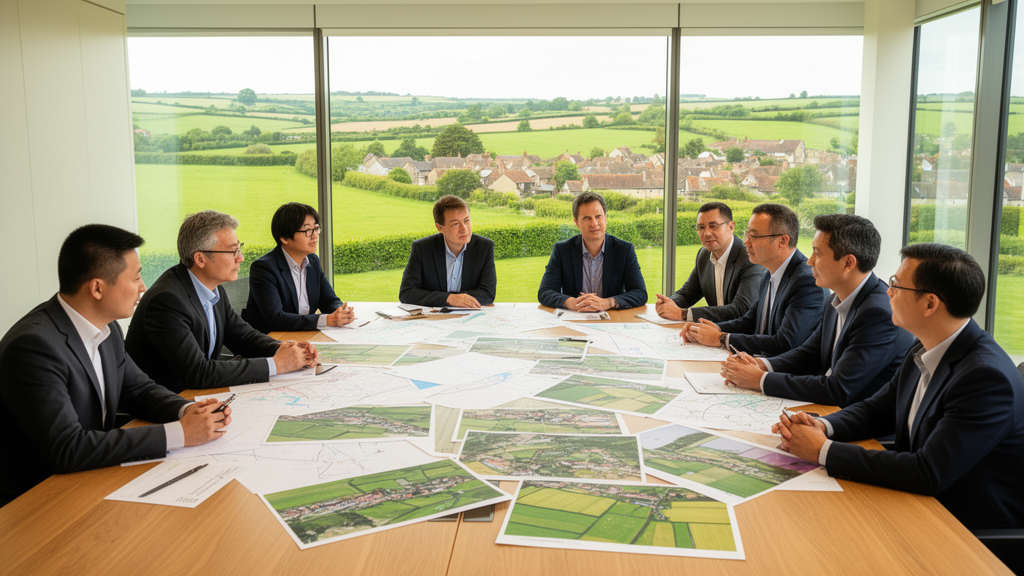
The hybrid landscapes where cities press against the countryside have long defied conventional planning, and a new review article argues that they demand a fundamentally different approach. The event brought together scholars based in China and the United Kingdom to present research and debate how to understand and delineate what they call the ‘metropolitan countryside’.
The review, published as an open access article on 10 August 2026, puts three critical issues under the spotlight: the forms of planning appropriate to these areas; spatial governance, state capacity and the role of communities in their future; and the importance of international knowledge networks in informing solutions to the complex challenges such countryside areas face. The authors describe the paper as an extension of the discussion started at the Symposium, drawing together insights from the UK participants and highlighting issues of common concern and the potential for further exchange.
The metropolitan countryside, as the authors frame it, is the interstitial zone created whenever towns and cities grow, a place where urban and rural land uses collide and trigger a special challenge for planning and public policy. Some countries, including the UK, have responded by fixing growth boundaries and seeking a separation of town and country. But the authors contend that this approach, represented in the UK by the ‘metropolitan green belt’, is focused on managing conflict and has failed to capture the benefits arising from the unique dynamics and possibilities of fringe areas.
A central conclusion of the review is that generalised or ‘standard’ approaches to planning are inadequate in the metropolitan countryside, and even across the different metropolitan countrysides within China. Instead, the authors argue, policy and practice need to work with the dynamics and the range of interests that produce this zone, capturing and further advancing its multifunctional potential. Planning effort, they suggest, should be rooted in a spatial governance approach that draws together expertise with other forms of knowledge, particularly knowledge held within communities, extending to the farming and local business sectors.
The Chinese experience features prominently in this argument. The authors note that universities in China have proven to be highly effective knowledge brokers, co-producing many outcomes and working across boundaries. They have played an important role in bridging between local people, entrepreneurial counter-urbanites, and the state. The success of spatial governance strategies in China has also been rooted in the country’s land market and, in rural areas, its distribution of benefits between new investors and local people, with rural development rooted in the commoning of land and property.
The review also reflects candidly on the nature of the exchange itself. The Symposium aimed to bring UK ‘experts’ into dialogue with Chinese rural scholars for the purpose of knowledge exchange, yet the authors write that they were ultimately more comfortable being labelled ‘learners’. Through the Symposium, and excursions into Shanghai’s peripheral rural spaces, they gained glimpses of the complexity of rural China and the possibilities for collaborative learning. The article is presented as a first attempt to map out their collective observations and reflections, centred primarily on the metropolitan countryside.
International exchanges and knowledge networks, the authors conclude, provide a source of inspiration, offering glimpses of alternative practices and different futures by identifying a wider range of potential responses to many shared challenges. But these responses need to fit circumstance and flex with need. Invoking a century-old principle, they cite Patrick Abercrombie’s 1926 argument for the ‘continuous administration of planning principles’ as development occurs, a reminder that planning is an ongoing process rather than a fixed blueprint.
Planning policy and practice, and international knowledge exchange, the review argues, need to be place-based, aligned to local dynamics, targeting long-term goals while accepting that the future is uncertain. Some challenges, however, are likely to be constant and amplify over time. Climate change is identified as one such challenge, with the metropolitan countryside and its communities expected to be at the front line of adaptation and mitigation efforts. The zone will also remain an interface between rural and urban pressures, requiring what the authors describe as a collaborative, flexible and multi-functional approach to its planning.
The article carries no associated data, and the authors are careful to position it as a reflective review rather than an empirical study. Its contribution lies in mapping shared concerns between two planning traditions with very different institutional settings: one that has long used fixed green belts to hold back urban growth, and another that has pursued spatial governance strategies through land institutions and university-mediated collaboration. For planners watching fringe areas on both sides, the message is that the boundary between town and country is not a line to defend but a landscape to govern.
Subject of Research: A review article reflecting on the Sino-UK Symposium on rural planning and spatial governance in metropolitan countryside areas
Article Title: Planning for the metropolitan countryside: reflections from the Sino-UK symposium on rural planning and spatial governance
Article References: Gallent, N., Gkartzios, M., Mell, I., Parker, G., Shaw, D., & Sturzaker, J. (2026). Planning for the metropolitan countryside: reflections from the Sino-UK symposium on rural planning and spatial governance. Frontiers of Urban and Rural Planning, 4(1), Article 19. https://doi.org/10.1007/s44243-026-00091-8
Image Credits: AI Generated
DOI: 10.1007/s44243-026-00091-8
Keywords: rural planning, spatial governance, metropolitan countryside, urban-rural fringe, China, United Kingdom, knowledge exchange, green belt, climate change adaptation, community participation, Planning, metropolitan
News Source: Courtney Benton. (October 29, 2026). Sino-UK Symposium Puts the Metropolitan Countryside at the Centre of Rural Planning. Scienmag.