A focused meta-analysis evaluating radical rectal tumor surgery has demonstrated that minimally invasive pelvic exenteration provides meaningful perioperative advantages over open surgery while maintaining comparable oncological outcomes. The published comparative analysis reported notable reductions in intraoperative blood loss, accelerated times to postoperative dietary recovery, and decreased rates of abdominal wound complications. These clinical findings provide timely evidence supporting the continued evolution of radical pelvic procedures, confirming that minimally invasive operative approaches can successfully preserve both short-term and long-term cancer control in appropriately selected surgical patients.
Pelvic exenteration remains widely recognized as one of the most technically demanding and formidable procedures in colorectal surgery. The radical operation requires complex multivisceral resection performed entirely within anatomically restricted operative spaces that frequently feature hostile tissue planes altered by prior radiation therapy.
Although minimally invasive techniques have gained clinical traction, currently available evidence predominantly reflects conventional multiport robotic platforms and standard laparoscopic approaches. Conventional multiport robotic systems offer distinct intraoperative advantages, including magnified three-dimensional visualization, enhanced instrument dexterity, effective tremor filtration, and improved ergonomics for the operating surgeon. Nevertheless, the physical architecture of multiport systems can remain severely constrained during deep pelvic dissection, creating risks of external robotic arm collisions, restricting operative access to the narrow pelvic floor, and necessitating frequent redocking or repositioning across compartments.
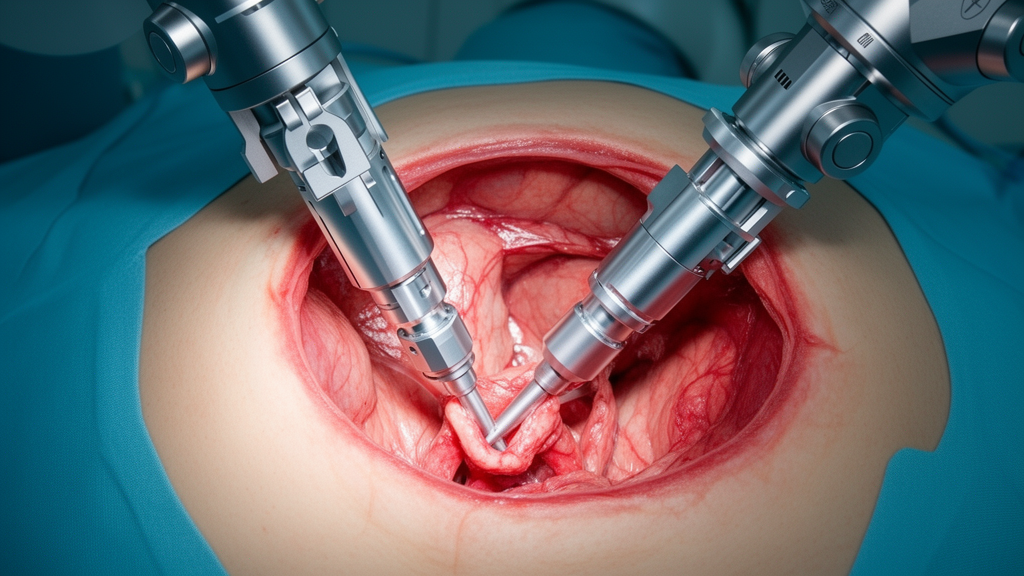
To overcome these recurring physical constraints, single-port robotic technology represents a promising technical development designed to expand the feasibility of minimally invasive pelvic exenteration. The da Vinci single-port surgical platform incorporates an articulating three-dimensional endoscope and three fully wristed instruments operating through a single multichannel cannula.
These mechanical characteristics are particularly valuable given the formidable technical challenges encountered throughout radical exenterative surgery. Patients requiring exenteration often present with dense post-radiotherapy fibrosis, distorted anatomical tissue planes, lateral pelvic sidewall involvement, and prolonged operative times that place a critical premium on instrument maneuverability.
Early clinical experience has provided an essential proof of concept for the application of single-access robotic technology in deep pelvic surgery. The first published clinical report documenting a complete robotic-assisted total pelvic exenteration performed entirely with the da Vinci single-port platform has confirmed the technical feasibility of this surgical approach, successfully incorporating robotic-assisted urinary reconstruction. While this single case report cannot demonstrate clinical superiority over established multiport or open exenterative approaches, it establishes technical feasibility and supports further structured clinical evaluation, alongside existing colorectal experience that remains limited to small series.
Crucially, surgical specialists emphasize that the primary value of single-port robotics in pelvic exenteration must not be framed as a cosmetic benefit or a simple reduction in abdominal incisions. Patient recovery after radical exenteration is predominantly determined by the biological extent of multivisceral resection, the complexity of perineal reconstruction, and overall systemic morbidity. The true contribution of single-port technology is fundamentally mechanical, directly aligning advanced robotic instrumentation and articulating endoscopes with the intrinsic anatomical constraints imposed by the deep pelvic cavity.
Despite these promising mechanical attributes, whether anatomy-specific robotic platforms can genuinely improve technical performance and long-term patient outcomes remains an important but unproven hypothesis. Broader clinical adoption of single-port robotics will depend heavily on prospective comparative evidence, specialized surgeon training, overcoming steep technical learning curves, institutional platform availability, and thorough cost-effectiveness evaluations. Prospective multicenter registries and dedicated collaborative studies from specialist exenteration centers will be essential before broader clinical implementation can be formally recommended in routine practice.
Subject of Research: Single-port robotics in minimally invasive pelvic exenteration
Article Title: Matters arising in IJCD beyond minimally invasive pelvic exenteration: can single-port robotics overcome deep pelvic constraints?
Article References: Kontovounisios, C. (2026). Matters arising in IJCD beyond minimally invasive pelvic exenteration: can single-port robotics overcome deep pelvic constraints?. International Journal of Colorectal Disease, 41(1), Article 136. https://doi.org/10.1007/s00384-026-05224-5
Image Credits: AI Generated
DOI: 10.1007/s00384-026-05224-5
Keywords: pelvic exenteration, single-port robotics, minimally invasive surgery, rectal tumours, da Vinci SP, deep pelvic dissection, multivisceral resection, surgical ergonomics, post-radiotherapy fibrosis, urinary reconstruction, intracorporeal triangulation, multiport robotics, colorectal surgery, surgical feasibility, perineal reconstruction, surgical learning curve
News Source: Denise Maddox. (November 20, 2026). Single-Port Robotics Shows Early Technical Feasibility in Deep Pelvic Exenteration. Scienmag.