Credit: Prof. Fabian Pauly, University of Konstanz
The theoretical physicists Junior Professor Fabian Pauly and his postdoc Dr. Safa G. Bahoosh now succeeded in a team of experimental physicists and chemists in demonstrating a reliable and reproducible single molecule switch. The basis for this switch is a specifically synthesized molecule with special properties. This is an important step towards realising fundamental ideas of molecular electronics. The results were published in the online journal Nature Communications on 9 March 2017.
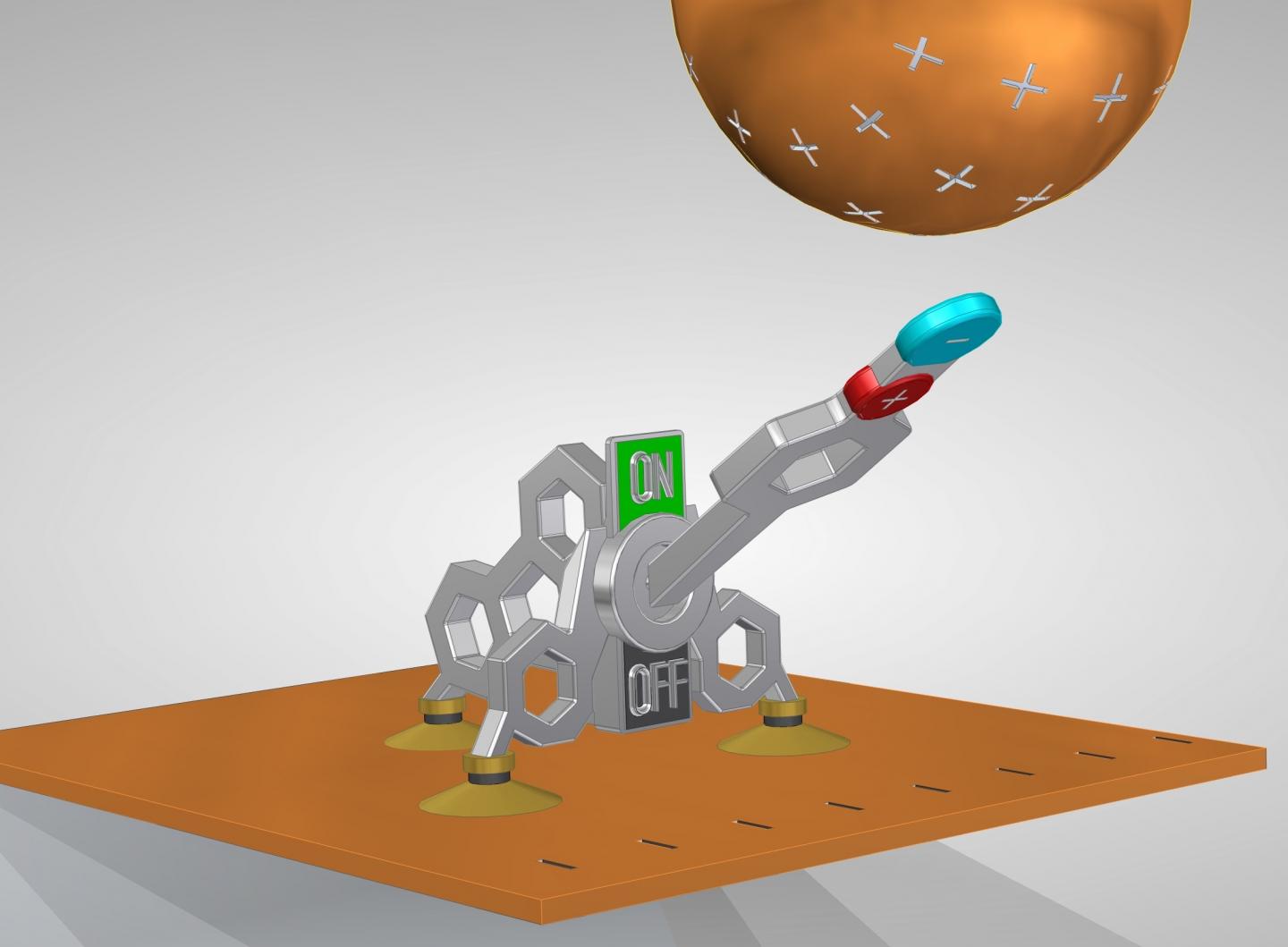
Fabian Pauly compares the molecule, which was synthesised by Professor Marcel Mayor who is affiliated to the University of Basel in Switzerland and to the Karlsruhe Institute of Technology (KIT) in Germany, with a three-legged lunar landing spacecraft that has some sort of head on top and is standing on the moon's surface. Its three "legs" have anchor groups that form robust links to the surface – in this case a gold substrate. A nitrile group, positioned at its "head", points away from the gold surface and is thus well separated from it. A second electrode, the gold tip of a scanning tunnelling microscope, can connect and establish contact. In this way electric current can flow through the molecule. Using the highly precise technique of the scanning tunnelling microscope, it has now become possible for the first time for such a complex three-legged molecule to measure the conductance value at every position above the nitrile group. Length control in the range of picometres, the trillionth part of a metre, is required for this process.
The nitrile group's dipole moment, i.e. an electric plus-minus charge, makes not only mechanical control possible, but also control through electric fields. The voltage between the electrodes can be used to adjust the height of the head, as was demonstrated by Safa G. Bahoosh in theoretical calculations. If a positive field is applied, the molecule's head is pressed down. If the field becomes negative through polarity reversal, the head moves up. This means that the contact can be electrically established or broken, and thus the current can be switched on and off. "What's really great about this result is that we have a well-defined on and off state", says Fabian Pauly. Previous concepts often failed because it was too difficult to control the electronic contact to single molecules and therefore only statistical interpretations of the behaviour of molecular contacts could be made.
Now, for the first time, contact between a molecule and the gold tip of the scanning tunnelling microscope could be opened and closed reproducibly many thousand times both mechanically and electrically, without causing any plastic deformations. Fabian Pauly's team member Safa G. Bahoosh, who has just succeeded in acquiring funding from the German Research Foundation (DFG) for her position for the next three years, used density functional theory to calculate geometric structures, electric conductance values and the images that would be produced by the scanning tunnelling microscope. With her simulations she was able to predict the shape of the individual molecule on the surface. Her results agree with the experiments conducted at the KIT. There, headed by Dr. Lukas Gerhard and Professor Wulf Wulfhekel, the electron transport was measured with the scanning tunnelling microscope. In addition to the switching functionality, the theoretical simulations combined with the systematic experiments reveal new insights into minute energies and forces that occur during reconfigurations in molecular contacts.
###
Original publication: Lukas Gerhard, Kevin Edelmann, Jan Homberg, Michael Valášek, Safa G. Bahoosh, Maya Lukas, Fabian Pauly, Marcel Mayor & Wulf Wulfhekel: An electrically actuated molecular toggle switch. Nature Communications 9 March 2017 DOI: 10.1038/NCOMMS14672; Link: https://doi.org/10.1038/ncomms14672
Facts:
- The study was conducted at the University of Konstanz in the Collaborative Research Centre (SFB) 767 "Controlled Nanosystems".
- The position of coauthor Dr. Sara G. Bahoosh, based in Konstanz, will be funded by the German Research Foundation (DFG) in the next three years.
- Fabian Pauly's junior professorship is sponsored by the Carl-Zeiss Foundation.
- Computing time for the numerical simulations was provided, amongst others, by the initiative for high performance computing in the state of Baden-Württemberg (bwHPC).
Note to editors:
You can download a photo here: https://www.uni-konstanz.de/fileadmin/pi/fileserver/2017/Einzelmolekuelschalter-Uni-KN.jpg
Caption: Schematic of a tripodal single molecule switch. The height of the molecular head, containing a dipolar group, can be changed through applied electric fields. In this way an electric current can flow between the gold electrodes through the molecule or not, the switch is "on" or "off".
Contact
University of Konstanz
Communications and Marketing
Phone: + 49 7531 88-3603
E-Mail: [email protected]
Media Contact
Julia Wandt
[email protected]
https://cms.uni-konstanz.de/en/university-of-konst
############
Story Source: Materials provided by Scienmag