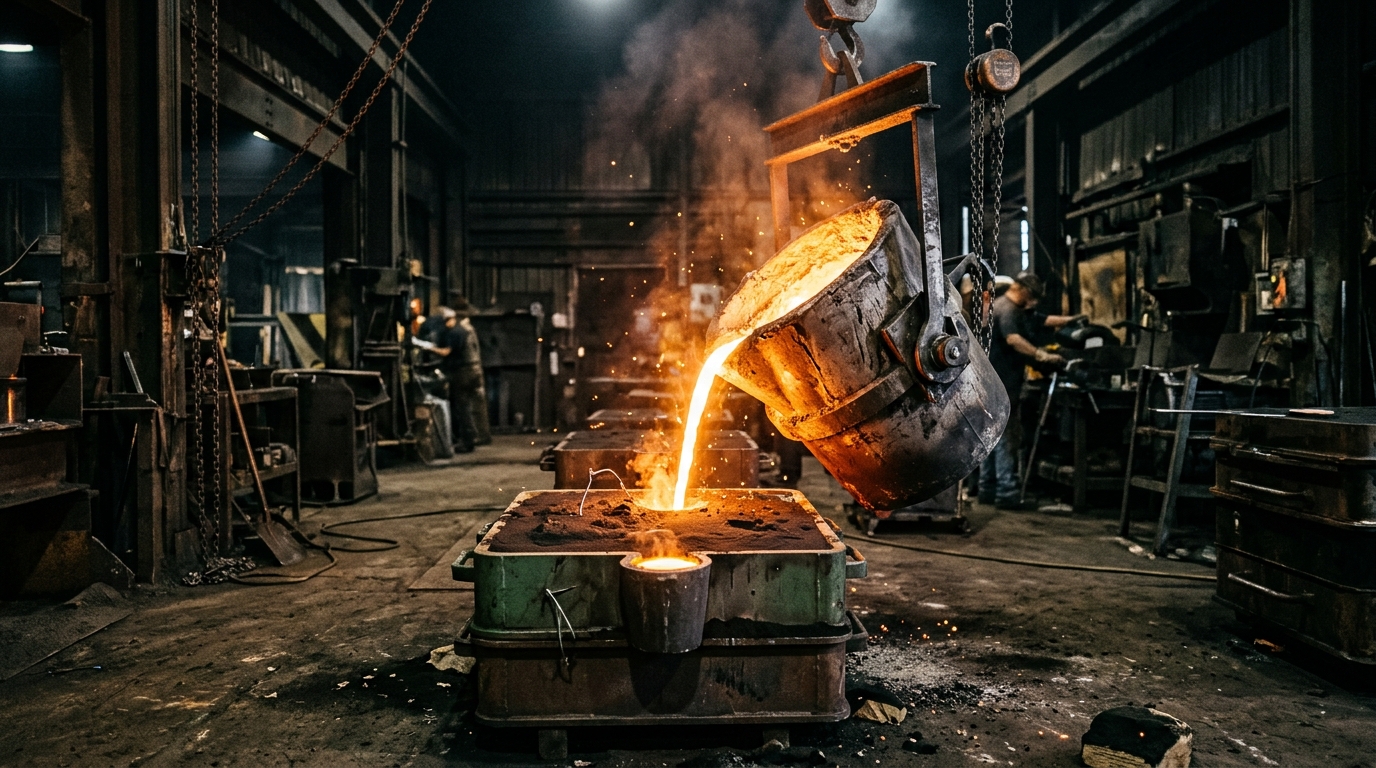
A new engineering evaluation model developed by researchers Xiuxu Zhao, Wei Cai, and Aojie Zhuang provides a detailed quantitative methodology for calculating greenhouse gas emissions during the sand casting of individual metal components, revealing that melting operations generate the vast majority of environmental impacts. Published in Carbon Neutral Systems, the study establishes a bottom-up mathematical framework that breaks down foundry operations into four core stages: molding, melting, recycling, and machining. Unlike aggregate assessments that evaluate emissions across an entire factory or national sector, this single-piece model isolates both variable material consumption tied directly to casting geometry and fixed indirect inputs spread across broader production runs. To validate the calculation method under real industrial conditions, the investigators conducted a case study at JZL Enterprise, a manufacturing company with an annual casting capacity of 50,000 tons producing metal components for wind turbines, injection molding machines, die-casting equipment, aerospace applications, and automotive tooling. By tracking the exact production steps of a massive wind turbine locking disk, the study demonstrates how floor-level operational choices dictate product carbon footprints.
The need for precise, unit-level carbon accounting in metal casting is driven by the severe environmental footprint of traditional metallurgical manufacturing. In China, nationwide greenhouse gas emissions reached 12,295.62 megatons of carbon dioxide equivalent, representing 25.88 percent of global emissions and ranking first worldwide, creating urgent pressure to meet international decarbonization goals established under agreements such as the Paris Agreement. Within this industrial ecosystem, the conventional foundry sector serves as a fundamental manufacturing pillar but suffers from acute energy inefficiencies, maintaining an average energy utilization rate of only 15 to 25 percent, falling well below international industrial averages. Furthermore, Chinese foundry production generates emissions of waste sand, furnace slag, and exhaust gases exceeding those of developed nations by more than tenfold. Despite these heavy environmental burdens, foundries have historically lacked practical tools to measure emissions from individual castings, making it difficult for engineers to evaluate how specific design parameters, tooling configurations, and operational workflows influence overall greenhouse gas output.
Prior research on carbon emissions in the casting industry has focused almost exclusively on macro-level system assessments rather than individual components. Earlier investigations commonly compared broad manufacturing categories, evaluating carbon differences between three-dimensional sand printing, lost wax investment casting, and traditional sand casting, or analyzed isolated geometric design adjustments like draft angles, mold slope, and machining allowances. Other life cycle assessments utilized explicit topology optimization to adjust structural stiffeners on components like box girders to minimize material consumption. However, these system-level studies relied heavily on top-down Input-Output models or broad Process Life Cycle Assessment techniques that aggregate emissions across an entire bill of materials or broad industrial classifications. While Input-Output tools provide convenient macroeconomic estimates, they lack the granular resolution needed to optimize specific casting runs. Standard life cycle methods rarely account for shop-floor operational realities like sandbox substitutions or shifting raw material blends, leaving an analytical gap for manufacturers handling diverse, small-batch production schedules.
To address these operational complexities, the research team developed an accounting framework that explicitly tracks carbon sources across materials, energy consumption, and environmental waste within four defined manufacturing stages. The accounting boundary begins with raw materials entering the workshop and ends when the finished casting leaves the final machining station, deliberately excluding raw material extraction and post-consumer product disposal. In the material modeling module, emissions are divided into variable carbon emissions governed directly by production parameters and fixed emissions distributed across ongoing plant operations. For the molding stage, variable material emissions arise from the consumption of resin sand, calculated from the volumetric difference between the casting mold and the external sandbox multiplied by sand density. The researchers formulated a sand-iron ratio parameter to represent this relationship concisely, adjusting for the first-stage recycling recovery rate of the foundry sand processing line, while supplementary materials like binders and coatings are amortized across total output as fixed emissions.
In the melting stage, material carbon emissions stem from the consumption of furnace charge components, including pig iron, scrap steel, carburizers, and silicon carbide, with total required iron mass adjusted by a designated pouring shrinkage margin. Because these raw material inputs can be assigned directly to specific production heats, melting material emissions are treated entirely as variable carbon emissions. Meanwhile, material emissions occurring in the sand recycling and mechanical machining stages represent indirect emissions arising from continuous tooling and process losses, modeled mathematically as fixed emissions amortized over the facility’s total casting production over a given timeframe. By integrating these four distinct stages into a unified material carbon equation, the model provides an exact mathematical formulation connecting component mass, the sand-iron ratio, sand reclamation rates, pouring shrinkage coefficients, raw material proportions, and material emission factors to calculate the comprehensive material carbon burden of an individual casting.
Energy carbon emissions across the casting lifecycle are calculated using a power-based methodology that evaluates electrical energy consumed by processing machinery and overhead handling equipment. During the molding stage, the model quantifies electricity used by mechanical sand mixers—determined by operating power, mixing efficiency, and mixed sand mass—alongside power consumed by electric cranes moving workpieces between work areas. Melting stage energy emissions encompass electrical power needed to liquefy iron in intermediate-frequency furnaces, calculated from single-ton melting electricity consumption and poured metal volume, combined with crane handling energy for molten ladles. In the recycling phase, energy emissions track electricity consumed by the used-sand reclamation line per ton of reclaimed sand plus crane transport power. For the machining stage, the model calculates the operational power and duration of shot blasting equipment alongside final crane handling. By systematically incorporating crane transit distances, travel speeds, and motor wattages across all four stages, the framework accurately captures previously overlooked workshop transport logistics.
The model also incorporates a waste carbon formulation that quantifies environmental emissions generated as airborne smoke, exhaust gases, and solid industrial residues. Because modern foundries utilize specialized recovery and filtration systems to neutralize airborne pollutants and collect solid byproducts, the researchers calculated waste carbon emissions based on electrical energy consumed by environmental protection equipment during treatment. Molding waste emissions account for electric power consumed by fume recovery systems treating dust and non-methane hydrocarbons generated during sand mixing and core fabrication, alongside thermal decomposition gases released from furan resin sand during pouring. Melting waste emissions combine the power consumption of fume extraction systems scrubbing furnace smoke with transport energy required by heavy equipment hauling electric furnace slag. Recycling waste calculations isolate electrical power of dust collectors servicing sand shakeout units and old sand processing lines, while machining waste models capture the energy of fume recovery equipment treating dust generated during shot blasting and grinding operations.
The research team validated their mathematical framework at JZL Enterprise by evaluating the production of a wind turbine locking disk cast from QT500-14 ductile iron, featuring a finished weight of 6,932 kilograms and an iron density of 7.08 grams per cubic centimeter. The pouring shrinkage allowance was set to 0.1 across trials. In the baseline scenario, designated locking disk No. 1, workers selected a sandbox measuring 6,000 by 6,000 by 550 millimeters, yielding a calculated sand-iron ratio of 8.25. The component moved through four workshop stages: molding in region eight with a 20-meter crane transfer to region eleven; melting in region five with molten iron transported 70 meters to region eleven; cooling followed by a 30-meter transit to sand drop area ten; and final transport over 130 meters to grinding area twenty-one. Shop equipment parameters included an 11.5-kilowatt sand mixer operating at 6.2855 kilograms per second, a single-ton melting energy requirement of 500 kilowatt-hours, sand reclamation energy of 0.0119 kilowatt-hours per ton, an 80-kilowatt shot blasting machine operating for 20 minutes, and a 17.7-kilowatt crane traveling at 16 meters per minute.
Applying the accounting model to locking disk No. 1 established a total carbon emission value of 48,180.455 kilograms of carbon dioxide equivalent, revealing an overwhelming concentration of emissions in the melting phase. Specifically, the melting stage generated 99.14 percent of total emissions, followed by molding at approximately 0.53 percent, machining at roughly 0.31 percent, and used-sand recycling at just 0.02 percent. This hierarchy—melting, molding, machining, and recycling—demonstrates that smelting represents the primary environmental leverage point in sand casting. The study showed melting emissions are dominated by embodied carbon in raw iron charges alongside electrical furnace consumption. To explore operational variations, the authors examined a second trial, locking disk No. 2, which used an oversized spare sandbox measuring 7,300 by 6,950 by 550 millimeters due to equipment shortages, causing the sand-iron ratio to reach 11.71. This substitution increased resin sand consumption by 41.97 percent and molding material emissions by 22.27 percent, while sand mixing and reclamation energy emissions rose by 41.97 percent and 41.86 percent.
The second production trial also demonstrated the environmental penalty of workshop logistics disruptions, as reassignment to an auxiliary production team altered the travel route and added 50 meters of crane transport, increasing crane energy emissions by 20.02 percent. Sensitivity index calculations across raw material inputs revealed that silicon carbide exhibited the largest absolute sensitivity coefficient because of its exceptionally high carbon concentration, meaning small adjustments in silicon carbide feeding drastically alter cumulative emissions. Despite these practical insights, the authors noted several limitations in their current model, including reliance on historical averages rather than real-time power metering on furnaces and cranes, the omission of sporadic equipment maintenance and ambient shop ventilation data, and inconsistencies across published emission factor databases. Future research must establish standardized carbon coefficient libraries, implement direct equipment energy monitoring, and incorporate dynamic shop scheduling to fully optimize casting decarbonization.
Subject of Research: Quantitative carbon emission modeling for individual sand casting processes
Article Title: Research on carbon emission calculation of sand casting for individual castings and case study
Article References: Zhao, X., Cai, W., & Zhuang, A. (2025). Research on carbon emission calculation of sand casting for individual castings and case study. Carbon Neutral Systems, 1(1), Article 6. https://doi.org/10.1007/s44438-025-00004-0
Image Credits: AI Generated
DOI: 10.1007/s44438-025-00004-0
Keywords: sand casting, carbon emissions, life cycle assessment, foundry decarbonization, industrial engineering, metal manufacturing, melting emissions, clean production, Research, carbon, emission, calculation
News Source: Denise Maddox. (November 9, 2026). Single-Casting Carbon Model Reveals Melting Dominates Emissions in Sand Casting Operations. Scienmag.