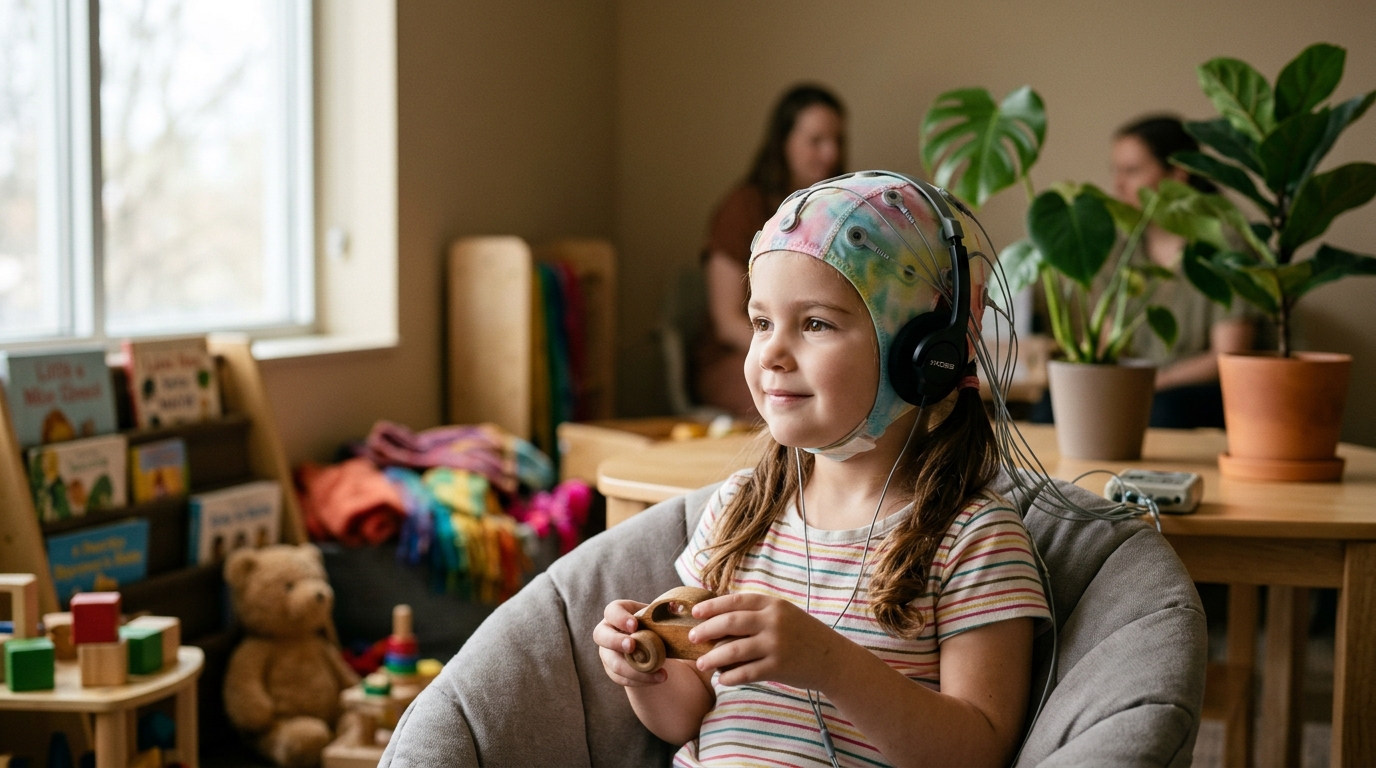
A single thirty-minute session of Berard auditory integration training produced immediate shifts in relative electroencephalographic band power among children diagnosed with autism spectrum disorder, but it resulted in no statistically significant changes in parameterized aperiodic neural activity, according to findings from an uncontrolled pilot study. The research project evaluated baseline resting-state electroencephalographic characteristics between autistic children and typically developing peers, while simultaneously tracking acute pre-to-post neurophysiological variations surrounding one clinical training session. Although auditory integration training is widely utilized as a complementary intervention for individuals on the autism spectrum, investigators underscored that both its immediate neurophysiological mechanisms and its potential clinical effects have remained largely uncertain in pediatric populations.
The foundational rationale for the study centered on the observation that resting-state electroencephalography characteristics may differ substantially between autistic and non-autistic children. However, conventional analytical approaches that calculate traditional frequency band power inherently conflate periodic oscillatory peaks with broad, underlying broadband activity. To resolve this methodological challenge, the study employed spectral parameterization, an advanced decomposition technique capable of systematically separating periodic oscillatory peaks from continuous aperiodic background activity. By isolating these distinct components, the investigators sought to clarify whether observed electroencephalographic features reflect true rhythmic neural oscillations or broader alterations in the underlying aperiodic spectral background.
The study cohort comprised twenty children diagnosed with autism spectrum disorder and fifteen typically developing comparison children, with all participants aged between six and eight years. Resting-state electroencephalographic activity was collected from the autistic participants immediately prior to the intervention and immediately following a single thirty-minute session of Berard auditory integration training. Within the autistic cohort, sixteen participants provided usable paired electroencephalographic recordings across both measurement intervals, allowing researchers to evaluate within-subject shifts directly. The experimental protocol evaluated relative power across five classical frequency bands, while periodic and aperiodic spectral features were decomposed and parameterized utilizing the FOOOF computational algorithm.
Baseline neurophysiological assessments revealed distinct electroencephalographic differences between the autistic children and the typically developing comparison group prior to any intervention. Specifically, children with autism spectrum disorder exhibited significantly higher relative power within the delta frequency band alongside comparatively lower relative power across the theta, alpha, and beta bands relative to typically developing controls. However, once spectral parameterization was applied to model and isolate the periodic spectral peaks, the FOOOF-derived aperiodic parameters—specifically the aperiodic exponent and the aperiodic offset—exhibited no statistically significant differences between the two pediatric groups at baseline.
Following the administration of the thirty-minute Berard auditory integration training session, paired within-subject analyses across the sixteen usable recordings in autistic participants identified notable shifts in conventional spectral bands. Delta band relative power demonstrated a statistically measurable decrease immediately post-session compared to baseline measurements. Concurrently, relative power measured within the higher-frequency beta and gamma bands showed a significant increase following the training session. In contrast to these conventional frequency changes, paired statistical tests evaluating pre-to-post adjustments in FOOOF-derived aperiodic exponent and offset values were nonsignificant, demonstrating that the aperiodic background remained unchanged.
The authors conducted detailed examinations of algorithm performance, identifying noticeable variability in model fit quality across individual recording sessions. Specifically, five out of twenty baseline electroencephalography recordings and seven out of eighteen post-session recordings failed to achieve an R-squared goodness-of-fit threshold of 0.90. To rigorously determine whether poor fit quality might have influenced or distorted the primary outcomes, the researchers executed extensive sensitivity analyses. These targeted evaluations systematically varied the applied R-squared inclusion thresholds, the operational aperiodic modes, model fitting parameter configurations, and spatial channel aggregation strategies, confirming that the null findings regarding aperiodic parameters remained stable across all methodological adjustments.
Given the uncontrolled pilot design of the investigation, the authors emphasized that the observed pre-to-post band-power differences must be interpreted with substantial scientific caution. Because the study lacked a sham-training condition or an untreated control arm measured across the same time window, the reported spectral changes cannot be uniquely or causally attributed to the specific auditory integration training protocol itself. The researchers explicitly noted that the observed shifts could instead reflect non-specific influences, including the effects of repeated electroencephalographic measurement over time, fluctuations in participant arousal, psychological expectancy, or simple physiological responses to generic auditory stimulation during the thirty-minute session.
Ultimately, the research team characterized the findings of this pilot investigation as hypothesis-generating observations rather than definitive evidence of therapeutic efficacy. The relatively small sample size of twenty children with autism spectrum disorder, combined with the variable spectral model fit quality observed across baseline and post-session recordings, placed distinct limitations on analytical precision. In light of these constraints, the investigators concluded that well-powered, controlled longitudinal studies will be necessary to distinguish intervention-specific mechanisms from non-specific factors and to determine whether auditory integration training offers meaningful neurophysiological or clinical utility for autistic children.
Subject of Research: Resting-state EEG spectral parameterization and band power in autistic children undergoing auditory integration training
Article Title: Resting-state EEG spectral characteristics before and after a single auditory integration training session in children with autism spectrum disorder
Article References: Wang, Y., You, Y., Wu, X., Chu, H., & Lu, C. (2026). Resting-state EEG spectral characteristics before and after a single auditory integration training session in children with autism spectrum disorder. Frontiers in Psychiatry, 17, Article 1948611. https://doi.org/10.3389/fpsyt.2026.1948611
Image Credits: AI Generated
DOI: 10.3389/fpsyt.2026.1948611
Keywords: Auditory Integration Training, Autism Spectrum Disorder, Resting-State EEG, Spectral Parameterization, FOOOF, Aperiodic Exponent, Aperiodic Offset, Periodic Oscillations, Delta Band Power, Theta Band Power, Alpha Band Power, Beta Band Power, Gamma Band Power, Berard AIT, Relative Power, Uncontrolled Pilot Study, Pediatric Neurophysiology
News Source: Cassandra Pierce. (November 13, 2026). Single Auditory Session Shifts Brain Waves in Autistic Children Without Aperiodic Changes. Scienmag.