• HOME
  • NEWS
  • EXPLORE
    • CAREER
      • Companies
      • Jobs
    • EVENTS
    • iGEM
      • News
      • Team
    • PHOTOS
    • VIDEO
    • WIKI
  • BLOG
  • COMMUNITY
    • FACEBOOK
    • INSTAGRAM
    • TWITTER
Wednesday, December 17, 2025
BIOENGINEER.ORG
No Result
View All Result
  • Login
  • HOME
  • NEWS
  • EXPLORE
    • CAREER
      • Companies
      • Jobs
        • Lecturer
        • PhD Studentship
        • Postdoc
        • Research Assistant
    • EVENTS
    • iGEM
      • News
      • Team
    • PHOTOS
    • VIDEO
    • WIKI
  • BLOG
  • COMMUNITY
    • FACEBOOK
    • INSTAGRAM
    • TWITTER
  • HOME
  • NEWS
  • EXPLORE
    • CAREER
      • Companies
      • Jobs
        • Lecturer
        • PhD Studentship
        • Postdoc
        • Research Assistant
    • EVENTS
    • iGEM
      • News
      • Team
    • PHOTOS
    • VIDEO
    • WIKI
  • BLOG
  • COMMUNITY
    • FACEBOOK
    • INSTAGRAM
    • TWITTER
No Result
View All Result
Bioengineer.org
No Result
View All Result
Home NEWS Science News

Simultaneous detection of multiple spin states in a single quantum dot

Bioengineer by Bioengineer
March 13, 2017
in Science News
Reading Time: 2 mins read
0
Share on FacebookShare on TwitterShare on LinkedinShare on RedditShare on Telegram
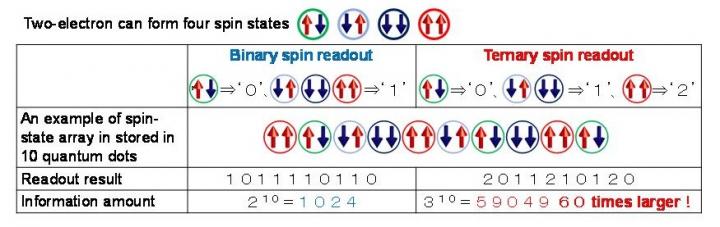
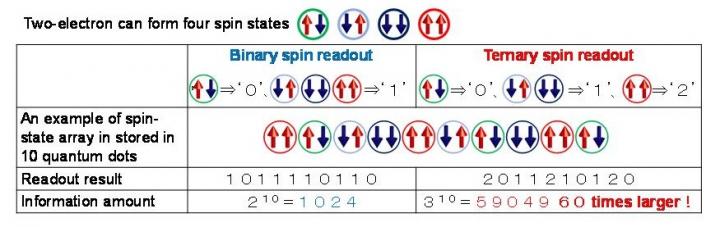
IMAGE

Credit: Osaka University

Osaka, Japan – Quantum dots are very small particles that exhibit luminescence and electronic properties different from those of their bulk materials. As a result, they are attractive for use in solar cells, optoelectronics, and quantum computing. Quantum computing involves applying a small voltage to quantum dots to regulate their electron spin state, thus encoding information. While traditional computing is based on a binary information system, electron spin states in quantum dots can display further degrees of freedom because of the possibility of superposition of both states at the same time. This feature could increase the density of encoded information.

Readout of the electron spin of quantum dots is necessary to realize quantum computing. Single-shot spin readout has been used to detect spin-dependent single-electron tunneling events in real time. The performance of quantum computing could be improved considerably by single-shot readout of multiple spin states.

A Japanese research collaboration based at Osaka University has now achieved the first successful detection of multiple spin states through single-shot readout of three two-electron spin states of a single quantum dot. They reported their findings in Physical Review Letters.

To read out multiple spin states simultaneously, the researchers used a quantum point contact charge sensor positioned near a gallium arsenide quantum dot. The change in current of the charge sensor depended on the spin state of the quantum dot and was used to distinguish between singlet and two types of triplet spin states.

"We obtained single-shot ternary readout of two-electron spin states using edge-state spin filtering and the orbital effect," study first author Haruki Kiyama says.

That is, the rate of tunneling between the quantum dot and electron reservoir depended on both the spin state of the electrons and the interaction between electron spin and the orbitals of the quantum dot. The team identified one ground state and two excited states in the quantum dot using their setup.

The researchers then used their ternary readout setup to investigate the spin relaxation behavior of the three detected spin states.

"To confirm the validity of our readout system, we measured the spin relaxation of two of the states," Kiyama explains. "Measurement of the dynamics between the spin states in a quantum dot is an important application of the ternary spin readout setup."

The spin relaxation times for the quantum dot measured using the ternary readout system agreed with those reported, providing evidence that the system yielded reliable measurements.

This ternary readout system can be extended to quantum dots composed of other materials, revealing a new approach to examine the spin dynamics of quantum dots and representing an advance in quantum information processing.

###

Media Contact

Saori Obayashi
[email protected]
81-661-055-886
@osaka_univ_e

http://www.osaka-u.ac.jp/en

############

Story Source: Materials provided by Scienmag
Share12Tweet8Share2ShareShareShare2

Related Posts

AI and Data Science Transform Cervical Cancer Care

AI and Data Science Transform Cervical Cancer Care

December 17, 2025

Transforming Color Fundus Photos into Fluorescein Angiography

December 17, 2025

Two Decades of Spinal Cord Injury Care Insights

December 17, 2025

MAT2A Drives Macrophage Changes, Weakening Plaques

December 17, 2025
Please login to join discussion

POPULAR NEWS

  • Nurses’ Views on Online Learning: Effects on Performance

    Nurses’ Views on Online Learning: Effects on Performance

    70 shares
    Share 28 Tweet 18
  • NSF funds machine-learning research at UNO and UNL to study energy requirements of walking in older adults

    70 shares
    Share 28 Tweet 18
  • MoCK2 Kinase Shapes Mitochondrial Dynamics in Rice Fungal Pathogen

    72 shares
    Share 29 Tweet 18
  • Unraveling Levofloxacin’s Impact on Brain Function

    52 shares
    Share 21 Tweet 13

About

We bring you the latest biotechnology news from best research centers and universities around the world. Check our website.

Follow us

Recent News

AI and Data Science Transform Cervical Cancer Care

Transforming Color Fundus Photos into Fluorescein Angiography

Two Decades of Spinal Cord Injury Care Insights

Subscribe to Blog via Email

Enter your email address to subscribe to this blog and receive notifications of new posts by email.

Join 70 other subscribers
  • Contact Us

Bioengineer.org © Copyright 2023 All Rights Reserved.

Welcome Back!

Login to your account below

Forgotten Password?

Retrieve your password

Please enter your username or email address to reset your password.

Log In
No Result
View All Result
  • Homepages
    • Home Page 1
    • Home Page 2
  • News
  • National
  • Business
  • Health
  • Lifestyle
  • Science

Bioengineer.org © Copyright 2023 All Rights Reserved.