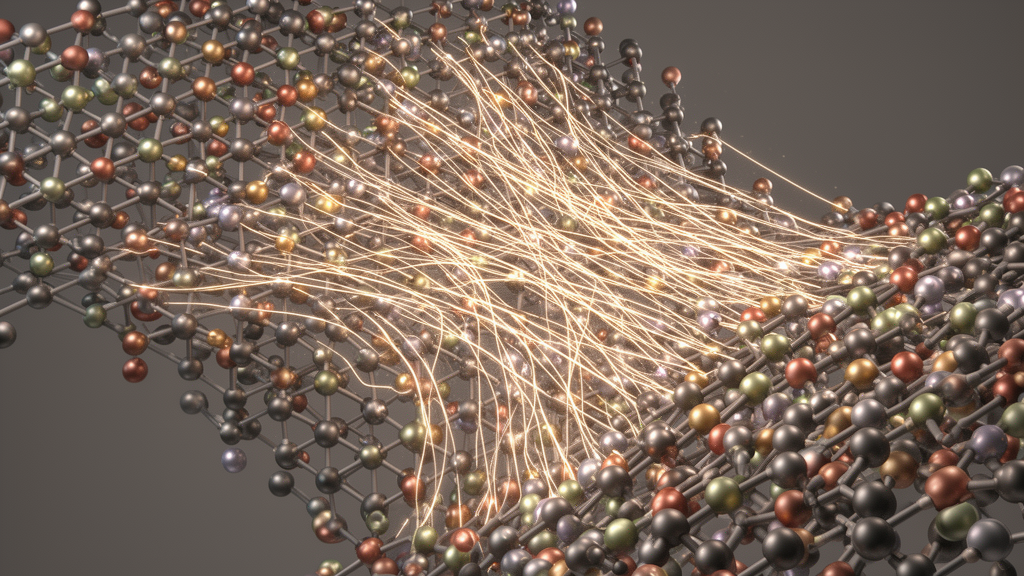
Atomistic simulations of single-phase face-centered cubic complex concentrated alloys subjected to uniaxial tension demonstrate that serrated plastic flow is governed by universal dislocation avalanches within the quasi-static deformation regime. Researchers Kamran Karimi, Amin Esfandiarpour, and Stefanos Papanikolaou investigated the intermittent mechanical dynamics of equiatomic NiCoCrFeMn Cantor alloy and medium-entropy NiCoCr alongside pure nickel to characterize how atomic-level chemical complexity influences collective defect motions. Under slow driving conditions, sudden drops in tensile stress correspond directly to internal structural rearrangements, generating scale-free event distributions that match mean-field theoretical predictions. The numerical study demonstrates that despite extensive chemical randomness and severe lattice distortions, the statistical exponents characterizing plastic slip bursts remain largely invariant between five-element and three-element compositions. These computational findings establish a direct microscopic link between macroscopic serrated stress signals and the spatial formation of planar defect clusters within crystalline bulk volumes.
Serrated flow represents a widespread physical phenomenon observed across driven, non-equilibrium systems pushed beyond their stability thresholds at low driving velocities. Physical manifestations of such intermittent crackling dynamics include acoustic emissions during crystal plasticity or brittle fracture, Barkhausen noise generated by domain-wall motion in ferromagnets, and stick-slip earthquake dynamics occurring along geological fault zones. Within crystalline solids undergoing plastic deformation, internal relaxation occurs through intermittent slip bursts driven by the spontaneous nucleation, depinning, and collective glide of dislocations across crystal planes. These collective bursts, commonly termed dislocation avalanches, exhibit scale-free characteristics spanning multiple orders of magnitude in energy, length, and temporal duration. Because these bursts reflect critical behavior associated with the yielding transition, physical models frequently employ mean-field theory to describe their scale invariance, while recognizing that microstructural features, crystalline phase, orientation, and driving rates can introduce notable non-universal deviations.
Understanding avalanche mechanisms becomes markedly challenging in multi-element high-entropy and medium-entropy alloys due to their intrinsic structural and chemical heterogeneity. Unlike conventional pure metals or dilute alloys, complex concentrated alloys feature rugged potential energy landscapes produced by disparate atomic radii and varying local bonding environments. These atomic-level variations induce substantial fluctuations in local Peierls resistance, roughening dislocation lines and inducing atypical pinning patterns during plastic glide. Previous experimental work has revealed that compressed high-entropy alloy nanopillars accumulate dense dislocation bands and pile-ups rather than undergoing the rapid surface-induced dislocation annihilation characteristic of pure face-centered cubic crystals. Furthermore, compositional heterogeneities such as local chemical ordering, nanoscale precipitation, and strain-induced phase transformations interact with moving defects in complex manners. Prior acoustic emission experiments established the presence of critical jerky flow in high-entropy metals, yet connecting rapid surface acoustic waveforms directly to interior three-dimensional defect evolution has remained experimentally elusive.
To overcome experimental characterization constraints and examine the microscopic origin of deformation intermittency, the authors conducted large-scale molecular dynamics simulations using the open-source LAMMPS software. The researchers constructed three-dimensional cubic computational domains containing ten thousand atoms measuring forty angstroms per side, applying periodic boundary conditions along the coordinate axes corresponding to the standard crystallographic directions. Interatomic interactions were modeled utilizing a recently developed modified embedded-atom method potential parameterized for multi-component nickel, cobalt, chromium, iron, and manganese systems. Constant-temperature and constant-pressure ensembles were regulated through Nose-Hoover thermostats and barostats, using relaxation times of ten femtoseconds and one hundred femtoseconds with an integration time step of one femtosecond. Initial defect-free atomic configurations were brought to potential energy minima at zero kelvin under fixed pressure and subsequently equilibrated at three hundred kelvin and zero bar for one hundred picoseconds prior to tensile deformation.
Tensile deformation was applied along the longitudinal z direction under zero lateral pressures across constant strain rates spanning ten to the eighth power to ten to the tenth power per second. Recognizing that atomistic simulations necessarily operate at strain rates orders of magnitude faster than typical laboratory testing, the authors completed supplementary evaluations at reduced rates of zero point five times ten to the eighth and zero point twenty-five times ten to the eighth per second. These additional simulations confirmed that the statistical avalanche distributions and scaling exponents converged stably within the quasi-static limit. Due to the initially defect-free crystalline lattice, plastic deformation initiated at an elevated yield stress near eight gigapascals, consistent with theoretical critical shear stresses reported for face-centered cubic nickel. Following initial yielding, the plastic response transitioned into a sustained stick-slip regime displaying sharp stress drops preceded by prolonged elastic stress accumulation stages.
Individual dislocation avalanches were tracked throughout the steady-state plastic flow interval between tensile strains of zero point two and one point zero, intentionally omitting initial yielding transients. The authors calculated the size of each avalanche event by integrating the negative time derivative of normal stress over the event duration, which began when the stress release rate crossed a threshold set by the median negative stress rate. To separate genuine slip-induced stress drops from thermal fluctuations inherent to molecular dynamics at room temperature, optimal Wiener filtering was implemented to smooth stress time series. Ensembles comprising ten to one hundred independent simulation realizations were generated for each strain rate, yielding extensive datasets encompassing one thousand to ten thousand discrete avalanche events per material condition. Systematic evaluations confirmed that slight modifications to the strain integration window or the detection threshold did not alter the measured power-law scaling exponents.
Statistical evaluation of steady-state avalanches revealed that the average event size scaled with event duration according to a power law whose exponent approximated one point zero across all three investigated metals. For the Cantor alloy deformed at the slowest rate of ten to the eighth per second, the probability distribution of avalanche sizes exhibited an asymptotic power-law decay spanning two orders of magnitude with a scaling exponent matching the classical mean-field prediction of three halves. Medium-entropy NiCoCr exhibited identical power-law decay behavior, although its scale-free window was comparatively truncated, a feature the authors attribute to stronger local lattice misfits and pronounced chemical disorder driving the material away from pure criticality. Conversely, pure nickel exhibited a distinctly shallower exponent below three halves at equivalent low rates, signaling an increased prevalence of large events in the absence of solute-induced pinning obstacles, before converging toward mean-field values as strain rates increased.
Microstructural tracking conducted via common neighbor analysis in the OVITO package allowed the authors to classify atomic coordination changes, specifically monitoring the emergence of hexagonal close-packed and body-centered cubic local configurations. Hexagonal close-packed atomic layers directly signify stacking faults created by the passage of partial dislocations gliding across close-packed crystal planes. Spatial cluster analysis demonstrated that hexagonal close-packed atomic clusters formed predominantly planar geometries characterized by a fractal dimension of two point zero when relating cluster size to the radius of gyration. The probability distribution of these structural clusters displayed power-law tails spanning over two decades, exhibiting an exponent near one point zero at the slowest strain rate, which is shallower than the standard percolation prediction of two. As deformation rates intensified, the cluster distributions steepened toward percolation estimates before transitioning into subcritical states lacking scale-free behavior.
Crystallographic orientation mapping of the normal vectors of hexagonal close-packed glide planes confirmed that dislocation glide was initially concentrated along the four close-packed slip families of the face-centered cubic lattice. Under sustained uniaxial elongation, mechanical reorientation rotated active planes toward cube and diagonal crystallographic orientations, with rapid deformation rates producing noticeably broader orientation spreads. Correlation analyses comparing the logarithm of avalanche stress drops with integrated changes in structural phase fractions confirmed strong positive associations between avalanche magnitude and hexagonal close-packed formation at low strain rates. Stress drops correlated more strongly with hexagonal close-packed stacking fault generation than with body-centered cubic transitions, demonstrating that plastic bursts are primarily driven by partial dislocation propagation. However, as the deformation velocity increased toward ten to the tenth per second, these correlations degraded significantly, indicating that rapid driving disperses localized critical dynamics into uncorrelated, homogeneous atomic shearing.
The authors emphasize key physical constraints inherent to their atomistic models, noting that small periodic boxes exclude external free surfaces, grain boundaries, and pre-existing defect structures such as dislocation loops that govern laboratory micro-scale experiments. Despite the accelerated strain rates required by atomistic modeling, the simulations successfully reproduce critical scale-free exponents observed in physical experiments, while capturing the rate-dependent crossover from stick-slip avalanches to continuous viscous flow. These findings indicate that while local chemical disorder restricts the spatial extent of individual slip planes, collective dislocation dynamics in chemically complex alloys retain universal scaling signatures shared with simpler crystalline lattices. Furthermore, establishing quantitative relationships between external stress fluctuations and interior defect morphology supports the development of machine-learning models designed to deduce internal damage progression from external mechanical and acoustic monitoring.
Subject of Research: Atomistic simulation of dislocation avalanches and serrated plastic flow in complex concentrated alloys
Article Title: Serrated plastic flow in deforming complex concentrated alloys: universal signatures of dislocation avalanches
Article References: Karimi, K., Esfandiarpour, A., & Papanikolaou, S. (2024). Serrated plastic flow in deforming complex concentrated alloys: universal signatures of dislocation avalanches. Journal of Materials Science: Materials Theory, 8(1), Article 7. https://doi.org/10.1186/s41313-024-00059-5
Image Credits: AI Generated
DOI: 10.1186/s41313-024-00059-5
Keywords: dislocation avalanches, serrated plastic flow, high-entropy alloys, medium-entropy alloys, Cantor alloy, NiCoCrFeMn, NiCoCr, atomistic simulations, molecular dynamics, LAMMPS, power-law scaling, mean-field theory, stacking faults, common neighbor analysis, quasi-static deformation, stick-slip dynamics, percolation theory
News Source: Denise Maddox. (November 21, 2026). Simulations Reveal Universal Dislocation Avalanches in Deforming Chemically Complex Alloys. Scienmag.