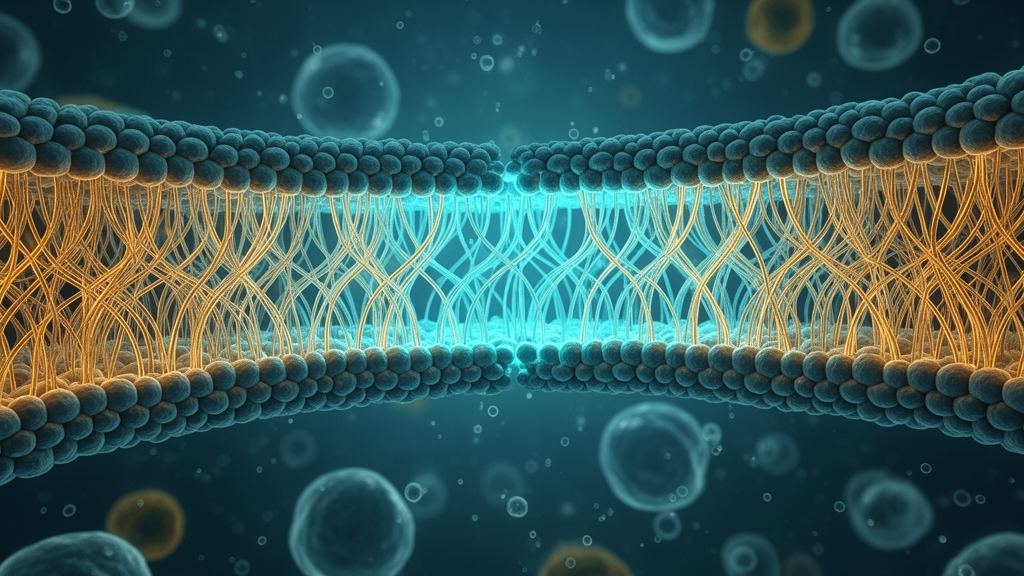
Computational biophysicists using atomistic molecular dynamics simulations have characterized how specific molecular contacts within the linker of nucleoskeleton and cytoskeleton complex govern mechanical load transmission across the nuclear envelope. By modeling the trimeric SUN2–KASH2 interface under applied tensile force, the researchers discovered that mechanical propagation does not behave as an all-or-none rupture event. Instead, load transfer is regulated by discrete structural elements functioning as molecular force gates, primarily a covalent intermolecular disulfide bond and a noncovalent beta-sheet hydrogen-bond network. Disruption of these distinct interfaces revealed that load transmission is separated into separable mechanical observables: the covalent bridge dictates absolute peak and sustained force capacity, whereas the flanking beta-sheet network coordinates interfacial coupling, structural compliance, and the temporal duration of mechanical engagement.
Mechanical forces generated within the eukaryotic cytoskeleton propagate through defined molecular bridges to reach the nuclear interior, where they guide cellular positioning, organize chromatin architectures, and drive mechanosensitive transcriptional signaling. A central pathway facilitating this transmission is the LINC complex, an assembly spanning both bilayers of the nuclear envelope. Within this bridging architecture, inner nuclear membrane SUN proteins interact directly with outer nuclear membrane KASH peptides to channel cytoplasmic tension into the nuclear lamina. Dysregulation of this mechanical transmission pathway is closely associated with mechanopathic disorders known as laminopathies, including Hutchinson–Gilford Progeria Syndrome. In such pathological states, compromised mechanical coupling between the cytoplasm and the nuclear lamina leads to aberrant stress localization, severe nuclear blebbing, genomic instability, and cellular dysfunction.
Although mammals express several SUN and KASH isoforms, somatic tissues predominantly utilize SUN1 and SUN2, which assemble as trimers that anchor into the nuclear lamina via their amino-terminal domains. While accumulation of SUN1 has been implicated in excessive nucleus–microtubule coupling in certain laminopathy models, SUN2 is elevated in Zmpste24-deficient backgrounds under mechanical strain, where it directly drives nuclear stiffening, structural damage, and blebbing. To resolve the atomistic details of force propagation across this critical junction, the researchers established structural models derived from the crystallographic structure of the human SUN2–KASH2 complex. Because obtaining high-resolution dynamic readouts of force-loaded interfaces remains experimentally challenging, the team used steered molecular dynamics simulations to quantify the individual mechanical contributions of specific interfacial contacts.
To deconstruct the load-bearing pathway, the investigative team introduced site-directed perturbations into the crystallized SUN2–KASH2 trimer. In the wild-type interface, mechanical continuity depends on three primary motifs: a covalent intermolecular disulfide bridge formed between SUN2 cysteine 563 and KASH2 cysteine 6862, an extensive beta-sheet hydrogen-bond network between the KASH peptide and an overlying SUN2 loop known as the KASH lid, and a conserved carboxy-terminal KASH PPPX sequence that docks into the SUN binding pocket. Because altering the PPPX motif abolishes baseline assembly altogether, the researchers preserved this anchor and instead targeted the beta-sheet pairing. By substituting KASH2 residues 6875 and 6877 with proline—an amino acid incapable of donating backbone hydrogen bonds—they disrupted beta-sheet registration without destabilizing the global fold, creating the double-proline construct KASH-2P. Separately, they modeled a disulfide-deleted variant, designated delta SS, by removing the covalent connectivity between the paired cysteines while leaving the residue identities intact.
Prior to applying directional pulling forces, all engineered constructs were evaluated for structural stability across 100-nanosecond equilibrium simulations in explicit water with physiological salt concentrations approximating the nucleoplasmic environment. System potential-energy trajectories showed steady behavior around construct-specific means without drift, confirming that all assemblies sampled stable conformational ensembles. Root mean square deviation tracking demonstrated that wild-type SUN2–KASH2 maintained the lowest structural divergence from its starting coordinates, plateauing near 0.22 to 0.28 nanometers. Removing the covalent tether in the delta SS construct caused modest increases in conformational variability due to the newly unconstrained peptide chain, whereas introducing proline substitutions in KASH-2P and the combined delta SS-KASH-2P variant elevated backbone root mean square deviation to between 0.30 and 0.36 nanometers. Importantly, all constructs reached structural plateaus within ten nanoseconds, confirming that downstream alterations in pulling performance originated from specific contact losses rather than gross assembly destabilization.
Detailed geometric and energetic analyses confirmed that the double-proline substitutions disrupted the beta-sheet force gate. In wild-type and delta SS complexes, backbone dihedral angles within KASH residues 6874 through 6879 resided in favorable beta-strand regions for more than 91 percent of the simulation time, maintaining persistent hydrogen bonding with the SUN KASH-lid. Conversely, double-proline mutants exhibited pronounced shifts toward polyproline conformations, with favorable Ramachandran occupancy dropping to approximately 75 to 79 percent alongside a complete collapse of interfacial hydrogen bonding. Per-residue free-energy decompositions using generalized Born implicit solvent models revealed substantial losses in stabilizing interaction energy at SUN2 residues leucine 573 and serine 575, which normally pair with KASH2 positions 6875 and 6877. In parallel, solvent-accessible surface area measurements of the KASH peptide increased markedly from approximately 23 square nanometers in wild-type assemblies to between 24 and 30 square nanometers in proline-bearing variants, reflecting physical uncoupling and lost burial against the SUN lid.
To evaluate how structural disruption translates into dynamic force propagation, the authors subjected the constructs to constant-velocity steered pulling simulations applied to the oxygen atoms of KASH2 cysteine 6862 at one angstrom per nanosecond for 50 nanoseconds, anchored against positionally restrained glycine 522 residues on the SUN2 coiled-coil stalk. Trajectory analyses revealed a striking bimodal separation dictated entirely by the presence or absence of the intermolecular disulfide bond. Assemblies retaining an intact disulfide bond sustained high mechanical resistance, exhibiting trajectory-mean forces ranging from 348 to 446 piconewtons and peak forces reaching 626 to 756 piconewtons. In contrast, disulfide-deleted systems displayed dramatic reductions across both parameters, yielding mean forces of only 142 to 190 piconewtons and peak forces between 381 and 460 piconewtons, establishing that the covalent cross-link is indispensable for maximum load-bearing capacity.
Crucially, the simulations demonstrated that the noncovalent beta-sheet network provides an independent layer of mechanical regulation rather than merely scaling peak resistance. While the double-proline mutant KASH-2P retained the disulfide bond, its mean pulling force decreased moderately to 396 piconewtons and peak force reached 626 piconewtons—differences falling within the replicate variability of the wild-type baseline. However, temporal force-time trajectories revealed that KASH-2P diverged late during loading, altering the duration and compliance of the interface. When tracking downstream structural transmission through root mean square fluctuation of the SUN2 coiled-coil stalk residues 522 to 554, wild-type showed an increase to 0.525 nanometers under tension compared to 0.083 nanometers at rest. In KASH-2P, stalk fluctuations rose even higher to 0.706 nanometers despite lower mean transmitted force, indicating increased structural compliance and altered mechanical deformation routes through the SUN trimer.
Dynamic cross-correlation analysis and kernel-based change-point detection further exposed how these distinct contact points direct mechanical communication pathways. In wild-type complexes, pulling induced extensive positive correlations across all three SUN protomers, reflecting coordinated motion throughout the trimeric bundle. Removing the disulfide bond severed this cooperative communication, isolating movement to the immediate pulling site and preventing strain from propagating into downstream coiled-coil domains. Application of change-point detection algorithms to spatial coordinate time series identified dense clusters of coordinated transitions across the wild-type interface as tensile forces traversed successive gates. In contrast, mutant complexes showed significantly reduced change-point density, with the combined delta SS-KASH-2P construct displaying the fewest structural rearrangements and failing to engage downstream SUN domains.
These atomistic findings establish a conceptual force-gate framework wherein discrete structural motifs at the nuclear envelope act sequentially and modularly to modulate force transmission. The authors note, however, several key physical and experimental constraints that bound these conclusions. First, the data derive entirely from atomistic computer simulations utilizing accelerated pulling rates that exceed physiological loading regimes, requiring future single-molecule biophysical validation. Second, the simulations modeled symmetric pulling across all three KASH docking sites simultaneously, representing a fully occupied reference state; in living cells, stoichiometry measurements indicate that KASH occupancy is frequently substoichiometric, which would generate asymmetric load distributions across fewer engaged pairs. Additionally, downstream salt-bridge ruptures in the coiled-coil domain remain model-based predictions, and whether these force-gating principles can eventually be manipulated to protect mechanically fragile nuclei in laminopathies remains a speculative avenue for ongoing research.
Subject of Research: Mechanisms of mechanical force transmission across the nuclear envelope mediated by SUN–KASH molecular force gates
Article Title: Molecular force gates regulate mechanical transmission across the nuclear envelope
Article References: Domkam, N., Yerima, G., Tsukamoto, S., & Mofrad, M. R. K. (2026). Molecular force gates regulate mechanical transmission across the nuclear envelope. Nucleus, 17(1), Article 2756751. https://doi.org/10.1080/19491034.2026.2756751
Image Credits: AI Generated
DOI: 10.1080/19491034.2026.2756751
Keywords: nuclear envelope, LINC complex, SUN2, KASH2, mechanotransduction, molecular dynamics, steered molecular dynamics, force gates, disulfide bond, beta-sheet network, laminopathies, Hutchinson-Gilford progeria syndrome, cross-correlation analysis, change-point detection, protein mechanics, nuclear lamina
News Source: Drew Townsend. (November 23, 2026). Simulations Reveal Molecular Force Gates Controlling Mechanical Load Across Nuclear Envelopes. Scienmag.