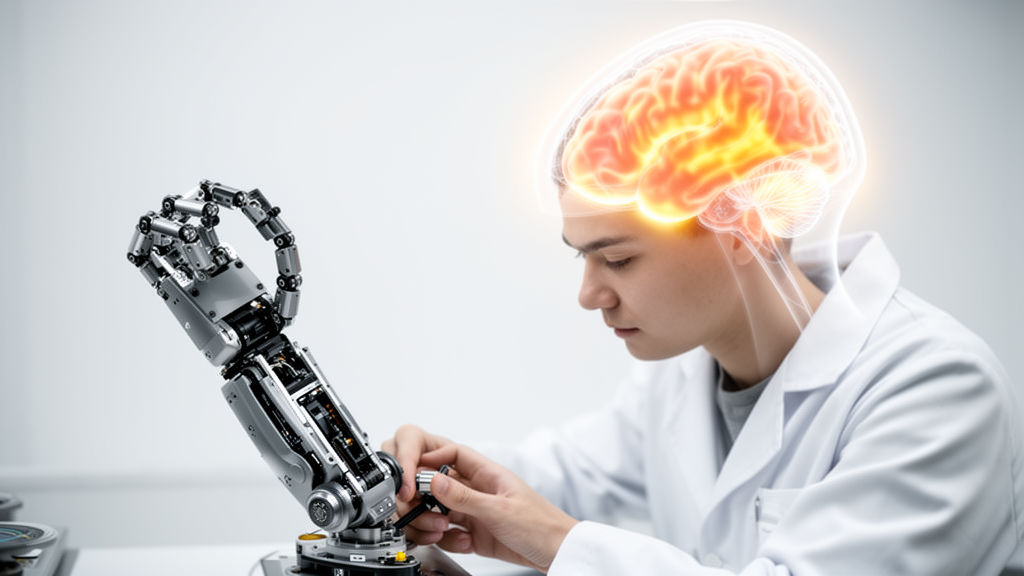
Using a simulated tendon-driven prosthesis during daily living activities significantly increases subjective mental demand and prefrontal cortical activation compared to natural hand use, according to research published in the Journal of NeuroEngineering and Rehabilitation. In a controlled investigation led by researchers Lorena Velásquez, Gabriella Goytizolo, Hasan Ayaz, and Jeremy D. Brown, upper-limb prosthesis use elevated subjective mental demand ratings by 2.80 to 3.85 points across experimental tasks (all p < 0.001).
The researchers observed corresponding neurophysiological changes using functional near-infrared spectroscopy, known as fNIRS, to measure prefrontal cortical activation. During a carton transfer and pour task, prosthesis use increased prefrontal oxygenated hemoglobin by 0.96 to 1.14 micromolar across recorded regions (all p < 0.001). These neurophysiological measurements captured biological manifestations of cognitive workload as participants executed the prosthesis-mediated task demands.
Eye-tracking measures, which evaluated gaze behavior and pupillary dynamics, revealed task-dependent physiological responses across the different testing conditions. Pupillary activity successfully differentiated prosthesis use from natural hand use during a block transfer task (p < 0.001) and a checker transfer task (p < 0.05). However, pupillary activity did not differentiate between conditions during the carton transfer and pour task (p = 0.47), demonstrating that cognitive responses vary across distinct modalities depending on the specific activity performed.
The study was designed to investigate a multimodal framework for assessing cognitive load during activities of daily living, addressing a persistent challenge in assistive technology. The cognitive burden associated with upper-limb prosthesis use remains a barrier to functional adoption, yet existing evaluations often rely on single-modality measures. By assessing subjective, behavioral, and neurophysiological metrics concurrently, the multimodal framework evaluated how prosthesis-mediated task demands manifest across multiple functional domains.
To establish this assessment framework, the team implemented a within-subject experimental design involving twelve participants without limb loss. Each participant completed standardized activities of daily living under two conditions: utilizing their natural hand and operating a simulated tendon-driven prosthesis. Cognitive workload was evaluated across these conditions through objective task performance metrics, subjective ratings from the NASA Task Load Index, pupillary dynamics and gaze behavior from eye-tracking, and fNIRS recordings of prefrontal activation.
The authors concluded that a multimodal framework delivers a more comprehensive assessment of cognitive load than any single evaluation measure applied on its own. By tracking how cognitive demand manifests across behavioral, perceptual, and biological domains, the investigation establishes a controlled baseline for multimodal cognitive workload assessment. This controlled baseline in participants without limb loss provides an empirical foundation for future investigations examining cognitive load in individuals with limb loss.
Subject of Research: Multimodal assessment of cognitive load during simulated upper-limb prosthesis use
Article Title: Multimodal evaluation of cognitive load during prosthetic device use in activities of daily living
Article References: Velásquez, L., Goytizolo, G., Ayaz, H., & Brown, J. D. (2026). Multimodal evaluation of cognitive load during prosthetic device use in activities of daily living. Journal of NeuroEngineering and Rehabilitation. https://doi.org/10.1186/s12984-026-02221-1
Image Credits: AI Generated
DOI: 10.1186/s12984-026-02221-1
Keywords: prosthetic device use, cognitive load, activities of daily living, upper-limb prosthesis, multimodal framework, tendon-driven prosthesis, NASA Task Load Index, NASA-TLX, eye tracking, gaze behavior, pupillary dynamics, prefrontal cortical activation, functional near-infrared spectroscopy, fNIRS, oxygenated hemoglobin, mental demand, block transfer task, checker transfer task, carton transfer and pour task
News Source: Cassandra Pierce. (November 16, 2026). Simulated Prosthesis Use Elevates Mental Demand and Prefrontal Brain Activation. Scienmag.