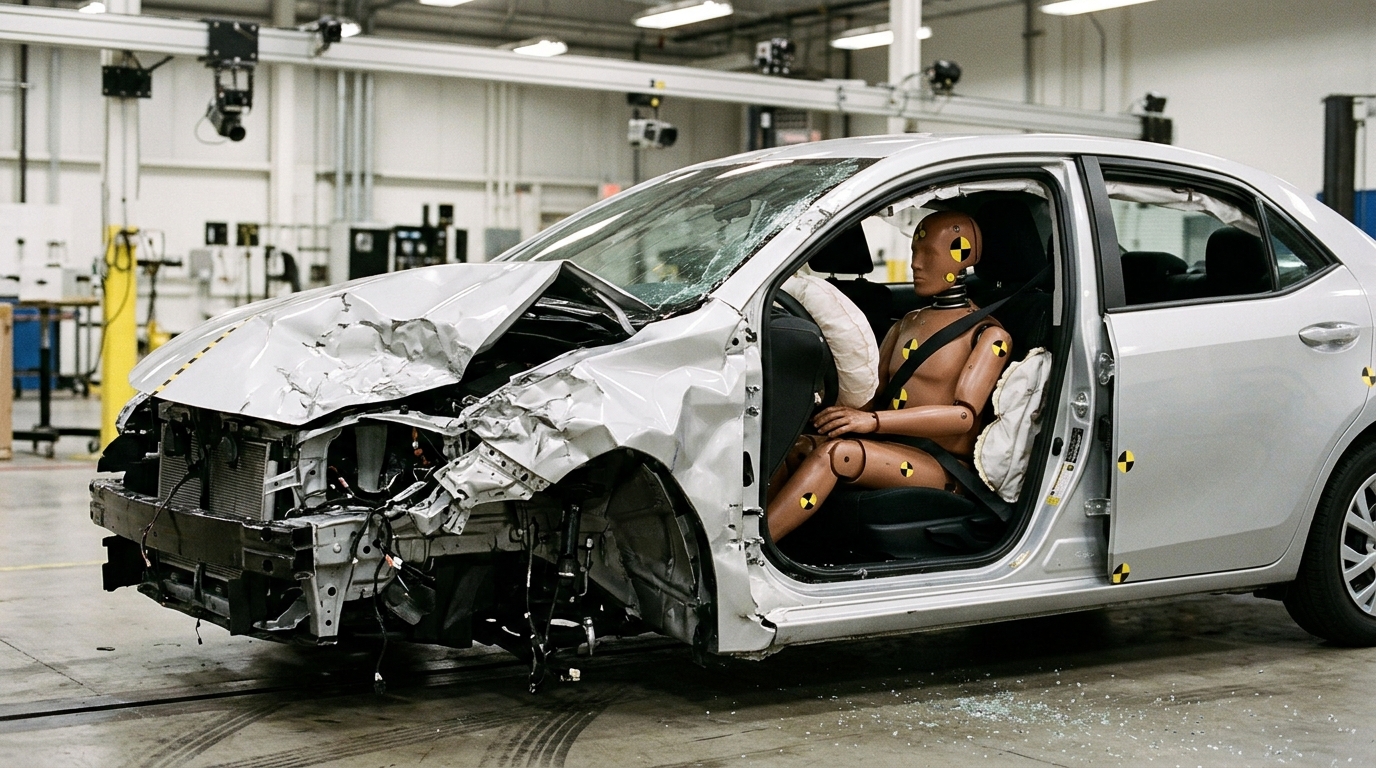
Virtual forward simulation serves as an increasingly central engineering methodology for evaluating the prospective safety performance of advanced driver assistance systems before vehicles enter the circulating fleet. When active safety interventions such as autonomous emergency braking or lane keeping assist fail to prevent an imminent collision, computerized simulation routines must reliably resolve subsequent structural impact mechanics to quantify how effectively those systems mitigate collision severity. However, contemporary crash reconstruction databases and pre-crash numerical datasets frequently encode vehicle contours as crude two-dimensional geometric approximations, such as simple rectangles or low-order polygons, to minimize the technical effort required during large-scale data compilation. A detailed investigation published in the Journal of King Saud University Engineering Sciences reveals that omitting realistic vehicle contours introduces substantial numerical errors into advanced dynamic simulation models, underestimating change in velocity by more than five kilometers per hour and underestimating predicted driver injury probabilities by up to sixty percent in real-world collision scenarios.
The international research initiative, conducted by investigators Michelangelo-Santo Gulino, Giulio Vichi, Gianmarco Aiazzi, and Dario Vangi, evaluated how geometric simplification propagates through computational frameworks commonly deployed to prospectively assess automotive safety systems. Under international standards such as ISO TR 21934, prospective evaluation procedures compare baseline crash simulations lacking advanced safety features against replicated runs where automated intervention technologies are active. Performing these assessments across representative driving conditions requires extensive pre-crash databases that record real-world kinematics, obstacle trajectories, and vehicle motions in standardized formats like the Pre-Crash Matrix used across registries including GIDAS, IGLAD, CIDAS, and RASSI. While these structured datasets document pre-impact kinematic variables up to five seconds prior to impact, the physical boundaries of participating passenger cars are almost universally simplified into bounding boxes defined by four to six vertices, obscuring the bumper curves, corner tapers, and exterior contours that govern initial vehicular contact.
To rigorously identify the exact data fidelity necessary for reliable impact assessments, the researchers implemented a specialized two-dimensional simulation tool built upon a reduced order dynamic model. Unlike heavy finite element analysis routines that require extensive supercomputing resources, or rigid momentum-based formulations that compute post-crash velocities without tracking structural deformation energies or dynamic force histories, reduced order dynamic models establish an operational balance between computational efficiency and physical accuracy. The simulation platform adopted for the study had previously undergone rigorous empirical validation across forty-seven real-world crashes and standardized experimental crash tests documented by expert reconstructions and crash footage. In this computational architecture, each vehicle perimeter is discretized into two hundred discrete nodes connected through spring elements to an inertial center of mass, using structural stiffness parameters derived from standardized crash test load-deformation curves to simulate elasto-plastic structural responses under planar impact conditions.
The experimental campaign encompassed four thousand three hundred and twenty systematic forward simulations executed across standard collision configurations defined in accordance with ISO 6813 standards. The investigators selected representative passenger cars spanning six fundamental European market classifications, comprising vehicle segments A, B, C, D, and E alongside sport utility vehicles. To eliminate confounding mechanical artifacts arising from unequal masses during baseline evaluations, each standard collision scenario paired identical vehicle models as both striking bullet and struck target, with the target vehicle positioned at rest while the striking vehicle initiated impacts at regulated speeds of thirty, fifty, or ninety kilometers per hour. Eight impact geometries were examined for each vehicle segment, including centered and fifty-percent offset front-to-front collisions, centered and fifty-percent offset front-to-rear collisions, and four front-to-side configurations where the striking vehicle contacted the target across the center of mass, passenger compartment, front overhang, or rear overhang.
Geometric simplification was imposed through progressive node decimation, reducing the high-resolution baseline perimeter of two hundred boundary nodes down through eleven discrete stages containing one hundred fifty, one hundred, fifty, forty, thirty, twenty, fifteen, ten, eight, six, and four shape points. When the reduced perimeter was established, two hundred functional nodes were redistributed along the simplified profile to preserve the collision detection algorithm’s ability to track continuous structural overlap. The experimental protocol systematically applied geometric reduction to the striking vehicle alone, the struck target vehicle alone, and both interacting vehicles simultaneously. Across every simulation, the computational tool continuously solved contact identification, principal force directions, mutual node interactions, and local structural force exchanges at five-millisecond time intervals throughout compression and restitution, recording post-crash velocity change along with cumulative vehicle deformation energy.
The resulting kinematic parameters were subsequently translated into severe driver injury risk estimates through an established injury risk function formulated by Jurewicz and colleagues. This risk function specifically maps calculated velocity changes and localized impact zones to the probability of a belted driver sustaining severe injuries classified as level three or higher on the Maximum Abbreviated Injury Scale, assuming functional airbag deployment without rollover or secondary obstacle strikes. Because empirical human injury risk functions follow characteristic sigmoidal logit trajectories, the mathematical relationship exhibits pronounced non-linear sensitivity. Within specific velocity bands where the risk curve displays steep slopes, modest discrepancies in simulated velocity change generate disproportionately large variations in estimated injury outcomes, whereas corresponding velocity variations in flatter low-speed or saturated high-speed intervals produce comparatively muted shifts in calculated occupant hazard.
Statistical evaluation of the standard configuration simulations demonstrated strong, statistically significant correlations between geometric decimation and calculation errors across velocity change, structural deformation energy, and driver injury risk, each yielding p-values of zero point one percent. Pearson correlation coefficients remained consistently negative across all measured outputs, verifying that absolute numerical errors increase progressively as boundary geometry is coarsened. The specific identity of the simplified vehicle also represented an influential factor, demonstrating p-values below two percent for velocity change errors and below zero point five percent for energy and injury deviations. This finding indicates that maintaining high-resolution geometric fidelity on only one interacting vehicle is insufficient to preserve kinematic accuracy, because mutual force exchanges depend entirely on the paired boundary shapes established at the dynamic contact interface.
In standard front-to-side impact scenarios involving a striking vehicle travelling at ninety kilometers per hour, reducing geometric detail down to six shape points generated average velocity change errors reaching six kilometers per hour relative to high-fidelity baselines. When vehicle profiles were collapsed into four-point rectangular geometries matching conventional database encoding, differences in absolute velocity error between vehicle segments reached five kilometers per hour, with the B-segment passenger car exhibiting velocity variations spanning ten kilometers per hour between eight and thirty shape points. Crucially, the analysis established that calculation errors reliably subsided below three kilometers per hour only when boundary definitions exceeded forty shape points, while discrepancy margins approached zero once geometric discretization exceeded one hundred shape points across both deformation energy and velocity metrics.
To evaluate whether these synthetic geometric sensitivities alter real-world forensic assessments, the researchers examined twenty documented car-to-car collisions reconstructed from the international IGLAD Pre-Crash Matrix database. The case cohort included nine front-to-side collisions, four front-to-rear impacts, three sliding configurations, two front-to-front crashes, and two small-overlap frontal collisions where vehicle stiffness properties and two-dimensional computer-aided design profiles were accessible. Each accident was simulated first utilizing actual vehicle contours and subsequently using the simplified four-point rectangular perimeters documented in the database registry. Simulated outputs were compared against reconstructed physical values verified through video records and expert technical analyses, revealing that simulations conducted with actual vehicle shapes never deviated from database velocity benchmarks by more than eleven percent across any collision scenario.
Conversely, simulating identical crashes with simplified rectangular shapes introduced severe estimation distortions, underestimating severe driver injury risk by more than twenty percent in three separate incidents and by fifty-eight point nine percent in an extreme case where geometric simplification induced a velocity change error of fifteen point five kilometers per hour. Across the broader sample, rectangular representations consistently skewed outcomes toward substantial underestimations of occupant trauma whenever absolute error margins exceeded five percent. When geometric corners and planar tapers are replaced by rigid rectangular profiles, artificial edge contacts alter local force vectors and premature vehicle separation occurs, incorrectly diminishing the simulated mechanical work performed during plastic deformation phases and artificially depressing the resulting velocity transitions experienced by vehicle occupants.
To determine whether geometric fidelity represents a universal requirement across all computational tools, the authors duplicated standard collision configurations using an alternative two-dimensional momentum-based impact model developed by the Graz University of Technology. Simulating collisions between identical C-segment passenger cars across two-hundred-node, six-node, and four-node definitions revealed that the momentum-based formulation was essentially insensitive to geometric coarsening, yielding velocity change discrepancies ranging between zero and one point one kilometers per hour. However, this apparent stability stems from the momentum formulation’s inability to resolve dynamic deformation processes, localized structural stiffness, or time-resolved acceleration pulses. Because momentum models omit structural deformation mechanics entirely, they maintain internal numerical consistency across varying shapes while remaining subject to substantial baseline estimation errors during complex crash trajectories, particularly in glancing or sliding impacts.
The study authors highlighted several methodological limitations governing the current analytical framework, noting that the planar two-dimensional simulation architecture necessarily omits out-of-plane physical behaviors such as vehicle pitch, body roll, structural override, and vehicle underride. Furthermore, the standardized injury risk function applied throughout the research utilizes velocity change and struck vehicle quadrant as proxies for structural compromise, omitting direct physical measurements of passenger compartment intrusion, seat positioning, or interior occupant kinematics. The authors also noted that contact friction variations and vehicle-specific stiffness uncertainties were held constant to isolate pure geometric effects. Nevertheless, the findings establish that adopting high-fidelity vehicle contours represents an indispensable prerequisite for advanced virtual forward simulation routines, demonstrating that existing pre-crash databases must expand beyond simplified rectangular envelopes to support reliable automated safety system evaluation.
Subject of Research: The effect of vehicle geometry fidelity on virtual forward crash simulations and injury risk estimation
Article Title: Vehicle shape influence on virtual forward simulation of car crashes
Article References: Gulino, M.-S., Vichi, G., Aiazzi, G., & Vangi, D. (2026). Vehicle shape influence on virtual forward simulation of car crashes. Journal of King Saud University – Engineering Sciences, 38(5), Article 39. https://doi.org/10.1007/s44444-026-00114-1
Image Credits: AI Generated
DOI: 10.1007/s44444-026-00114-1
Keywords: Virtual Forward Simulation, Vehicle Geometry, Crash Reconstruction, Reduced Order Dynamic Model, Pre-Crash Matrix, Advanced Driver Assistance Systems, Injury Risk Function, Automotive Safety, Delta V Estimation, Impact Dynamics, IGLAD Database, Collision Mitigation, Passive Safety, Active Safety Systems, Finite Element Analysis, Multi-Body Simulation, Kinematics
News Source: Denise Maddox. (November 18, 2026). Simplifying Vehicle Shapes in Virtual Crash Simulations Underestimates Occupant Injury Risks. Scienmag.