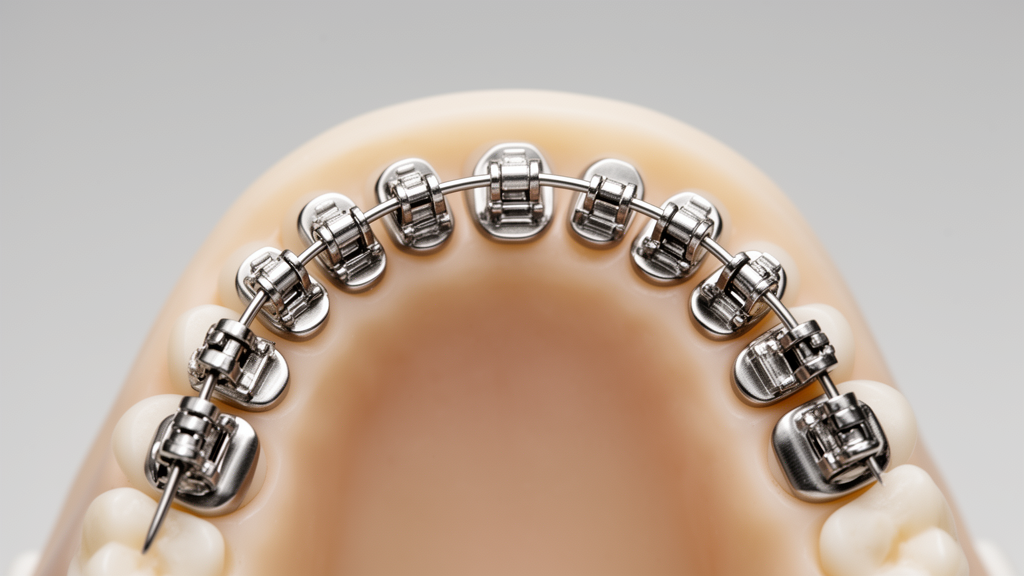
An analytical framework verified through three-dimensional finite element simulations demonstrates that reducing the distance between adjacent orthodontic brackets substantially increases torsional stiffness and amplifies torque transfer along rectangular archwires. Researchers developed a one-dimensional lumped-parameter mechanical model to examine how interbracket distance and bracket play interact to dictate moment expression when a wire segment undergoes torsional rotation. The investigation established an analytical prediction model grounded in classical mechanics while explicitly identifying which mechanical components were numerically validated through computational simulations and which baseline parameters were adopted from previous empirical literature.
The theoretical framework models the free span of archwire situated between two consecutive brackets as a linear elastic torsional spring aligned in series with an idealized backlash element representing bracket play. Rather than simulating the physical contact dynamics of bracket engagement, the researchers treated bracket play as an assumed dead-zone parameter, incorporating published in vitro experimental values ranging between 8.4 degrees and 18.7 degrees for rectangular 0.019 by 0.025-inch stainless steel archwires. Under this configuration, applied rotational angles below the threshold of bracket play produce zero moment, whereas any angular activation exceeding that play zone immediately activates the elastic resistance of the wire segment.
To verify the mechanical behavior of the elastic spring component, the authors implemented four independent three-dimensional finite element models representing an isolated, straight stainless steel archwire segment measuring 0.019 by 0.025 inches across free lengths of 4, 8, 12, and 16 millimeters. The computational simulations were constructed and solved in FreeCAD version 1.0.2 utilizing the open-source CalculiX solver. Generic linear-elastic material properties were assigned to the modeled stainless steel segments, isolating the foundational structural response of the rectangular cross-section under pure axial twist without introducing confounding biological or mechanical variables.
The boundary conditions across all numerical models were strictly standardized to replicate Saint-Venant torsional deformation under restrained conditions. One terminal end of each archwire segment was completely fixed against displacement and rotation, while a precise rotation of 5 degrees around the longitudinal axis was applied to the opposing terminal end through a rigid-body coupling. The cross-sectional warping at both extremities was restrained within the solver. The authors noted that the finite element geometry excluded bracket slots, wire-to-slot contact interfaces, friction, ligation ties, individual teeth, and multi-bracket arch assemblies, focusing solely on the pure mechanics of the free wire span.
The numerical computations demonstrated tight correlation between the simulated reaction moments and classical Saint-Venant analytical predictions across all four tested interbracket lengths. The reaction moments calculated by the finite element analysis exceeded the analytical Saint-Venant predictions by a modest margin of 1.1 percent to 1.9 percent across the evaluation series. Mesh convergence assessments confirmed that the simulation results were computationally stable: refining the mesh density from an element size of 0.15 millimeters to 0.08 millimeters shifted the resulting reaction moment by less than 0.5 percent for both the shortest 4-millimeter span and the longest 16-millimeter span under the prescribed 5-degree torsional load.
Stress evaluations indicated that peak material loading remained within safe elastic boundaries under the primary baseline activation parameters. The maximum von Mises stress identified in the most heavily loaded 4-millimeter wire segment under a 5-degree rotation reached 1,135 megapascals, staying beneath the recognized yield strength of standard orthodontic stainless steel. Because torsional stiffness exhibits an inverse proportionality to span length, the stiffness ratios between configurations scaled predictably, yielding a ratio of approximately 3.0 between the 4-millimeter and 12-millimeter spans, and approximately 2.0 between the 8-millimeter and 16-millimeter spans. However, the model indicates that excess twists beyond roughly 7 degrees on the 4-millimeter span would exceed the material’s elastic limit.
Integrating the verified torsional spring stiffness with the assumed backlash dead zone yielded a closed-form formula wherein model-predicted moment equals shear modulus multiplied by the torsional constant divided by length, scaled by degrees-to-radians conversion and the net activation exceeding bracket play. The study concludes that within the stated assumptions of this lumped-parameter framework, shorter interbracket distances consistently produce greater torsional stiffness. Consequently, any orthodontic activation imposed past the bracket-play dead zone generates a larger model-predicted moment in tighter spans, providing a validated quantitative reference for wire mechanics.
Subject of Research: Analytical and finite element modeling of archwire torsional stiffness between orthodontic brackets
Article Title: Archwire-mediated torque transfer between adjacent brackets: an analytical model with finite element verification
Article References: Thomas, R. B., Easwar, S., & Ravi, M. S. (2026). Archwire-mediated torque transfer between adjacent brackets: an analytical model with finite element verification. BMC Oral Health. https://doi.org/10.1186/s12903-026-10424-0
Image Credits: AI Generated
DOI: 10.1186/s12903-026-10424-0
Keywords: orthodontic torque, archwire mechanics, interbracket distance, bracket play, torsional stiffness, finite element analysis, Saint-Venant torsion, lumped-parameter model, stainless steel archwire, CalculiX solver, FreeCAD, von Mises stress, dead-zone model, mesh convergence, reaction moment, elastic deformation, orthodontic biomechanics
News Source: Ophelia Keating. (November 20, 2026). Shorter Orthodontic Spans Increase Archwire Torque Transfer in New Mechanical Model. Scienmag.