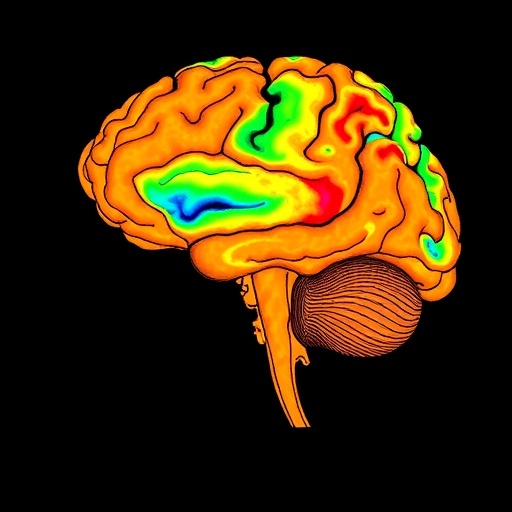
The future deployment of AIs and robots in our everyday work and life, from fully automated vehicles, to delivery robots, and AI assistants, could either be done by making increasingly capable agents that can do many tasks, or simpler more narrow agents that are designed for specific tasks.
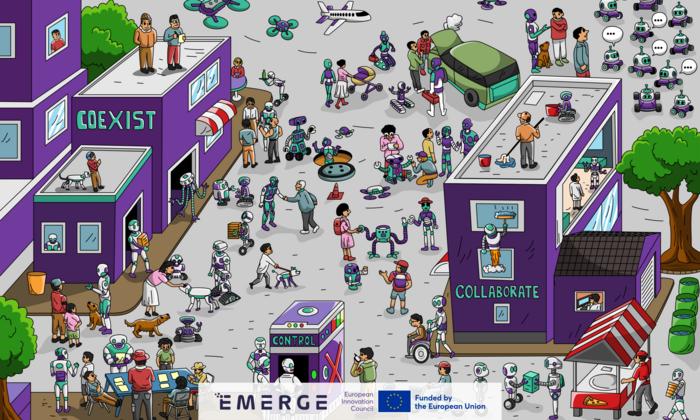
Credit: EMERGE Project
The future deployment of AIs and robots in our everyday work and life, from fully automated vehicles, to delivery robots, and AI assistants, could either be done by making increasingly capable agents that can do many tasks, or simpler more narrow agents that are designed for specific tasks.
The former is most often in the spotlight: AI systems incrementally trained with generalised competencies across many domains with the eventual development of an artificial general intelligence, which is ultimately linked with the possibility – or fear – of artificial entities gaining consciousness.
This raises several concerns. An automated face recognition system may be acceptable to assist in border control or asylum request processing when working within some boundaries and with appropriate high-security criteria. Endowing domain-general AI, also capable of speaking and taking health, educational or military decisions with such capacities is a threat. Besides that, operating a general-purpose system incurs in significant energy and emission costs, as evidenced by generative architectures such as large language models.
The alternative vision is defended by researchers members of the EMERGE project consortium in their recent publication in the journal Advanced Intelligent Systems. The authors argue that when orchestrating numerous simultaneous or sequential actions across different specialised AI systems, the presence of consciousness as a private integrative mechanism within each system is neither essential nor sufficient.
They propose that specialized AI systems tailored to specific tasks can be more reliable, energy-efficient, ethically tractable, and overall more effective than general intelligence. Meanwhile, these systems raise mostly a problem of effective coordination between different systems and humans, for which, they argue, simpler ways of sharing awareness are sufficient.
“What is needed is the capacity for selectively sharing relevant states with other AI systems in order to facilitate coordination and cooperation – or a collaborative shared awareness for short. As the word ‘awareness’ is sometimes used as a synonym for consciousness, it is important to stress that collaborative awareness is significantly different from consciousness,“ says Ophelia Deroy, Professor of Philosophy and Neuroscience at the Ludwig Maximilian University in Munich, Germany.
First, shared awareness is not a private state, by definition. If a swarm of bots has a shared awareness of the whole factory floor, this shared awareness is not reducible to the representation of space that each individual agent has. It is an emergent property. Second, shared awareness can be only transient, sharing states with others only when there is a need to coordinate individual goals or cooperate on a common goal. Third, shared awareness can be selective regarding which states are relevant to be shared with others. And while the dominant views of consciousness mean it is integrated or unified, shared awareness can be partitioned across different agents: one system may need to share spatial information with another system, energy-levels with their controller, and share other aspects such as their confidence with other systems or their users.
“Shared awareness makes artificial agents easier to monitor, and control for human operators. It also enables systems to work better together, even if they were designed by different companies. Shared awareness could help autonomous vehicles avoid collisions, logistics robots coordinate the delivery of packages, or AI systems analyse complex patient medical history to come up useful treatment recommendations” says Sabine Hauert, Professor of Swarm Engineering at the University of Bristol, UK.
About the EMERGE project
The EMERGE project will deliver a new philosophical, mathematical, and technological framework to demonstrate, both theoretically and experimentally, how a collaborative awareness – a representation of shared existence, environment and goals – can arise from the interactions of elemental artificial entities. Learn more: https://eic-emerge.eu/
Journal
Advanced Intelligent Systems
DOI
10.1002/aisy.202300740
Article Title
Shared Awareness Across Domain-Specific Artificial Intelligence: An Alternative to Domain-General Intelligence and Artificial Consciousness
Article Publication Date
17-Jul-2024