• HOME
  • NEWS
  • EXPLORE
    • CAREER
      • Companies
      • Jobs
    • EVENTS
    • iGEM
      • News
      • Team
    • PHOTOS
    • VIDEO
    • WIKI
  • BLOG
  • COMMUNITY
    • FACEBOOK
    • INSTAGRAM
    • TWITTER
Tuesday, November 17, 2026
BIOENGINEER.ORG
No Result
View All Result
  • Login
  • HOME
  • NEWS
  • EXPLORE
    • CAREER
      • Companies
      • Jobs
        • Lecturer
        • PhD Studentship
        • Postdoc
        • Research Assistant
    • EVENTS
    • iGEM
      • News
      • Team
    • PHOTOS
    • VIDEO
    • WIKI
  • BLOG
  • COMMUNITY
    • FACEBOOK
    • INSTAGRAM
    • TWITTER
No Result
View All Result
Bioengineer.org
No Result
View All Result
Home NEWS Science News Technology

Shaking Table Experiments Reveal How Earthquakes Damage Soil-Embedded Communication Poles

by
November 7, 2026
in Technology
Reading Time: 2 mins read
0
Shaking Table Experiments Reveal How Earthquakes Damage Soil-Embedded Communication Poles

Shaking Table Experiments Reveal How Earthquakes Damage Soil-Embedded Communication Poles

Share on FacebookShare on TwitterShare on LinkedinShare on RedditShare on Telegram

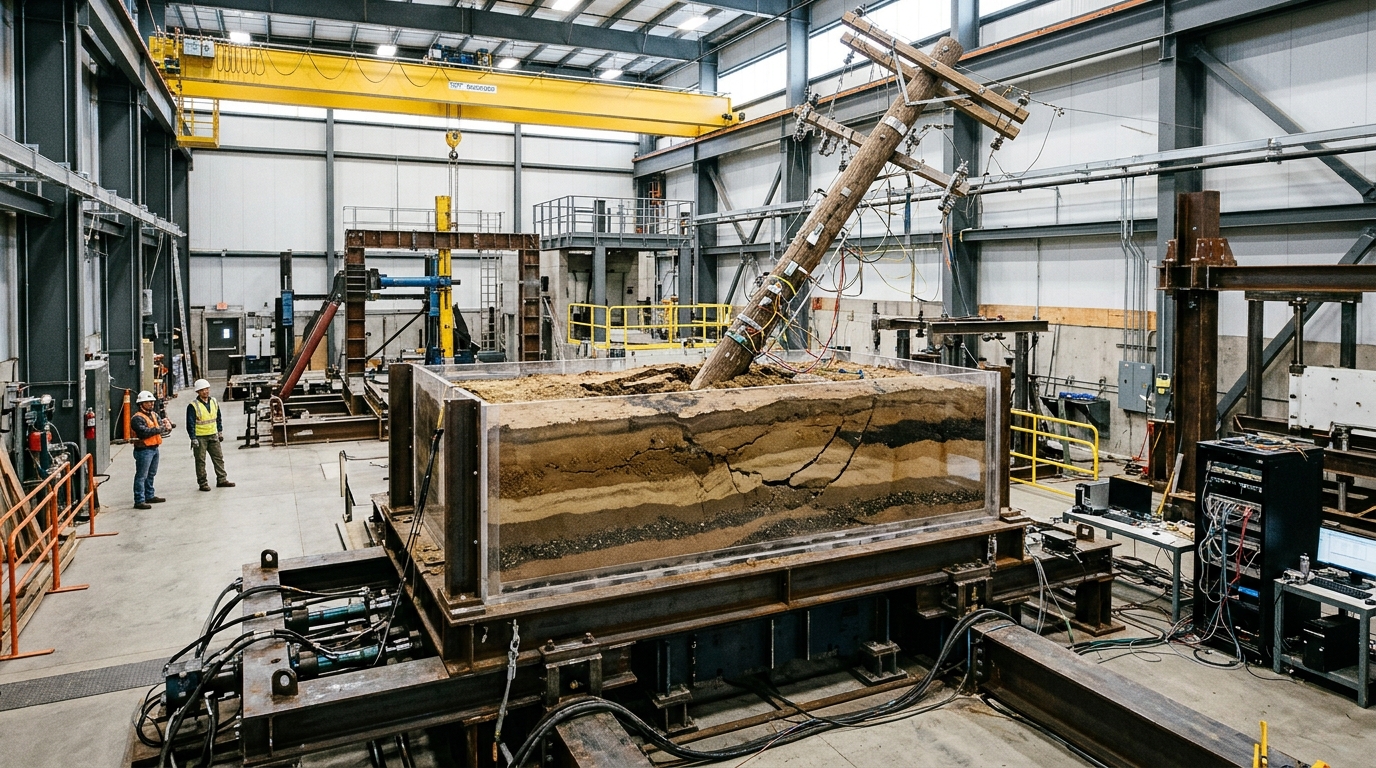
Experimental shaking table tests investigating prototype reinforced concrete communication poles have demonstrated that intense earthquake excitations induce soil plasticity and severely weaken base anchoring, while physical damage to the poles concentrates as hairline cracks in their bottom third. Dynamic testing further revealed that the seismic response of the interconnected pole-line system was significantly amplified under near-field ground motion.

Communication networks depend fundamentally on overhead lines to link operational nodes and transmit information across communities. Because these overhead transmission lines constitute a substantial portion of overall communication system investment, their continued reliability is essential for network connectivity. However, overhead line infrastructure frequently suffers widespread damage following earthquake events. Prior to this research, existing structural studies remained insufficient in revealing their seismic performance. According to the research team, this critical knowledge gap has hindered the accurate assessment and effective mitigation of seismic risks across the entire communication network.

To address this critical gap in earthquake engineering, the investigators conducted a shaking table test on a soil-communication pole-line system utilizing four prototype reinforced concrete poles. Specifically, two of the prototype poles were embedded within a soil box to evaluate foundation support, while two additional poles were anchored directly to the shaking table surface. The complete pole-line system was established by linking one soil-embedded pole to the two anchored poles via suspended messenger wires, creating an interconnected structural configuration for dynamic evaluation.

Through this multi-pole experimental setup, the researchers investigated the characteristic damage patterns and dynamic seismic responses under progressively increased seismic intensity, focusing especially on the base anchoring effect of the soil and the structural influence of the suspended messenger wires. The test results show that the characteristic seismic damage of the reinforced concrete poles manifested as hairline cracks concentrated in the bottom one-third of the pole structures. Crucially, intense seismic excitations induced soil plasticity within the soil box, a behavioral change that severely weakened the base anchoring effect supporting the embedded pole.

Furthermore, the experimental observations revealed that the seismic response of the pole-line system was significantly amplified under near-field ground motion. Consequently, the authors emphasized that in areas characterized by high seismic risk, the necessity of conducting formal seismic design for communication poles deserves serious attention from engineers and infrastructure planners, moving beyond the traditional industry reliance on wind-resistance design alone.

Subject of Research: Seismic performance and damage characteristics of soil-communication pole-line systems

Article Title: Shaking table test study on seismic performance of the soil-communication pole-line system

Article References: Mao, C., Zhang, Z., & Wang, T. (2026). Shaking table test study on seismic performance of the soil-communication pole-line system. Earthquake Engineering and Engineering Vibration, 25(4), 1011-1030. https://doi.org/10.1007/s11803-026-2418-9

Image Credits: AI Generated

DOI: 10.1007/s11803-026-2418-9

Keywords: earthquake engineering, communication poles, shaking table test, seismic performance, reinforced concrete, soil-structure interaction, overhead lines, near-field ground motion, Shaking, table, test, seismic

News Source: Denise Maddox. (November 7, 2026). Shaking Table Experiments Reveal How Earthquakes Damage Soil-Embedded Communication Poles. Scienmag.


Tags: communication polesearthquake engineeringnear-field ground motionoverhead linesreinforced concreteseismicseismic performanceShakingshaking table testsoil-structure interactiontabletest
Share12Tweet7Share2ShareShareShare1

Related Posts

Mirabilis Jalapa Extracts Modulate Optical Band Gap in Polyvinyl Alcohol Films

Mirabilis Jalapa Extracts Modulate Optical Band Gap in Polyvinyl Alcohol Films

November 17, 2026
Affect-Aware Framework May Improve Relational Grounding in LLM Conversations

Affect-Aware Framework May Improve Relational Grounding in LLM Conversations

November 17, 2026

Algal Nanoparticles Offer Versatile Tools to Remove Emerging Contaminants from Wastewater

November 17, 2026

Balanced Workplace Helping Boosts Peer Social Status by Reducing Relational Uncertainty

November 17, 2026

POPULAR NEWS

  • Orthognathic Mixed Reality Templates Show Sub-Two-Millimeter Deviations in Early Scoping Review

    Orthognathic Mixed Reality Templates Show Sub-Two-Millimeter Deviations in Early Scoping Review

    29 shares
    Share 12 Tweet 7
  • Iron Oxide Nanoparticles Alleviate Cadmium Stress and Accumulation in Atractylodes Lancea

    29 shares
    Share 12 Tweet 7
  • Elevated Lipoprotein (a) Does Not Predict Long-Term Mortality After Heart Attack

    29 shares
    Share 12 Tweet 7
  • Incremental Deep Learning Reconstruction Improves High-Resolution Coronary CT Angiography Image Quality

    29 shares
    Share 12 Tweet 7

About

We bring you the latest biotechnology news from best research centers and universities around the world. Check our website.

Follow us

Recent News

Mirabilis Jalapa Extracts Modulate Optical Band Gap in Polyvinyl Alcohol Films

BTN3A3 Downregulation Across Multiple Cancers Points to Potential Metastatic Biomarker

Affect-Aware Framework May Improve Relational Grounding in LLM Conversations

Subscribe to Blog via Email

Enter your email address to subscribe to this blog and receive notifications of new posts by email.

Join 88 other subscribers
  • Contact Us

Bioengineer.org © Copyright 2023 All Rights Reserved.

Welcome Back!

Login to your account below

Forgotten Password?

Retrieve your password

Please enter your username or email address to reset your password.

Log In
No Result
View All Result
  • Homepages
    • Home Page 1
    • Home Page 2
  • News
  • National
  • Business
  • Health
  • Lifestyle
  • Science

Bioengineer.org © Copyright 2023 All Rights Reserved.