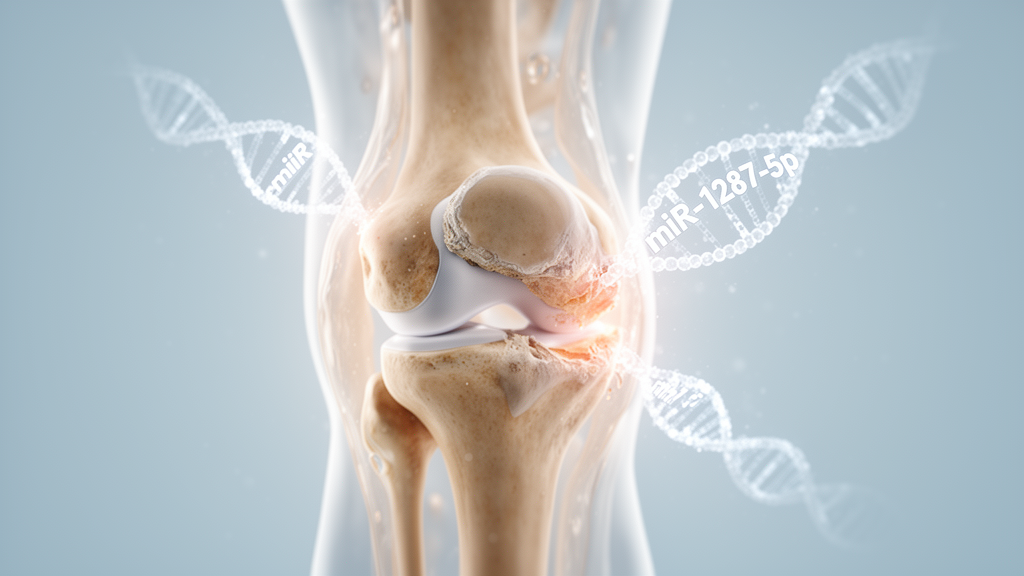
Researchers have identified a small RNA molecule, miR-1287-5p, that is markedly elevated in the blood of patients with knee osteoarthritis and appears to contribute directly to the cartilage damage that defines the disease. The study, published in BMC Immunology as an open-access research article on 9 October 2026, combined clinical measurements in a single-centre observational cohort with laboratory experiments in human chondrocytes, the cells responsible for maintaining cartilage.
The clinical arm of the study enrolled 130 primary knee osteoarthritis patients together with 100 age- and sex-matched healthy controls. The team measured circulating levels of miR-1287-5p in serum using RT-qPCR, a technique that quantifies specific RNA molecules. Patients with osteoarthritis showed markedly upregulated serum miR-1287-5p compared with healthy subjects. Importantly, the abundance of this microRNA was positively correlated with disease severity, pain scores, markers of cartilage degradation, and pro-inflammatory cytokines, meaning that higher levels tracked with more advanced and more symptomatic disease within this cohort.
According to the authors, serum miR-1287-5p showed promising diagnostic potential both for distinguishing osteoarthritis patients from healthy subjects and for discriminating advanced-stage from early-stage knee OA. They explicitly note that these findings are based on their single-centre observational cohort, so the results require validation in other populations before any clinical use.
Beyond its association with disease, the study investigated what the microRNA actually does in cartilage cells. The target relationship was verified with a dual-luciferase reporter assay and RNA immunoprecipitation, standard laboratory methods for confirming that a microRNA binds a specific messenger RNA.
Functional rescue experiments then tested whether the miR-1287-5p/PIK3R3 axis drives the cellular damage seen in the disease model. When the researchers inhibited miR-1287-5p in IL-1β-stimulated chondrocytes, the cells recovered from the evoked dysfunction: aberrant apoptosis was reduced, and the excessive secretion of matrix catabolic enzymes and pro-inflammatory factors was dampened. Crucially, these mitigating effects were offset when PIK3R3 was knocked down, indicating that PIK3R3 mediates the protective outcome and that the microRNA promotes chondrocyte injury and inflammation through this target.
The authors conclude that serum miR-1287-5p may serve as a promising non-invasive biomarker for osteoarthritis diagnosis and severity assessment, and that the microRNA promotes chondrocyte injury and inflammation via targeting PIK3R3. Because osteoarthritis is a degenerative joint disorder characterised by progressive cartilage destruction and chronic inflammation, with no curative therapies currently available, a blood-based marker that reflects disease activity could be valuable if validated. The mechanistic findings, however, come from cell culture experiments and do not by themselves establish therapeutic efficacy in patients. The published version is an early-release, peer-reviewed accepted manuscript that carries a permanent DOI and remains subject to further editorial edits before the final version of record appears.
Subject of Research: The role of serum miR-1287-5p and its target PIK3R3 in knee osteoarthritis diagnosis and chondrocyte dysfunction
Article Title: Identification of the miR-1287-5p/PIK3R3 regulatory axis in knee osteoarthritis: clinical correlation and functional validation
Article References: Nian, Z., Zhao, B., & Zhang, Y. (2026). Identification of the miR-1287-5p/PIK3R3 regulatory axis in knee osteoarthritis: clinical correlation and functional validation. BMC Immunology. https://doi.org/10.1186/s12865-026-00913-w
Image Credits: AI Generated
DOI: 10.1186/s12865-026-00913-w
Keywords: knee osteoarthritis, miR-1287-5p, PIK3R3, biomarker, chondrocytes, RT-qPCR, cartilage degradation, inflammation, microRNA, ROC analysis, IL-1β, BMC Immunology
News Source: Ophelia Keating. (October 28, 2026). Serum microRNA miR-1287-5p emerges as a candidate biomarker and driver of knee osteoarthritis. Scienmag.