• HOME
  • NEWS
  • EXPLORE
    • CAREER
      • Companies
      • Jobs
    • EVENTS
    • iGEM
      • News
      • Team
    • PHOTOS
    • VIDEO
    • WIKI
  • BLOG
  • COMMUNITY
    • FACEBOOK
    • INSTAGRAM
    • TWITTER
Friday, July 10, 2026
BIOENGINEER.ORG
No Result
View All Result
  • Login
  • HOME
  • NEWS
  • EXPLORE
    • CAREER
      • Companies
      • Jobs
        • Lecturer
        • PhD Studentship
        • Postdoc
        • Research Assistant
    • EVENTS
    • iGEM
      • News
      • Team
    • PHOTOS
    • VIDEO
    • WIKI
  • BLOG
  • COMMUNITY
    • FACEBOOK
    • INSTAGRAM
    • TWITTER
  • HOME
  • NEWS
  • EXPLORE
    • CAREER
      • Companies
      • Jobs
        • Lecturer
        • PhD Studentship
        • Postdoc
        • Research Assistant
    • EVENTS
    • iGEM
      • News
      • Team
    • PHOTOS
    • VIDEO
    • WIKI
  • BLOG
  • COMMUNITY
    • FACEBOOK
    • INSTAGRAM
    • TWITTER
No Result
View All Result
Bioengineer.org
No Result
View All Result
Home NEWS Science News Chemistry

Sensory perception is not superficial brain work

Bioengineer by Bioengineer
February 10, 2020
in Chemistry
Reading Time: 3 mins read
0
IMAGE
Share on FacebookShare on TwitterShare on LinkedinShare on RedditShare on Telegram

IMAGE

Credit: Remi Gau


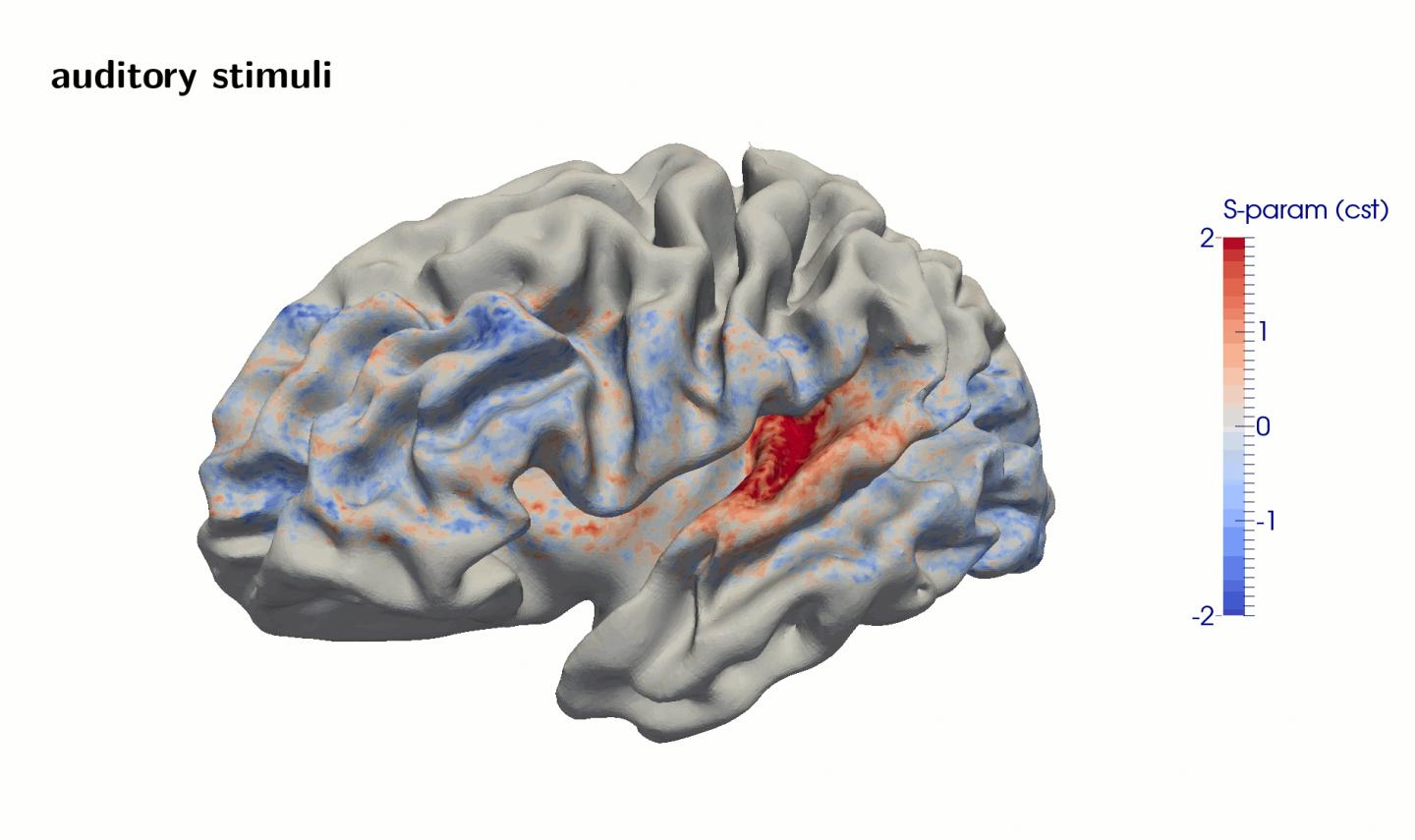
If we cross a road with our smartphone in view, a car horn or engine noise will startle us. In everyday life we can easily combine information from different senses and shift our attention from one sensory input to another – for example, from seeing to hearing. But how does the brain decide which of the two senses it will focus attention on when the two interact? And, are these mechanisms reflected in the structure of the brain?

To answer these questions, scientists at the Max Planck Institute for Human Cognitive and Brain Sciences (MPI CBS) in Leipzig and the Computational Neuroscience and Cognitive Robotics Centre at the University of Birmingham measured how sensory stimuli are processed in the brain. In contrast to previous studies, they did not restrict their observations to the surface the cerebral cortex. For the first time, they also measured the sensory signals at different depths in the cortex. The researchers’ findings suggest that our brains conduct the multi-sensory flow of information via distinct circuits right down to the smallest windings of this highly folded brain structure.

While the participants in their study were lying in a magnetic resonance tomograph (MRI), the scientists showed them visual symbols on a screen while simultaneously playing sounds. In a prior condition, the participants had been asked to explicitly focus their attention on either the audible or visible aspect of the stimuli. The neurophysicists Robert Turner, Robert Trampel and Rémi Gau then analyzed at which exact points the sensory stimuli were being processed. Two challenges needed to be overcome. “The cerebral cortex is only two to three millimeters thick. So we needed a very high spatial resolution (of less than one millimeter) during data acquisition,” explains Robert Trampel, who co-directed the study at the MPI CBS. “Also, due to the dense folding of the cerebral cortex, we had to digitally smooth it and break it down into different layers, in order to be able to precisely locate the signals. This was all done on a computer of course.”

The results showed that when participants heard a sound, visual areas of their brains were largely switched off. This happened regardless of whether they focused on the audible or visible aspect of the stimuli. However, if they strongly attended to the auditory input, brain activity decreased, particularly in the regions representing the center of the visual field. Thus, it seems that sound can strongly draw our attention away from what we’re looking at.

In auditory brain regions the researchers also observed, for the first time, that the activity pattern, across different cortical layers, changed when participants were presented with only sounds. The situation was different when participants only perceived “something to the eye”: in that case there was no change. Rémi Gau sums up, “So when we have to process different sensory impressions at the same time, different neuron circuits become active, depending on what we focus our attention on. We have now been able to make these interactions visible through novel computerized experiments.”

###

Media Contact
Dr Robert Trampel
[email protected]
49-341-994-02293

Original Source

https://elifesciences.org/articles/46856

Related Journal Article

http://dx.doi.org/10.7554/eLife.46856

Tags: Biomechanics/BiophysicsChemistry/Physics/Materials Sciencesneurobiology
Share12Tweet8Share2ShareShareShare2

Related Posts

Artificial Intelligence Transforms Material Synthesis Methods

Artificial Intelligence Transforms Material Synthesis Methods

July 10, 2026
Computer Chip Uses Vibrations for Memory Storage

Computer Chip Uses Vibrations for Memory Storage

July 10, 2026

Rapid Screening Advances Discovery of Nanocrystals

July 10, 2026

New Eco-Friendly Method Developed for Alcohol Oxidation

July 10, 2026
Please login to join discussion

POPULAR NEWS

  • Detection of EDCs in Breast Milk and Infant Urine Up to Six Months Highlights Early Exposure Risks

    77 shares
    Share 31 Tweet 19
  • New Drug Candidate Developed at McMaster Shows Potential for Treating Brain Cancer

    58 shares
    Share 23 Tweet 15
  • KTU Researchers Explore Ultrasound’s Role in Enhancing Blood Flow Beyond Diagnostics

    53 shares
    Share 21 Tweet 13
  • 高齢者の骨粗鬆症治療の持続性比較

    51 shares
    Share 20 Tweet 13

About

We bring you the latest biotechnology news from best research centers and universities around the world. Check our website.

Follow us

Recent News

Long-Term Stem Cell Data Boosts Chronic Stroke Recovery Research

Hantavirus Risks and Pandemic Potential from Nature Cruises Explored

Study Explores Traditional Chinese Medicine for Treating Post-COVID Syndrome

Subscribe to Blog via Email

Enter your email address to subscribe to this blog and receive notifications of new posts by email.

Join 84 other subscribers
  • Contact Us

Bioengineer.org © Copyright 2023 All Rights Reserved.

Welcome Back!

Login to your account below

Forgotten Password?

Retrieve your password

Please enter your username or email address to reset your password.

Log In
No Result
View All Result
  • Homepages
    • Home Page 1
    • Home Page 2
  • News
  • National
  • Business
  • Health
  • Lifestyle
  • Science

Bioengineer.org © Copyright 2023 All Rights Reserved.