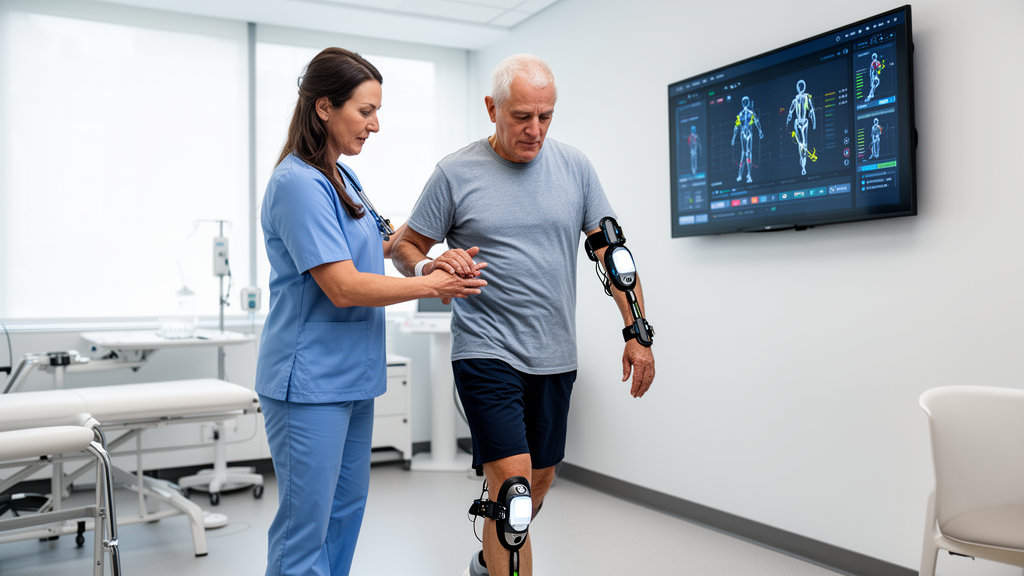
A qualitative investigation into sensor-supported stroke rehabilitation shows that integrating wearable monitoring devices into recovery routines reconfigures therapeutic dynamics into a three-agent relationship involving the patient, the practitioner, and the digital tool. Rather than diminishing the necessity of human clinicians or substituting automated instruction for clinical guidance, the implementation of physiological tracking devices demands that physical therapists step into expanded positions as contextual evaluators and relational anchors. Conducted alongside the early-stage engineering of PhysioMio, a wearable sensor designed to record electrical muscle activity, the study demonstrates that stroke survivors who undertake home-based regimens actively seek continued interpersonal guidance, looking to clinicians to interpret physiological readings within their broader daily circumstances and to validate machine-generated feedback.
Upper limb motor dysfunction impacts up to seventy-five percent of stroke survivors, creating an escalating global demand for neurorehabilitation services amidst widespread clinical personnel shortages. To address these recovery challenges, biomedical engineers at the Technical University of Munich developed PhysioMio, a wearable sensor prototype created at the Institute of Micro Technology and Medical Device Technology to detect muscle activity, continuously track motor progress, and assist home exercises. Instead of assessing technical specifications or clinical efficacy in isolation, researchers integrated an embedded ethics framework throughout early engineering stages. Guided by an ethics of care perspective rooted in moral philosophy, the investigators examined how automated diagnostic technologies alter personal interdependence, distribution of responsibility, and mutual trust between recovering individuals and their clinical care providers.
The methodological framework comprised qualitative interviews carried out between October 2023 and January 2026 with thirteen stroke survivors receiving care in a Bavarian rehabilitation facility and seven professional physical therapists practicing in stroke rehabilitation across Germany. Approved by the ethics commission of the Technical University of Munich under protocol number 2023-418-S-KK, the investigation gathered narrative accounts during sessions that ranged between twenty and one hundred minutes in duration. Transcripts underwent reflexive thematic analysis within Atlas.ti software, identifying recurring relational themes that were regularly discussed with device engineers in parallel development meetings. This iterative feedback process directly challenged initial technological assumptions, prompting early modifications to the software architecture and monitoring parameters before commercial finalization.
Stroke survivors participating in the study described the sudden loss of functional physical independence as an acutely destabilizing experience, frequently expressing anxiety that standard institutional physical therapy sessions were insufficient in frequency to foster rapid motor restoration. While patients welcomed wearable sensors as an empowering mechanism to facilitate consistent exercise routines at home, participants universally rejected the idea of detaching from their therapists. Stroke patients emphasized that their willingness to trust and use the wearable system depended almost entirely on whether their personal therapist endorsed the technology. Concurrently, therapists emphasized that self-directed training could place an excessive burden of treatment on vulnerable individuals, particularly early in recovery, raising concerns that unsupervised practice might inadvertently reinforce spastic movement patterns or induce extreme physical fatigue.
The collection and continuous transmission of home exercise metrics introduced distinct relational friction regarding accountability, behavioral monitoring, and therapeutic oversight. While most stroke patients accepted data tracking when explicitly tied to recovery goals, both patient and clinician interviews revealed concerns that continuous telemetry could transform therapists into authoritarian compliance monitors rather than supportive allies. Therapists noted that if tracking caused patients to exercise merely out of fear of negative appraisal rather than intrinsic motivation, the therapeutic alliance could erode. To prevent surveillance anxiety and maintain patient dignity, participants urged developers to implement granular data-sharing controls, giving individuals explicit authority to decide when daily records and timestamps are transmitted for professional clinical review.
Interpreting sensor outputs highlighted divergent viewpoints regarding machine-based detection versus clinical tactile observation. Although several therapists and patients acknowledged that electromyographic sensors can capture subtle muscular activations undetectable by direct vision, therapists affirmed that mechanical measurements cannot replicate the tactile dexterity and intuitive hands-on evaluation developed through clinical experience. Furthermore, clinicians and recovering participants expressed substantial concern that continuous streams of data would overwhelm clinical consultations, distracting attention from holistic assessments. Recognizing that excessive analytical information could detract from patient engagement, developers restructured the system’s software architecture to aggregate everyday ambient activities into broad summaries, reserving high-resolution metric collection exclusively for designated, intentional training sessions.
The psychological impact of visualizing motor performance emerged as another complex theme influencing patient emotional resilience and recovery motivation. While participants anticipated that visual graphs demonstrating gradual motor improvements would validate their strenuous rehabilitative efforts, they warned that displays depicting performance plateaus or functional declines could prove demoralizing. Furthermore, comparative evaluations between peers sparked strong ambivalence; although some participants viewed peer benchmarks as potential inspiration, others emphasized that stroke recovery is inherently non-linear and deeply individual. These specific qualitative findings caused the engineering team to abandon planned peer-comparison dashboard features, redesigning the device’s feedback interface to evaluate each patient’s progress solely against their own historical baseline.
Both clinician and patient cohorts strongly emphasized the necessity of maintaining holistic healthcare boundaries that extend beyond isolated neuromuscular performance metrics. Physical therapists affirmed that their primary responsibility encompasses emotional support, psychological encouragement, and evaluations of whole-body posture, spinal alignment, and functional balance that localized wearable sensors cannot capture. Additionally, therapists cautioned against keeping patients in permanent recovery mode, noting that uninterrupted physical monitoring across domestic and workplace settings risks causing psychological burnout. In response to participant insistence on preserving personal, unmonitored life spaces, developers abandoned an initial conceptual vision of round-the-clock sensor wear, revising device recommendations toward time-limited, conscious exercise periods.
Viewed through an ethics of care lens, the integration of wearable rehabilitation hardware reshapes clinical interaction from an interpersonal dialogue into an interdependent triad of patient, practitioner, and assistive machine. The research indicates that privacy in healthcare is not evaluated as an abstract absolute, but rather negotiated dynamically within trusted therapeutic relationships. Even within Germany’s highly regulated data protection landscape, participants accepted continuous data collection when clinical benefits were clear, and therapists retained their role as empathetic contextual interpreters. Ethical deployment therefore requires that informed consent operate as an ongoing communicative practice rather than a static administrative formality, allowing patients to continually adjust privacy parameters as rehabilitation proceeds.
The authors identified methodological limitations that temper the immediate generalizability of their conclusions, notably the small cohort of seven physical therapists recruited under resource constraints and the exclusive focus on a well-resourced Bavarian clinical environment characterized by universal health insurance coverage. Moreover, because the investigations examined the PhysioMio concept using descriptive sensor illustrations before interactive functional prototypes were fabricated, participant responses may have been shaped by the interviewer’s structured narrative framing. Nevertheless, the study offers empirical evidence that technological progress in neurorehabilitation succeeds not by seeking automated autonomy from healthcare personnel, but by embedding intelligent devices within supportive, trust-centered clinical relationships that accommodate individual human vulnerability.
Stroke survivors were recruited into the interview investigation while participating in an associated clinical trial designed to assess the sensor measurement precision of the PhysioMio apparatus. Clinical eligibility required participants to have sustained a stroke, with physical deficits ranging between subtle fine-motor impairments and hemiplegia, while individuals presenting with severe cognitive dysfunction were excluded. Physical therapists were recruited through professional networks and the German Association of Physical Therapy, requiring clinical background in neurorehabilitation in Germany. An initial cohort of three therapists completed interviews before investigators enrolled four additional clinicians to ensure comprehensive thematic exploration, ultimately concluding data gathering when additional sessions yielded no novel findings. Because recruitment depended entirely on self-initiated responses after viewing informational leaflets, the researchers could not determine how many prospective candidates declined participation. Following study completion, all seven therapists requested email updates regarding published results, whereas none of the thirteen stroke patients chose to request publication follow-up.
Interviews took place in German using tailored open-ended guides, with patient discussions conducted at the Bavarian clinical facility and practitioner sessions held either online or at the researcher’s workplace. Sessions were audio-recorded, pseudonymized, and transcribed verbatim using encrypted f4 software alongside rigorous audio re-checks, with field notes recorded after each session to refine ongoing conversational approaches. Transcripts were not returned to participants for verification. Methodologically, the study addressed researcher positionality, acknowledging that the primary interviewer was a female medical student and doctoral candidate unaffiliated with the engineering team. Although her medical background facilitated collaborative clinical dialogue and rapport with physical therapists, patient interviews demanded more structured guidance due to her lack of lived stroke recovery experience. To support interview consistency, the researcher undertook formal qualitative interviewing training, while an experienced research supervisor regularly reviewed emerging transcripts.
The investigation also evaluated how embedded ethics operates within medical hardware startups, where small development teams frequently lack established ethical review structures during preliminary prototyping phases. In addition to ongoing collaborative meetings, researchers conducted a dedicated interview with device engineers near the conclusion of the study to document how qualitative feedback transformed product design. Integrating wearable sensors introduces clinical responsibilities that extend beyond automated physical tracking. Drawing parallels to findings in geriatric care and telemedicine, the authors emphasized that sensor data cannot substitute for clinician empathy, intuitive touch, and holistic observational judgment. Rather than causing professional deskilling, digital monitoring expands the physical therapist’s function into that of an essential contextual evaluator who ensures that automated regimens accommodate personal vulnerability and maintain vital therapeutic boundaries.
Subject of Research: Qualitative ethical analysis of care relationships in sensor-based stroke rehabilitation
Article Title: Implications for Care Relationships in Technology-Supported Stroke Rehabilitation: A Qualitative Interview Study
Article References: Bechtel, J., Buyx, A., & Zimmermann, B. M. (2026). Implications for Care Relationships in Technology-Supported Stroke Rehabilitation: A Qualitative Interview Study. Science and Engineering Ethics, 32(5), Article 41. https://doi.org/10.1007/s11948-026-00625-9
Image Credits: AI Generated
DOI: 10.1007/s11948-026-00625-9
Keywords: stroke rehabilitation, wearable sensors, care relationships, physical therapy, ethics of care, PhysioMio, embedded ethics, neurorehabilitation, patient autonomy, home-based training, data privacy, qualitative research, upper limb recovery, thematic analysis, clinical supervision, medical technology ethics
News Source: Cassandra Pierce. (November 24, 2026). Sensor-Assisted Stroke Therapy Reshapes Care Relationships Without Replacing Physical Therapists. Scienmag.