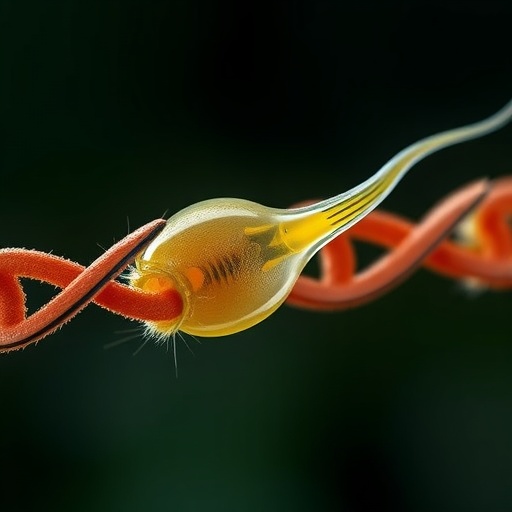
In a groundbreaking study led by the University of Utah, scientists have unlocked a long-standing evolutionary enigma: the mechanics by which “selfish chromosomes” subvert the established laws of genetic inheritance. This research reveals how these rogue genetic elements commandeer the Overdrive (Ovd) gene, exploiting its natural role to sabotage rival sperm and thus skew the odds of transmission in their favor. This discovery provides an unprecedented window into the molecular warfare waged within germline cells, offering insights that could reshape our fundamental understanding of genetics and reproductive biology.
The Overdrive gene was previously enigmatic in its function, but it now emerges as a crucial checkpoint overseeing sperm development quality. Under normal circumstances, Ovd operates by surveilling and excising defective sperm cells, ensuring the integrity of the genetic material passed to the next generation. However, selfish chromosomes have evolved to hijack this very gatekeeper, repurposing it as a weapon against competing sperm. By triggering Ovd’s quality control to eliminate rivals, these chromosomes secure their preferential inheritance, thereby violating Mendel’s classic 50/50 law and introducing a dramatic distortion known as segregation distortion.
This research stands out as the first to document that the same gene, Ovd, serves as a fundamental mediator for gamete elimination driven by multiple independent selfish chromosomes. Intriguingly, the team identified this phenomenon in two distantly related Drosophila species, each with distinct selfish chromosomes. This finding suggests that various selfish genomic elements have independently evolved mechanisms to converge on and exploit a shared molecular pathway, illuminating a pattern of evolutionary convergence in the realm of genetic conflict.
Segregation distortion itself is a phenomenon that traces back nearly a century, first identified in the 1920s through studies on Drosophila obscura. Despite the breadth of its demonstrated presence across the animal kingdom, from worms to mammals, the precise genetic and cellular underpinnings of this distortion remained elusive. The latest findings from the University of Utah group now fill a critical gap in this scientific narrative, elucidating how selfish elements subvert cellular checkpoints to bias genetic inheritance.
One remarkable facet of the study lies in its exploration of Ovd’s role beyond selfish chromosome contexts. Through targeted gene knockouts in both Drosophila pseudoobscura and Drosophila melanogaster—species bearing entirely different selfish chromosomes—the researchers observed that elimination of Ovd did not impair normal male fertility. This was a landmark observation: it clearly demonstrated that Ovd’s existence is not essential for the generation of viable sperm, but rather functions as a quality control sensor activated under stressful or damaging cellular conditions.
The analogies drawn between Ovd function and the well-characterized tumor suppressor gene P53 are particularly illuminating. Like P53, which acts as a cellular brake to prevent uncontrolled division and mutation accumulation, Ovd appears to function as a genomic guardian, selectively identifying and removing damaged sperm cells. Flies lacking P53 are viable in normal conditions but become vulnerable when genomic damage arises—a parallel that sheds light on Ovd’s subtle yet critical role in maintaining genomic fidelity within the germline.
To further elucidate the physiological cues that activate Ovd, the researchers exploited a known temperature-induced sterility threshold in fruit flies. Males exposed to temperatures above 31ºC typically become sterile, although the causative mechanism had remained unclear until now. The study revealed that wild-type flies experience Ovd-mediated sperm elimination under heat stress, whereas those lacking the Ovd gene retain fertility despite the elevated temperature, reinforcing the notion that Ovd acts as a heat-sensitive quality checkpoint to prevent the propagation of potentially defective sperm.
Importantly, this work distinguishes Ovd itself from the label of “selfish gene.” Instead, the gene serves as an endogenous mechanism co-opted by selfish chromosomes. This nuanced understanding reframes prior concepts and emphasizes the sophistication with which genetic elements manipulate cellular machinery, turning beneficial processes into tools of genetic competition.
The broader implications of these findings extend into the realms of evolutionary biology and reproductive medicine. Insights into how selfish chromosomes drive reproductive isolation may inform our understanding of speciation events—moments when new species diverge due to genetic incompatibilities often centered on fertility barriers. Additionally, while humans lack a direct equivalent of Ovd, the presence of analogous quality control mechanisms may be involved in certain forms of male infertility, opening avenues for translational research aimed at understanding and potentially treating these conditions.
The study’s senior author, Nitin Phadnis, emphasizes that uncovering the mode of action of Overdrive not only resolves a decades-old puzzle but simultaneously catalyzes new research trajectories focused on the cellular mechanisms governing gamete quality control and the emergence of sterility between closely related species. This kind of genetic conflict, long regarded as a curious anomaly, is beginning to reveal its central role in shaping the course of evolutionary diversification.
Future directions include expanding the investigation of Ovd function across a wider array of Drosophila species to assess the prevalence of this hijacking mechanism in different selfish chromosomes. Equally tantalizing is the prospect that segregation distortion mechanisms may exist within human lineages, albeit through currently unknown genes, which could have profound ramifications for understanding human fertility and evolutionary genetics.
This landmark publication, released in Nature Communications on February 10, 2026, marks a paradigm shift in our understanding of selfish genetic elements and their interaction with cellular quality control pathways. Through meticulous genetic experimentation and cross-species analysis, the team has not only illuminated the secret strategies of selfish chromosomes but also expanded our grasp of the evolutionary and physiological processes that safeguard reproductive success against internal genomic conflict.
Understanding the dual nature of Overdrive—as both a guardian and an unwitting accomplice to genetic selfishness—opens up new frontiers in evolutionary genetics, spotlighting the complex interplay between genes as cooperative units and as intense competitors vying for survival across generations.
Subject of Research: Animals
Article Title: Selfish chromosomes exploit a germline checkpoint to eliminate competing gametes.
News Publication Date: February 10, 2026
Web References:
https://doi.org/10.1038/s41467-025-68254-7
https://www.nature.com/articles/s41467-025-68254-7
References:
Phadnis, N., et al. “Selfish chromosomes exploit a germline checkpoint to eliminate competing gametes,” Nature Communications, 2026.
Phadnis & Orr, 2009; Science, DOI: 10.1126/science.1163934
Image Credits: Phil Baldassari/University of Utah
Keywords: selfish chromosomes, Overdrive gene, segregation distortion, Drosophila, genetic inheritance, gamete quality control, evolutionary genetics, reproductive isolation, molecular genetics, male infertility, genetic conflict, fruit fly