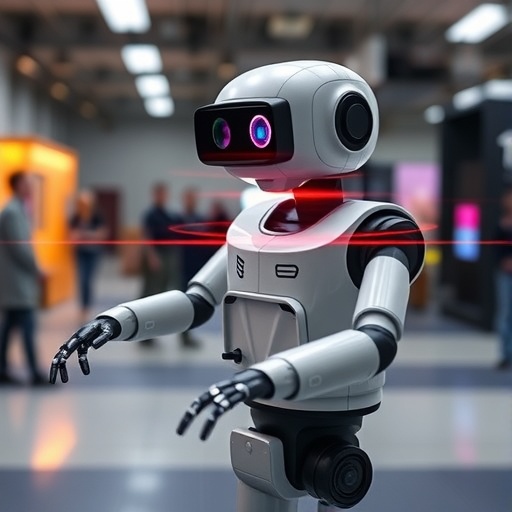
In the rapidly evolving landscape of robotics, researchers are making strides in creating more adaptable and autonomous systems. One such groundbreaking development comes from a collaborative effort led by L. Robinson, M. Gadd, and P. Newman, whose research titled “Robot-relay: building-wide, calibration-less visual servoing with learned sensor handover networks” aims to redefine how robots interact with their environments at a macro scale. This innovative approach focuses on eliminating the need for laborious calibration processes that have traditionally hindered the flexibility and deployment of robotic systems across varied settings.
A significant challenge in the realm of robotics is the need for precise control and interaction in dynamic environments. Most robots require tedious calibration to ensure that their sensory data aligns perfectly with their operational framework. This often involves manual adjustments and a level of human oversight that undermines the goal of full autonomy. The research spearheaded by Robinson and colleagues proposes a pioneering solution that utilizes learned sensor networks for handover processes, thus dramatically simplifying the calibration process.
At the heart of this research is the concept of visual servoing, which involves using visual feedback to control the movement of a robotic system. Traditional methods of visual servoing have relied on predefined settings, making systems less adaptable to new or changing environments. By developing a calibration-less technique, the team has opened new avenues for applications ranging from service robots in public spaces to autonomous vehicles navigating through complex urban landscapes.
The innovative aspect of this research lies in the use of learned sensor handover networks. These networks capitalize on deep learning methodologies to enable robots to effectively share sensory information across various nodes within a building or designated area. This sharing is crucial because it allows the system to develop a cohesive understanding of the environment without needing extensive manual calibration, thus speeding up deployment and enhancing operational efficiency.
Furthermore, the implications of calibration-less visual servoing extend beyond mere operational ease. The removal of stringent calibration processes means that robots can be more readily integrated into environments that are not only dynamic but also cluttered or unpredictable. This adaptability is essential for use cases such as hospital delivery robots, where navigating tight, busy corridors filled with people and equipment is a daily occurrence.
In practical terms, this advancement could also have widespread ramifications for autonomous vehicles. The ability to navigate and understand a complex environment without excess calibration could lead to safer, more reliable transportation systems. These vehicles could better adapt to real-time changes in their surroundings, thereby reducing accident rates and improving efficiency in traffic flow.
The potential for widespread application does not stop at mobility. The underlying technology behind the learned sensor networks could be used to enhance robotic interactions in customer service settings, where robots could seamlessly adapt to varying requirements or conditions without the need for intervention by human operators. This could lead to a more streamlined experience for users, improving satisfaction and efficiency.
Moreover, the concept of robot-relay introduces the idea of synergy among multiple robotic systems. With each robot equipped to learn from its environment and communicate with others, the potential for collaborative tasks expands tremendously. Imagine a fleet of delivery robots that not only understand their immediate surroundings but can also work together to optimize routes and mitigate obstacles effectively.
The inherent flexibility of the proposed system means that robotics can now evolve to align more closely with the needs of human users. As we move toward an era where robots play an increasingly significant role in our daily lives, systems characterized by flexibility, intelligence, and collaboration will likely become the norm rather than the exception. The work by Robinson, Gadd, and Newman is a pivotal step toward making this vision a reality.
Looking ahead, the ongoing evolution of robotic systems through research like this will undoubtedly shape the future of industries ranging from healthcare and logistics to urban planning and infrastructure development. As techniques such as calibration-less visual servoing become increasingly refined and adopted, we may witness a seismic shift in how robots are utilized across various sectors. The creation of versatile, intelligent robots that can adapt to the unique challenges of their environments without extensive human intervention heralds a new age of automation, where efficiency and adaptability are paramount.
In conclusion, the future of robotics is bright, with research initiatives such as “Robot-relay” leading the charge toward a world where machines can understand and interact with our environments with unprecedented autonomy and efficiency. As this technology matures, we can expect to see robots becoming integral components of our everyday lives, seamlessly performing tasks that would have been deemed impossible just a short time ago.
Subject of Research: Robot-relay technology for calibration-less visual servoing in robotics.
Article Title: Robot-relay: building-wide, calibration-less visual servoing with learned sensor handover networks.
Article References:
Robinson, L., Gadd, M., Newman, P. et al. Robot-relay: building-wide, calibration-less visual servoing with learned sensor handover networks. Auton Robot 50, 3 (2026). https://doi.org/10.1007/s10514-025-10227-2
Image Credits: AI Generated
DOI: 28 November 2025
Keywords: Visual servoing, robotics, sensor networks, automation, autonomous systems, adaptability, calibration-less technology, deep learning, collaborative robotics.
Tags: adaptable robotics solutionsAI-driven roboticsautonomous robotic systemscalibration-less robot technologydynamic environment interactionlearned sensor networks for robotsmacro scale robot interactionprecision control in roboticsrobotic system deployment challengesseamless visual servoingsensor handover networksvisual feedback control in robotics