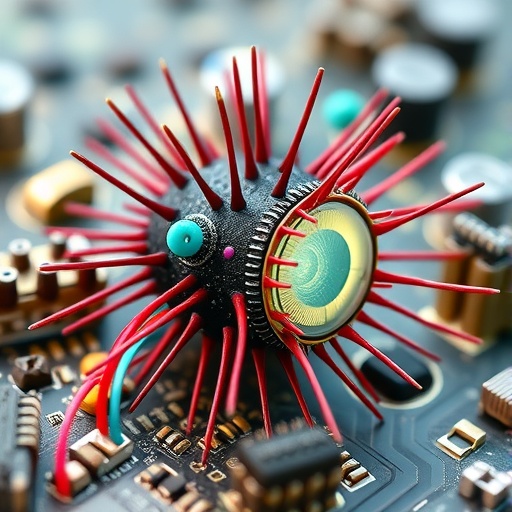
In a remarkable stride forward for tactile sensing technology, a team of researchers has unveiled a groundbreaking sensor design that draws inspiration from one of nature’s most intriguing organisms: the sea urchin. This innovative development harnesses the unique combination of rigid and soft materials to create a hybrid tactile sensor that exhibits an unprecedented wide linear range, rapid response times, and exceptional durability. The sensor, described in a recent publication in npj Flexible Electronics, promises to redefine the landscape of flexible sensors used in robotics, prosthetics, and human-machine interfaces.
The concept originates from a close examination of the sea urchin’s spiny exoskeleton, a structure renowned for its ability to endure harsh environmental conditions while maintaining high sensitivity. Unlike conventional tactile sensors, which often suffer from limited detectability ranges or slow response speeds due to their uniform material composition, the sea urchin’s architecture presents a compelling blueprint. By mimicking the interplay of rigid spines and soft tissue, the researchers crafted a sensor architecture that integrates firm, stable components with compliant, flexible materials, resulting in a device that can measure a wider range of tactile stimuli with higher fidelity.
This approach addresses several persistent challenges in tactile sensing technology. Traditional sensors tend to compromise between sensitivity and durability; soft sensors may be sensitive but fragile, while rigid sensors withstand heavy use but lack the finely tuned responsiveness required for detailed tactile perception. The rigid-soft hybrid sensor expertly balances these characteristics, providing a sensor that maintains structural integrity under repetitive stress and deformation without sacrificing sensitivity or linearity.
Central to the sensor’s exceptional performance is its design that enables a wide linear sensing range. The linear range defines the scope within which the sensor’s output is directly proportional to the applied pressure or force, a critical quality for accurate signal interpretation. The novel hybrid structure significantly expands this range, allowing precise detection of both subtle and intense tactile stimuli. This property is particularly beneficial for applications such as robotic grippers or prosthetic limbs, where the ability to discern gentle touches from firm grips is crucial for nuanced control.
Fast response speed is another hallmark of the sensor’s design, translating to nearly instantaneous reaction to changes in pressure. Responsive tactile sensors enable more fluid and dynamic interaction with the environment, mitigating delays that can hamper robotic functions or user experiences in wearable devices. The team achieved these rapid response times through meticulous material selection and sensor architecture, ensuring minimal hysteresis and rapid recovery after deformation.
Robustness—often the Achilles’ heel in tactile sensors—is significantly enhanced through the hybrid structure. The researchers incorporated materials that complement each other’s mechanical properties, where the rigid components provide strength and shape preservation, and the soft materials absorb shocks and accommodate deformations without damage. This synergy extends the lifespan and reliability of the sensor, making it well-suited for extended use in real-world conditions where wear and tear are inevitable.
The fabrication techniques developed to realize the sensor are equally impressive. By employing advanced microfabrication processes and material engineering, the team integrated conductive elements seamlessly within the rigid-soft matrix. This integration ensures consistent electrical performance, which is crucial for signal accuracy and sensor longevity. The multidisciplinary approach, combining insights from biology, materials science, and electrical engineering, exemplifies a trend in modern sensor innovation.
In discussing potential applications, the research highlights the transformative impact this sensor technology could have across diverse domains. In robotics, the sensor could empower machines with a more refined sense of touch, improving dexterity and safety in interactions with humans and delicate objects. Prosthetics developers could leverage the sensor’s capabilities to create limbs that provide wearers with lifelike tactile feedback, enhancing control and quality of life. The wearable technology sector might also benefit, with garments or gloves that monitor pressure distribution or detect environmental changes with greater precision.
Moreover, the sensor’s flexible form factor enables seamless integration into curved or irregular surfaces, expanding usability beyond flat or rigid platforms. This adaptability is crucial for devices that must conform to the complex geometry of the human body or robotic appendages. Its impressive mechanical properties and sensing capabilities do not compromise comfort or usability, underscoring the importance of user-centered design in cutting-edge sensor technology.
The research team also analyzed the sensor’s performance under various stress tests, demonstrating its resilience over thousands of cycles without performance degradation. Such testing is vital for validating its applicability in environments where continuous tactile monitoring is required—ranging from industrial automation settings to medical diagnostic tools.
Equally notable is the environmental resilience of the sensor, designed to withstand conditions that would typically degrade sensor functionality, such as temperature fluctuations, humidity, and mechanical abrasion. This robustness opens new avenues for deployment in outdoor or harsh environments, including exploration robotics or wearable devices used in demanding athletic or occupational scenarios.
In the realm of academia and industry, this technology sets a precedent for future tactile sensor research. Its bioinspired design philosophy coupled with practical engineering solutions serves as a model for creating sensor systems that do not merely mimic biological structures but transcend their limitations through hybrid material strategies. The interdisciplinary nature of the development underscores the critical role of collaborative innovation spanning biology, engineering, and materials science.
Looking ahead, the researchers envision further optimization of the sensor architecture, exploring new materials and integration techniques to enhance sensitivity and specificity. They also aim to develop scalable manufacturing methods that could facilitate widespread adoption of this sensor in consumer products, industrial applications, and healthcare devices.
In sum, this sea urchin-inspired rigid-soft hybrid tactile sensor represents a significant leap in tactile sensing technology. It merges natural design principles with advanced materials and fabrication to achieve a sensor that is sensitive, fast, durable, and versatile. As tactile sensing becomes an increasingly critical component of emerging technologies, this innovation promises to play a foundational role in shaping how machines perceive and interact with their surroundings.
Subject of Research: Development of a bioinspired rigid-soft hybrid tactile sensor exhibiting wide linear range, high response speed, and superior robustness.
Article Title: Sea urchin-inspired rigid-soft hybrid tactile sensor with wide linear range, fast response speed, and excellent robustness.
Article References:
Gao, W., Yao, J., Fei, X. et al. Sea urchin-inspired rigid-soft hybrid tactile sensor with wide linear range, fast response speed, and excellent robustness. npj Flex Electron (2025). https://doi.org/10.1038/s41528-025-00513-5
Image Credits: AI Generated
Tags: durable tactile sensing solutionsenhancing sensor detectabilityflexible sensor design innovationshuman-machine interface improvementshybrid tactile sensor technologymaterials science in sensor developmentnature-inspired engineering designsresponsive sensor technology advancementsrobotics and sensor applicationssea urchin-inspired tactile sensorsspiny exoskeletons in technologywide linear range sensors