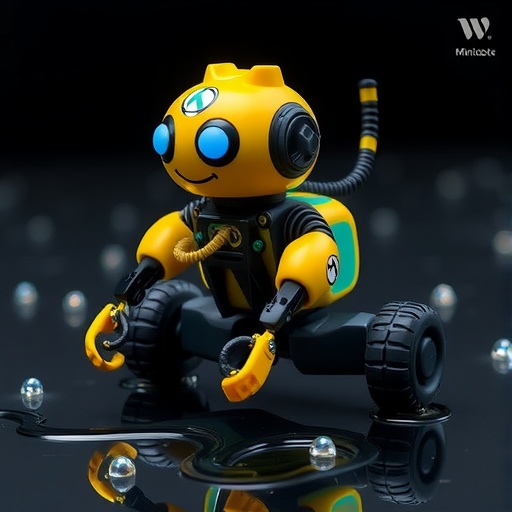
In the relentless struggle to protect our oceans from the devastating effects of oil spills, a team of engineers from RMIT University in Australia has unveiled an innovative robotic solution that could revolutionize environmental clean-up operations. This groundbreaking development centers around a remote-controlled minibot, affectionately termed the ‘Electronic Dolphin’, which employs a sophisticated bio-inspired filtering mechanism modeled after the unique microstructure of sea urchins. Unlike conventional oil spill remediation methods that are often hazardous, inefficient, or environmentally intrusive, this minibot offers a cleaner, more adaptable, and technology-driven approach that prioritizes safety and ecological sensitivity.
Oil spills have persisted as an ecological nightmare with far-reaching consequences. When hydrocarbons leak into marine environments, they pose grave threats to marine flora and fauna, jeopardize coastal ecosystems, and impose exorbitant economic burdens upon remediation efforts. Traditional cleanup strategies typically involve mechanical skimmers, chemical dispersants, or physical barriers — each bearing inherent limitations like incomplete oil recovery, potential harm to marine life, and labor-intensive procedures. Recognizing these challenges, the RMIT team’s innovation seeks to redefine the paradigm by leveraging advanced materials science and robotics for precise, autonomous oil collection.
At the heart of the Electronic Dolphin is a design embodiment inspired by biological phenomena. The minibot measures approximately the size of a human sneaker, featuring a dolphin-like profile for optimal maneuverability on water surfaces. Most notably, it houses a custom-engineered filter coated with a superwetting material that mimics the microscopic sea urchin spines. These nanostructured spikes, observable only under an electron microscope, function to trap air pockets that render the filter surface superhydrophobic – causing water molecules to bead and roll off instantly. Concurrently, the surface’s oleophilic properties enable oil slicks to adhere and be absorbed rapidly, ensuring selective collection.
This clever interfacing of superhydrophobic and oleophilic attributes allows the minibot to efficiently separate oil from water without becoming waterlogged, a key drawback in many existing materials. The onboard micro-pump facilitates the suction of oil across this specialized filter into an internal containment chamber, enabling continuous operation and oil storage during field deployment. During controlled laboratory trials, the minibot demonstrated an impressive extraction rate of approximately two milliliters of kerosene oil per minute with over 95 percent purity, suggesting a promising potential for scalability and real-world applicability.
Dr Ataur Rahman, the project’s lead engineer, emphasizes that while the current prototype operates with a 15-minute battery life, future iterations can be upscaled by enhancing pump performance and enlarging oil reservoir capacity. This vision includes fleets of such dolphin-sized minibots autonomously cruising oil-contaminated waters, vacuuming hydrocarbons, returning to base stations to offload collected oil, recharge, and then redeploy to continue the cleanup cycle in a seamless loop. Such an approach not only mitigates direct human exposure to hazardous environments but accelerates the response time to spills in ecologically sensitive zones.
A distinctive attribute of the filter coating is its environmentally friendly formulation. Departing from conventional oil remediation substances that frequently rely on harsh chemicals, the RMIT team synthesized a sustainable, non-toxic superwetting nanosheet coating. This innovation aligns with contemporary ecological engineering principles that advocate for minimal environmental footprint while maintaining operational efficacy. The reusability and light weight of the filter augment its practicality by enabling multiple cycles of oil collection and recovery before replacement or maintenance.
Material sciences PhD researcher Surya Kanta Ghadei, instrumental in the development of the superwetting filter, reflects on a personal impetus driving the work. Witnessing oil spill damage firsthand during his upbringing in India, particularly its lethal impact on marine turtles, instilled a profound commitment to creating technologies that could enable rapid and wildlife-friendly spill responses. The hope is that this minibot will empower responders with a safer tool to act decisively without endangering themselves or further disturbing fragile ecosystems.
Looking toward the future, the team’s research trajectory involves expanding the filter’s surface area on the minibot, thus increasing volumetric oil collection rates through a larger interface. This scalability necessitates higher-capacity pumping mechanisms to sustain suction while maintaining the minibot’s maneuverability and energy efficiency. Comprehensive field testing and durability assessments are planned to validate performance under varying environmental conditions, including turbulent waters and diverse hydrocarbon types.
RMIT University encourages collaboration with industry partners and innovators to refine the Electronic Dolphin’s design for specific applications, encompassing diverse spill scenarios and deployment modalities. The ultimate goal is to transition this robust proof-of-concept from laboratory settings to real-world spill response operations globally, where it could dramatically reduce ecological damage and clean-up costs. Interested organizations or collaborators are invited to engage with the RMIT research team via their official contact channels to explore joint development possibilities.
The science underpinning the Electronic Dolphin’s filter technology is documented in the peer-reviewed article titled “Multifunctional superwetting sea urchin mimetic nanosheet based interface for remote oil–water separation,” published in the esteemed journal Small. The work highlights not only the innovative material synthesis but its integrative application within mobile robotic platforms, setting a new benchmark for environmentally conscious oil spill remediation technologies.
Supporting this cutting-edge research is a wider collaborative environment fostered by leaders in materials and environmental engineering at RMIT University and allied institutions, including India’s Academy of Scientific and Innovative Research. This interdisciplinary synergy has proven critical in bridging advanced materials development with practical environmental engineering challenges, marking a significant milestone in the fight against one of the planet’s most persistent pollution threats.
The Electronic Dolphin minibot stands as a testament to how biomimicry combined with robotics and nanomaterials can catalyze transformative solutions for environmental crises. By harnessing nature’s own designs, scientists are now equipping humanity with tools capable of preserving delicate marine ecosystems more effectively than ever before. As the technology matures, it holds the potential not just to clean oil spills but to inspire a wave of next-generation, eco-friendly robotic interventions in environmental conservation worldwide.
Subject of Research: Not applicable
Article Title: Multifunctional superwetting sea urchin mimetic nanosheet based interface for remote oil–water separation
News Publication Date: 25-Jan-2026
Web References: http://dx.doi.org/10.1002/smll.202512846
References: Rahman, A., Ghadei, S.K., Bhaskaran, M., Sriram, S., Sakthivel, R. (2026). Multifunctional superwetting sea urchin mimetic nanosheet based interface for remote oil–water separation. Small. DOI: 10.1002/smll.202512846
Image Credits: Peter Clarke, RMIT University
Keywords
Oil spill remediation, Environmental robotics, Bio-inspired materials, Superhydrophobic filter, Oleophilic nanosheet, Nanotechnology, Marine pollution cleanup, Remote-controlled minibot, Sustainable engineering, Environmental nanomaterials, Biomimicry, Oil-water separation technology
Tags: advanced materials for marine cleanupautonomous oil spill remediation technologybio-inspired oil spill cleanup roboteco-friendly oil spill responseinnovative marine ecosystem protectionprecision robotic oil collectionremote-controlled environmental minibotRMIT University environmental roboticsrobotic ocean pollution solutionsea urchin microstructure filtrationsustainable oil spill recovery methodstechnology-driven ocean conservation