A systematic evaluation of nickel-based cermet anodes for intermediate-temperature solid oxide fuel cells reveals a distinct trade-off between high initial electrochemical activity and operational longevity. While direct contact between a nickel anode and a lanthanum gallate electrolyte produces high initial power output, introducing a samaria-doped ceria buffer layer physically separates the components and drastically suppresses interfacial degradation over extended operation.
The research addresses chemical incompatibility between nickel-based anodes and the La0.9Sr0.1Ga0.8Mg0.2O3 (LSGM) electrolyte, which represents a persistent limitation in intermediate-temperature solid oxide fuel cell development. When these materials interact directly at elevated operating temperatures, interfacial reactions take place between the metallic catalyst and the electrolyte, triggering severe performance deterioration over time.
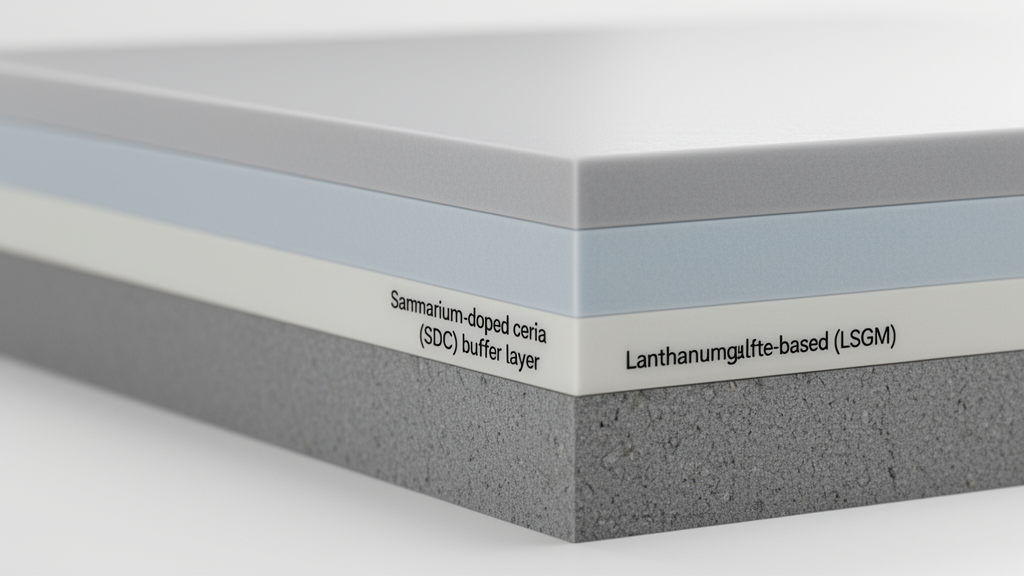
To identify viable interfacial architectures, researchers examined three distinct anode configurations supported on LSGM electrolytes: a direct-contact Ni/LSGM design, a composite Ni/SDC structure where Sm0.2Ce0.8O2 is incorporated directly into the anode material, and a composite Ni/SDC architecture equipped with an additional SDC buffer layer positioned at the electrolyte interface.
The comparative investigation relied on a comprehensive suite of analytical characterizations to assess electrochemical behavior and structural evolution. The researchers performed power density measurements and galvanostatic discharge tests, combined with electrochemical impedance spectroscopy and distribution of relaxation times analysis, while utilizing X-ray diffraction and scanning electron microscopy to monitor interfacial phase formation and morphology.
Experimental observations showed that the direct-contact Ni/LSGM configuration achieved the highest peak power density among the tested assemblies, reaching 608.3 mW cm−2 at 800 °C due to good interfacial contact and the high ionic conductivity of LSGM. Under continuous galvanostatic operation at 750 °C with a current density of 0.3 A cm−2, however, this unbuffered assembly experienced a 26.7% voltage decay over 100 hours as insulating secondary phases, including La2O3, developed at the interface.
In comparison, the composite Ni/SDC anode delivered a moderate balance between power output and durability, whereas the assembly incorporating an SDC buffer layer demonstrated the highest durability. By preventing direct contact and halting interfacial reactions between nickel and the LSGM electrolyte, the buffered configuration limited voltage degradation to 6.9% after 100 hours of testing, demonstrating that targeted interface engineering can preserve cell stability despite a lower initial power output.
To evaluate cell behavior across the three configurations, the experimental workflow combined electrical testing with structural characterization techniques. Power density measurements and galvanostatic discharge tests were conducted alongside electrochemical impedance spectroscopy and distribution of relaxation times analysis to evaluate electrochemical performance and operational stability over extended periods. In parallel, X-ray diffraction and scanning electron microscopy were utilized to inspect interfacial structures and detect the emergence of secondary phases resulting from chemical interactions between the cell components.
These structural and electrical evaluations clarified the mechanisms responsible for the rapid degradation observed in the direct-contact Ni/LSGM configuration. Although this unbuffered design achieved the highest peak power density of 608.3 mW cm−2 at 800 °C by capitalizing on the high ionic conductivity of LSGM and good interfacial contact, it proved unable to maintain performance during extended operation. When subjected to galvanostatic discharge at 750 °C under a current density of 0.3 A cm−2, the cell suffered approximately 26.7% total voltage decay after 100 hours, driven by interfacial reactions that produced insulating secondary phases including La2O3.
The comparative findings illustrate the distinct outcomes associated with modifying the anode material versus inserting an interfacial buffer layer. Incorporating Sm0.2Ce0.8O2 directly into the nickel cermet yielded a moderate balance between power output and operational durability. In contrast, incorporating an SDC buffer layer physically separated the nickel anode from the LSGM electrolyte, effectively suppressing interfacial reactions. This architectural configuration achieved the highest stability, limiting voltage degradation to 6.9% over 100 hours despite a lower initial power output, demonstrating the decisive influence of interface design in managing the trade-off between electrochemical performance and operational longevity in LSGM-supported solid oxide fuel cells.
Subject of Research: Electrochemical activity and stability of nickel-based cermet anodes in LSGM-based solid oxide fuel cells
Article Title: Evaluation of Ni-based cermet anodes for LaGaO3-based SOFCs: A trade-off between electrochemical activity and operational stability
Article References: Wang, Y., Yue, X., Fan, W., Lv, X., Yu, Y., Cao, X., Wu, Z., & Zhao, Z. (2026). Evaluation of Ni-based cermet anodes for LaGaO3-based SOFCs: A trade-off between electrochemical activity and operational stability. Ionics. https://doi.org/10.1007/s11581-026-07641-6
Image Credits: AI Generated
DOI: 10.1007/s11581-026-07641-6
Keywords: solid oxide fuel cells, LSGM electrolyte, Ni-based cermet anodes, SDC buffer layer, electrochemical impedance spectroscopy, distribution of relaxation times, X-ray diffraction, scanning electron microscopy, galvanostatic discharge, peak power density, voltage degradation, interfacial reactions, La2O3 secondary phase, Sm0.2Ce0.8O2, La0.9Sr0.1Ga0.8Mg0.2O3, intermediate-temperature SOFCs, operational stability
News Source: Victoria Harrison. (November 16, 2026). SDC Buffer Layer Enhances Durability in LSGM-Based Solid Oxide Fuel Cells. Scienmag.