• HOME
  • NEWS
  • EXPLORE
    • CAREER
      • Companies
      • Jobs
    • EVENTS
    • iGEM
      • News
      • Team
    • PHOTOS
    • VIDEO
    • WIKI
  • BLOG
  • COMMUNITY
    • FACEBOOK
    • INSTAGRAM
    • TWITTER
Thursday, March 26, 2026
BIOENGINEER.ORG
No Result
View All Result
  • Login
  • HOME
  • NEWS
  • EXPLORE
    • CAREER
      • Companies
      • Jobs
        • Lecturer
        • PhD Studentship
        • Postdoc
        • Research Assistant
    • EVENTS
    • iGEM
      • News
      • Team
    • PHOTOS
    • VIDEO
    • WIKI
  • BLOG
  • COMMUNITY
    • FACEBOOK
    • INSTAGRAM
    • TWITTER
  • HOME
  • NEWS
  • EXPLORE
    • CAREER
      • Companies
      • Jobs
        • Lecturer
        • PhD Studentship
        • Postdoc
        • Research Assistant
    • EVENTS
    • iGEM
      • News
      • Team
    • PHOTOS
    • VIDEO
    • WIKI
  • BLOG
  • COMMUNITY
    • FACEBOOK
    • INSTAGRAM
    • TWITTER
No Result
View All Result
Bioengineer.org
No Result
View All Result
Home NEWS Science News Chemistry

Scientists synthesize new nanowires to improve high-speed communication

Bioengineer by Bioengineer
April 10, 2019
in Chemistry
Reading Time: 2 mins read
0
IMAGE
Share on FacebookShare on TwitterShare on LinkedinShare on RedditShare on Telegram

IMAGE

Credit: HAN Ning

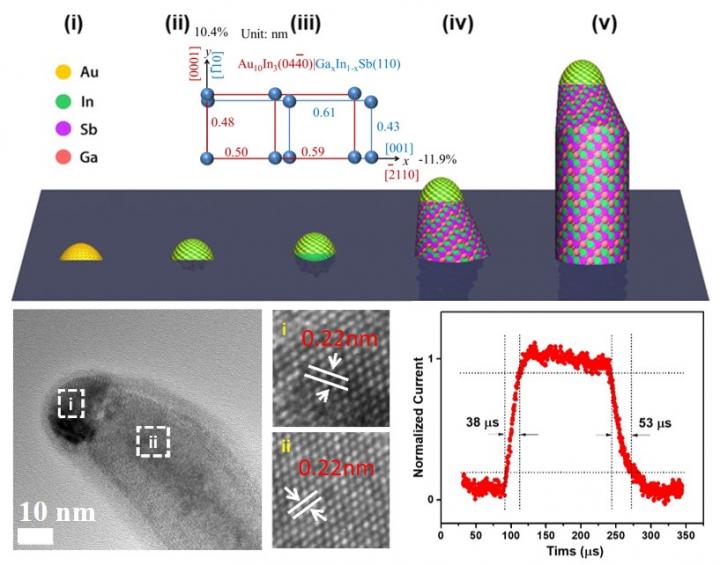
Chinese scientists have synthesized new nanowires with high carrier mobility and fast infrared light (IR) response, which could help in high-speed communication. Their findings were published in Nature Communications on April 10th.

Nowadays, effective optical communications use 1550 nm IR, which is received and converted into an electrical signal for computer processing. Fast light-to-electrical conversion is thus essential for high-speed communications.

According to quantum theory, 1550 nm IR has energy of ~ 0.8 eV, and can only be detected by semiconductors with bandgaps lower than 0.8 eV, such as germanium (0.66 eV) and III-V compound materials such as InxGa1-xAs (0.35-1.42 eV) and InxGa1-xSb (0.17-0.73 eV). However, those materials usually have huge crystal defects, which cause substantial degradation of photoresponse performance.

Scientists from the Institute of Process Engineering (IPE) of the Chinese Academy of Sciences, City University of Hong Kong (CityU) and their collaborators synthesized highly crystalline ternary In0.28Ga0.72Sb nanowires to demonstrate high carrier mobility and fast IR response.

In this study, the In0.28Ga0.72Sb nanowires (bandgap 0.69 eV) showed a high responsivity of 6000 A/W to IR with high response and decay times of 0.038ms and 0.053ms, respectively, which are some of the best times so far. The fast IR response speed can be attributed to the minimized crystal defects, as also illustrated by a high hole mobility of up to 200 cm2/Vs, according to Prof. Johnny C. Ho from CityU.

The minimized crystal defect is achieved by a “catalyst epitaxy technology” first established by Ho’s group. Briefly, the III-V compound nanowires are catalytically grown by a metal catalyst such as gold, nickel, etc.

“These catalyst nanoparticles play a key role in nanowire growth as the nanowires are synthesized layer by layer with the atoms well aligned with those in the catalyst,” said HAN Ning, a professor at IPE and senior author of the paper.

###

Media Contact
LI Xiangyu
[email protected]

Original Source

http://english.cas.cn/

Related Journal Article

http://dx.doi.org/10.1038/s41467-019-09606-y

Tags: Atomic/Molecular/Particle PhysicsChemistry/Physics/Materials SciencesNanotechnology/Micromachines
Share12Tweet8Share2ShareShareShare2

Related Posts

blank

Physicists Identify Electronic Drivers Behind Flat Band Quantum Materials

March 21, 2026
Würzburg Chemistry Professor Claudia Höbartner Receives Prestigious Honor

Würzburg Chemistry Professor Claudia Höbartner Receives Prestigious Honor

March 20, 2026

Scientists Reveal How Magnets Control Metamaterial Behavior

March 20, 2026

Gallium-Based Liquid Metals: Pioneering Cybernetic Bridges for Human-Machine Integration

March 20, 2026
Please login to join discussion

POPULAR NEWS

  • blank

    Revolutionary AI Model Enhances Precision in Detecting Food Contamination

    96 shares
    Share 38 Tweet 24
  • Imagine a Social Media Feed That Challenges Your Views Instead of Reinforcing Them

    1003 shares
    Share 397 Tweet 248
  • Uncovering Functions of Cavernous Malformation Proteins in Organoids

    54 shares
    Share 22 Tweet 14
  • Promising Outcomes from First Clinical Trials of Gene Regulation in Epilepsy

    51 shares
    Share 20 Tweet 13

About

We bring you the latest biotechnology news from best research centers and universities around the world. Check our website.

Follow us

Recent News

In-Sensor Cryptography Links Physical Process to Digital Identity

Can Psychosocial Factors Influence Cancer Risk?

Depression Factors in Elderly: Pre vs. Post-COVID Analysis

Subscribe to Blog via Email

Success! An email was just sent to confirm your subscription. Please find the email now and click 'Confirm' to start subscribing.

Join 78 other subscribers
  • Contact Us

Bioengineer.org © Copyright 2023 All Rights Reserved.

Welcome Back!

Login to your account below

Forgotten Password?

Retrieve your password

Please enter your username or email address to reset your password.

Log In
No Result
View All Result
  • Homepages
    • Home Page 1
    • Home Page 2
  • News
  • National
  • Business
  • Health
  • Lifestyle
  • Science

Bioengineer.org © Copyright 2023 All Rights Reserved.