

• HOME
  • NEWS
  • EXPLORE
    • CAREER
      • Companies
      • Jobs
    • EVENTS
    • iGEM
      • News
      • Team
    • PHOTOS
    • VIDEO
    • WIKI
  • BLOG
  • COMMUNITY
    • FACEBOOK
    • INSTAGRAM
    • TWITTER
Saturday, February 7, 2026
BIOENGINEER.ORG
No Result
View All Result
  • Login
  • HOME
  • NEWS
  • EXPLORE
    • CAREER
      • Companies
      • Jobs
        • Lecturer
        • PhD Studentship
        • Postdoc
        • Research Assistant
    • EVENTS
    • iGEM
      • News
      • Team
    • PHOTOS
    • VIDEO
    • WIKI
  • BLOG
  • COMMUNITY
    • FACEBOOK
    • INSTAGRAM
    • TWITTER
  • HOME
  • NEWS
  • EXPLORE
    • CAREER
      • Companies
      • Jobs
        • Lecturer
        • PhD Studentship
        • Postdoc
        • Research Assistant
    • EVENTS
    • iGEM
      • News
      • Team
    • PHOTOS
    • VIDEO
    • WIKI
  • BLOG
  • COMMUNITY
    • FACEBOOK
    • INSTAGRAM
    • TWITTER
No Result
View All Result
Bioengineer.org
No Result
View All Result
Home NEWS Science News Biology

Scientists reveal rules for making ribs

Bioengineer by Bioengineer
January 24, 2018
in Biology, Science News
Reading Time: 2 mins read
0
Share on FacebookShare on TwitterShare on LinkedinShare on RedditShare on Telegram
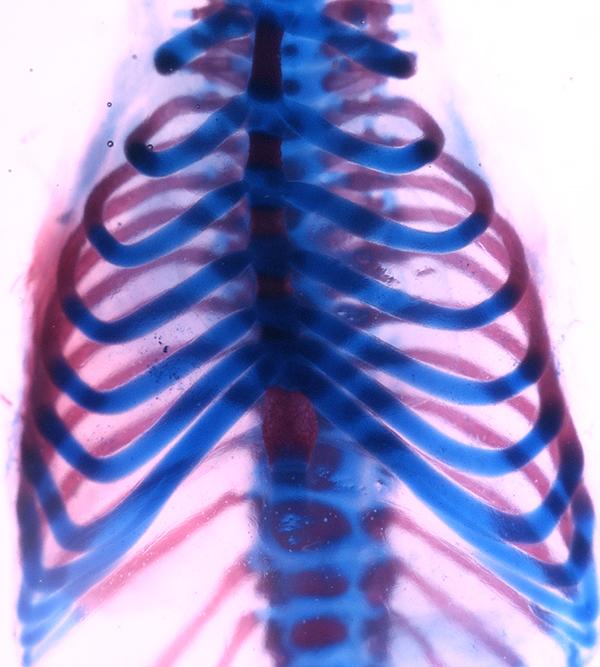
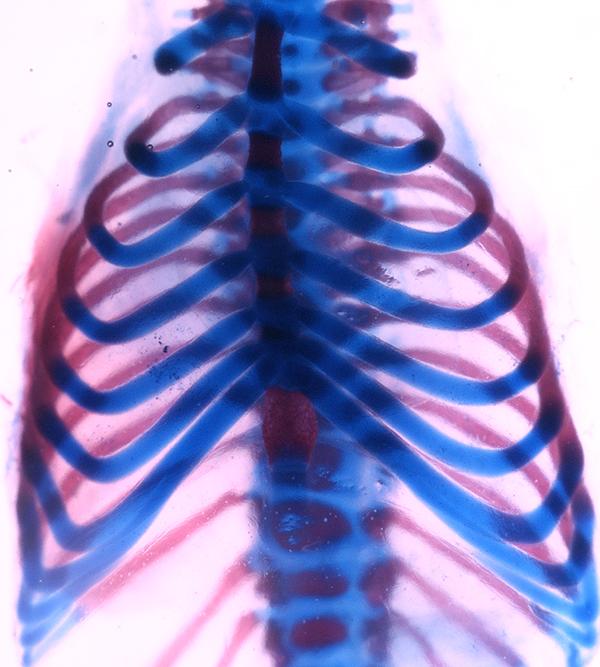
IMAGE

Credit: Francesca Mariani

Scientists from the USC Stem Cell lab of Francesca Mariani recently shared a recipe for ribs, and it doesn't even require barbecue sauce.

In a new publication in the journal eLife, first authors Jennifer Fogel from USC, Daniel Lakeland from Lakeland Applied Sciences and colleagues examine the development of the vertebrate ribcage, which supports the body, protects the internal organs and enables life on land.

In the study, the authors describe a simple computational tool that models the choices cells make while the ribcage develops in the early mouse embryo. Some cells choose to become the bony section of each rib that connects to the spine, while other cells choose to form the cartilage section of each rib that joins the sternum. Understanding this process required the team to integrate the effects of cell growth, cell death, and cell communication into their computational tool in order to gain insights into how the skeleton forms.

Using the model, the scientists propose that the different levels of a secreted protein called Hedgehog (Hh) are important for cells to make the decision to form bone or cartilage. High levels of Hh bias the cells towards making the bone component. As Hh travels further away from its source at the midline of the back, concentrations of Hh drop. Lower concentrations bias the cells towards making the more distant cartilage component of each rib.

Each cell's decision to contribute to the bone or cartilage component is likely locked-in early when the embryo is very small, and maintained as the embryo grows exponentially.

"Our study suggests that regardless of whether an embryo gives rise to a large elephant or a small mouse, that the rib skeleton has already organized itself while the embryo is smaller than a grain of rice," explained Mariani, assistant professor of stem cell biology and regenerative medicine and principal investigator in the Eli and Edythe Broad Center for Regenerative Medicine and Stem Cell Research at USC. "In addition, the modeling approach we developed can be used to understand the challenges of building new tissues in adults after injury."

###

In Kyoung Mah from USC also contributed to the study. Funding came from the University of Southern California, and NIH NIAMS. Fogel was supported by a postdoctoral fellowship from the California Institute for Regenerative Medicine.

Media Contact

Zen Vuong
[email protected]
213-300-1381
@keckmedusc

Keck Home

Original Source

http://stemcell.usc.edu/2017/11/22/mariani-lab-reveals-rules-for-making-ribs/ http://dx.doi.org/10.7554/eLife.29144

Share12Tweet8Share2ShareShareShare2

Related Posts

Decoding Prostate Cancer Origins via snFLARE-seq, mxFRIZNGRND

February 7, 2026

Digital Health Perspectives from Baltic Sea Experts

February 7, 2026

Florida Cane Toad: Complex Spread and Selective Evolution

February 7, 2026

Exploring Decision-Making in Dementia Caregivers’ Mobility

February 7, 2026
Please login to join discussion

POPULAR NEWS

  • Robotic Ureteral Reconstruction: A Novel Approach

    Robotic Ureteral Reconstruction: A Novel Approach

    82 shares
    Share 33 Tweet 21
  • Digital Privacy: Health Data Control in Incarceration

    63 shares
    Share 25 Tweet 16
  • Study Reveals Lipid Accumulation in ME/CFS Cells

    57 shares
    Share 23 Tweet 14
  • Breakthrough in RNA Research Accelerates Medical Innovations Timeline

    53 shares
    Share 21 Tweet 13

About

We bring you the latest biotechnology news from best research centers and universities around the world. Check our website.

Follow us

Recent News

Decoding Prostate Cancer Origins via snFLARE-seq, mxFRIZNGRND

Digital Health Perspectives from Baltic Sea Experts

Florida Cane Toad: Complex Spread and Selective Evolution

Subscribe to Blog via Email

Enter your email address to subscribe to this blog and receive notifications of new posts by email.

Join 73 other subscribers
  • Contact Us

Bioengineer.org © Copyright 2023 All Rights Reserved.

Welcome Back!

Login to your account below

Forgotten Password?

Retrieve your password

Please enter your username or email address to reset your password.

Log In
No Result
View All Result
  • Homepages
    • Home Page 1
    • Home Page 2
  • News
  • National
  • Business
  • Health
  • Lifestyle
  • Science

Bioengineer.org © Copyright 2023 All Rights Reserved.
