• HOME
  • NEWS
  • EXPLORE
    • CAREER
      • Companies
      • Jobs
    • EVENTS
    • iGEM
      • News
      • Team
    • PHOTOS
    • VIDEO
    • WIKI
  • BLOG
  • COMMUNITY
    • FACEBOOK
    • INSTAGRAM
    • TWITTER
Friday, April 3, 2026
BIOENGINEER.ORG
No Result
View All Result
  • Login
  • HOME
  • NEWS
  • EXPLORE
    • CAREER
      • Companies
      • Jobs
        • Lecturer
        • PhD Studentship
        • Postdoc
        • Research Assistant
    • EVENTS
    • iGEM
      • News
      • Team
    • PHOTOS
    • VIDEO
    • WIKI
  • BLOG
  • COMMUNITY
    • FACEBOOK
    • INSTAGRAM
    • TWITTER
  • HOME
  • NEWS
  • EXPLORE
    • CAREER
      • Companies
      • Jobs
        • Lecturer
        • PhD Studentship
        • Postdoc
        • Research Assistant
    • EVENTS
    • iGEM
      • News
      • Team
    • PHOTOS
    • VIDEO
    • WIKI
  • BLOG
  • COMMUNITY
    • FACEBOOK
    • INSTAGRAM
    • TWITTER
No Result
View All Result
Bioengineer.org
No Result
View All Result
Home NEWS Science News Biology

Scientists reveal function of histone variant H2A.Z in DNA replication selection

Bioengineer by Bioengineer
December 26, 2019
in Biology
Reading Time: 2 mins read
0
IMAGE
Share on FacebookShare on TwitterShare on LinkedinShare on RedditShare on Telegram

IMAGE

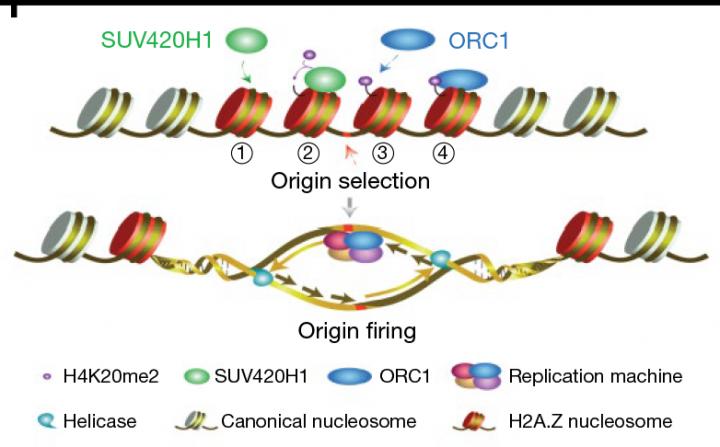
Credit: Image by Dr. LI Guohong’s lab


The research published in Nature on Dec. 25th, 2019, led by Dr. LI Guohong and Dr. ZHU Mingzhao from the Institute of Biophysics of the Chinese Academy of Sciences, has demonstrated that the histone variant H2A.Z facilitates the licensing and activation of early DNA replication origins.

DNA replication is a tightly regulated process that ensures the precise duplication of the genome during cell proliferation. Replication origins determine where replication starts on the genome and regulate the whole genome replication program. The human genome contains tens of thousands of origins; however, only about 10% of them are used in each cell cycle. So how are origins selected?

In eukaryotes, DNA wraps around histone octamers to form chromatin in the nucleus. The licensing and activation of replication origins are regulated by both the DNA sequence and chromatin features. However, chromatin-based regulatory mechanisms remain largely uncharacterized.

In this study, the scientists first found that knocking down H2AFZ genes in HeLa cells results in cell growth defects. Through mass spectrometry, many subunits of prereplication complex were enriched on H2A.Z mono-nucleosomes, indicating that H2A.Z may be involved in the licensing of DNA replication origins.

To find the mechanism of interaction between H2A.Z and the prereplication complex, the scientists then performed in vitro biochemical analysis and found that H2A.Z-containing nucleosomes bind directly to the histone lysine methyltransferase enzyme SUV420H1. This process promotes H4K20me2 deposition, which further recruits origins recognition complex 1 (ORC1) to help accomplish the licensing of DNA replication origins.

In addition, through genome-wide studies in HeLa cells, the scientists confirmed the role of H2A.Z in DNA replication. The results showed that signals from H4K20me2, ORC1 and nascent DNA strands (indicating active DNA replication origins) co-localize with H2A.Z, and the depletion of H2A.Z results in decreased H4K20me2, ORC1 and nascent-strand signals. H2A.Z-regulated replication origins have a higher firing efficiency and earlier replication timing compared with other origins.

Furthermore, the scientists generated CD4CreH2A.Zf/f mice to study the function of H2A.Z-regulated replication in a more physiological context. Using these mice, they conditionally knocked out (CKO) H2az1/H2az2 in T cells. They then found that in H2A.Z CKO mic the activated T cells have defects in cell proliferation and DNA replication.

This study describes a novel epigenetic regulation mechanism for DNA replication origin selection and offers a new way of understanding DNA replication regulation in eukaryotes. Importantly, this regulatory pathway can potentially serve as a target for cancer treatment and regulation of T cell function during immunotherapy.

###

Media Contact
LI Guohong
[email protected]

Original Source

http://english.cas.cn/newsroom/research_news/life/201912/t20191224_228387.shtml

Related Journal Article

http://dx.doi.org/10.1038/s41586-019-1877-9

Tags: BiologyCell Biology
Share12Tweet8Share2ShareShareShare2

Related Posts

Brain Power May Hold the Key to Predicting Cognitive Decline

Brain Power May Hold the Key to Predicting Cognitive Decline

April 2, 2026
Insights into CD4+ T-Cell Depletion and Pulmonary Infections in Critically Ill Immunocompromised Patients

Insights into CD4+ T-Cell Depletion and Pulmonary Infections in Critically Ill Immunocompromised Patients

April 2, 2026

Advanced Sensors Reduce Costs in Genetic Disorder Research

April 2, 2026

Advancing Blood Purification: Innovations Beyond Traditional Dialysis

April 2, 2026
Please login to join discussion

POPULAR NEWS

  • blank

    Revolutionary AI Model Enhances Precision in Detecting Food Contamination

    96 shares
    Share 38 Tweet 24
  • Imagine a Social Media Feed That Challenges Your Views Instead of Reinforcing Them

    1007 shares
    Share 398 Tweet 249
  • Promising Outcomes from First Clinical Trials of Gene Regulation in Epilepsy

    51 shares
    Share 20 Tweet 13
  • Popular Anti-Aging Compound Linked to Damage in Corpus Callosum, Study Finds

    44 shares
    Share 18 Tweet 11

About

We bring you the latest biotechnology news from best research centers and universities around the world. Check our website.

Follow us

Recent News

Revolutionizing the Body from Within: The Rise of ‘Transformation Electrodes’

Levothyroxine Shows No Benefit in Older Adults

National Dust Storm Impact on Tourism and Infrastructure

Subscribe to Blog via Email

Success! An email was just sent to confirm your subscription. Please find the email now and click 'Confirm' to start subscribing.

Join 78 other subscribers
  • Contact Us

Bioengineer.org © Copyright 2023 All Rights Reserved.

Welcome Back!

Login to your account below

Forgotten Password?

Retrieve your password

Please enter your username or email address to reset your password.

Log In
No Result
View All Result
  • Homepages
    • Home Page 1
    • Home Page 2
  • News
  • National
  • Business
  • Health
  • Lifestyle
  • Science

Bioengineer.org © Copyright 2023 All Rights Reserved.