• HOME
  • NEWS
  • EXPLORE
    • CAREER
      • Companies
      • Jobs
    • EVENTS
    • iGEM
      • News
      • Team
    • PHOTOS
    • VIDEO
    • WIKI
  • BLOG
  • COMMUNITY
    • FACEBOOK
    • INSTAGRAM
    • TWITTER
Friday, December 26, 2025
BIOENGINEER.ORG
No Result
View All Result
  • Login
  • HOME
  • NEWS
  • EXPLORE
    • CAREER
      • Companies
      • Jobs
        • Lecturer
        • PhD Studentship
        • Postdoc
        • Research Assistant
    • EVENTS
    • iGEM
      • News
      • Team
    • PHOTOS
    • VIDEO
    • WIKI
  • BLOG
  • COMMUNITY
    • FACEBOOK
    • INSTAGRAM
    • TWITTER
  • HOME
  • NEWS
  • EXPLORE
    • CAREER
      • Companies
      • Jobs
        • Lecturer
        • PhD Studentship
        • Postdoc
        • Research Assistant
    • EVENTS
    • iGEM
      • News
      • Team
    • PHOTOS
    • VIDEO
    • WIKI
  • BLOG
  • COMMUNITY
    • FACEBOOK
    • INSTAGRAM
    • TWITTER
No Result
View All Result
Bioengineer.org
No Result
View All Result
Home NEWS Science News Chemistry

Scientists probe electronic angular momentum to a chemical reaction for the first time

Bioengineer by Bioengineer
February 25, 2021
in Chemistry
Reading Time: 2 mins read
0
IMAGE
Share on FacebookShare on TwitterShare on LinkedinShare on RedditShare on Telegram

IMAGE

Credit: DICP

A chemical reaction can be understood in detail at the quantum state-resolved level, through a combined study of molecular crossed beam experiments and theoretical quantum molecular reaction dynamics simulations.

At a single collision condition, the molecular crossed beam apparatus is able to detect the scattering angle-resolved product with rotational state-resolution. Whereas, with accurate global potential energy surface, quantum reactive scattering theory is able to predict the corresponding reactive scattering information.

In previous studies, the chemical reaction dynamics was revealed only with the product rotational state-resolution. And the investigation of a reaction at a finer level would be an inspiring break through.

Recently, Professor YANG Xueming from the Dalian Institute of Chemical Physics (DICP) of the Chinese Academy of Sciences (CAS) and Professor WANG Xing’an from the University of Science and Technology of China developed molecular crossed beam apparatus with threshold ionization velocity map imaging technique, enabling to probe the scattering product with high angular resolution with quantum rotational-state recognition.

With this powerful apparatus, in combined with new quantum reactive scattering theory developed by Professor SUN Zhigang from the DICP, which included the electronic angular momentum effect, the electronic angular momentum effect to a chemical reaction was revealed for the first time.

This finding was published online in Science on Feb. 25, 2021.

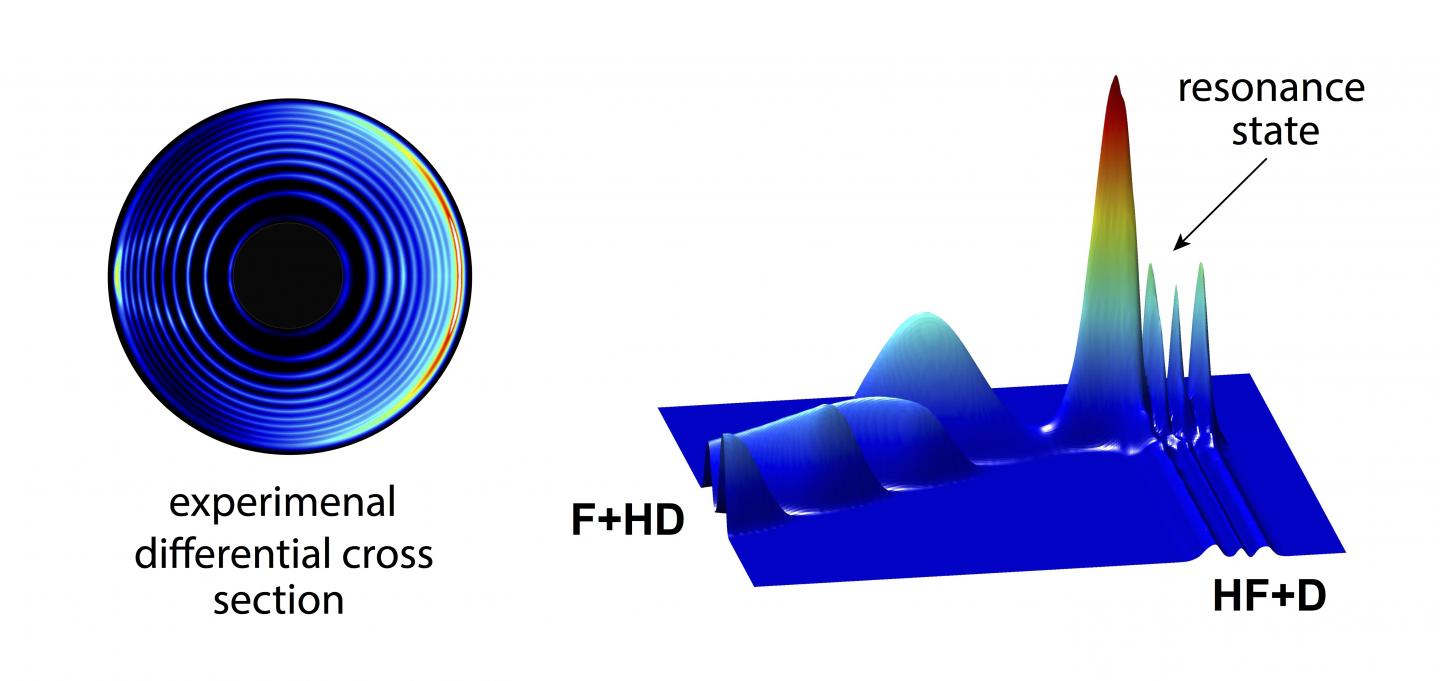
There is distinguished reactive scattering quantum resonance in the F + HD (the Fluorine atom with the HD isotope of the H2 molecule) reaction. It has been taken as the prototype to resolve partial wave resonance structures in a chemical reaction.

With this feature, the scientists thought that the role of the electronic angular momentum of the F atom in this chemical reaction would be recognized. The F atom was characterized by p electronic orbit with l=1, which could influence the partial wave resonance structures.

It was found that, by including the electronic angular momentum, the single partial wave structure would split into four-fold partial wave resonance structure, which was capable of varying the angular distributions of the chemical product.

The energy of the electronic angular momentum is much smaller than the rotational energy of a diatomic molecule (~ several tens wave number). Its influence to a chemical reaction is subtle and difficult to detect.

###

Media Contact
Jean Wang
[email protected]

Tags: Atomic PhysicsAtomic/Molecular/Particle PhysicsChemistry/Physics/Materials Sciences
Share13Tweet8Share2ShareShareShare2

Related Posts

Cutting Electrolyte Reduction Boosts High-Energy Battery Performance

Cutting Electrolyte Reduction Boosts High-Energy Battery Performance

December 19, 2025
Microenvironment Shapes Gold-Catalysed CO2 Electroreduction

Microenvironment Shapes Gold-Catalysed CO2 Electroreduction

December 11, 2025

Photoswitchable Olefins Enable Controlled Polymerization

December 11, 2025

Cation Hydration Entropy Controls Chloride Ion Diffusion

December 10, 2025
Please login to join discussion

POPULAR NEWS

  • Nurses’ Views on Online Learning: Effects on Performance

    Nurses’ Views on Online Learning: Effects on Performance

    70 shares
    Share 28 Tweet 18
  • NSF funds machine-learning research at UNO and UNL to study energy requirements of walking in older adults

    71 shares
    Share 28 Tweet 18
  • Unraveling Levofloxacin’s Impact on Brain Function

    54 shares
    Share 22 Tweet 14
  • Exploring Audiology Accessibility in Johannesburg, South Africa

    51 shares
    Share 20 Tweet 13

About

We bring you the latest biotechnology news from best research centers and universities around the world. Check our website.

Follow us

Recent News

Innovative Online Surface Reconstruction for Intraoperative Cranial Printing

Assessing Telemedicine Knowledge Among Fayoum Physicians

Exploring Nonclassical Correlations in Bose-Einstein Condensates

Subscribe to Blog via Email

Enter your email address to subscribe to this blog and receive notifications of new posts by email.

Join 71 other subscribers
  • Contact Us

Bioengineer.org © Copyright 2023 All Rights Reserved.

Welcome Back!

Login to your account below

Forgotten Password?

Retrieve your password

Please enter your username or email address to reset your password.

Log In
No Result
View All Result
  • Homepages
    • Home Page 1
    • Home Page 2
  • News
  • National
  • Business
  • Health
  • Lifestyle
  • Science

Bioengineer.org © Copyright 2023 All Rights Reserved.